

Journal of Clinical Pediatrics ›› 2026, Vol. 44 ›› Issue (2): 101-110.doi: 10.12372/jcp.2026.25e1033
• Original Article • Previous Articles Next Articles
LIU Xiaoyang1, SONG Jie1, WANG Xiaoyu1, ZHOU Hongmin1, LI Yuping1, XU Yujie1, GONG Yunhui2, XIONG Jingyuan3, WU Xiaona1( ), CHENG Guo1
Received:2025-08-25
Accepted:2025-11-24
Published:2026-02-15
Online:2026-02-02
CLC Number:
LIU Xiaoyang, SONG Jie, WANG Xiaoyu, ZHOU Hongmin, LI Yuping, XU Yujie, GONG Yunhui, XIONG Jingyuan, WU Xiaona, CHENG Guo. The association of gestational age at term and adverse perinatal outcomes: a retrospective study based on 43502 Chinese pregnant women[J].Journal of Clinical Pediatrics, 2026, 44(2): 101-110.
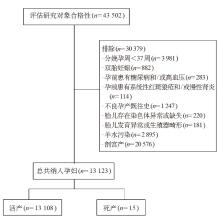
Figure 1
Flowchart for enrolling research subjects"
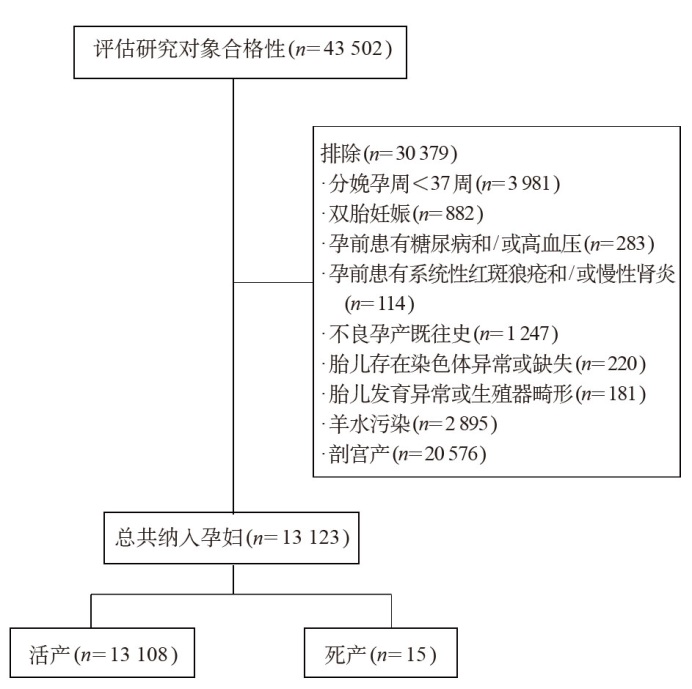

Table 1
Comparison of basic characteristics of pregnant women and their newborns delivered at different gestational weeks"
| 项目 | 孕37+0~37+6周(n=952) | 孕38+0~38+6周(n=2 707) | 孕39+0~39+6周(n=4 920) | |
|---|---|---|---|---|
| 产妇年龄[M(P25~P75)]/岁 | 31.0(29.0~34.0) | 31.0(29.0~33.0) | 31.0(29.0~33.0) | |
| 高龄产妇(≥35岁)[n(%)] | 173(18.2) | 437(16.1) | 707(14.4) | |
| 受孕方式[n(%)] | ||||
| 自然受孕 | 896(94.1) | 2 542(93.9) | 4 641(94.3) | |
| 辅助生殖受孕 | 56(5.9) | 165(6.1) | 279(5.7) | |
| 产妇身高[M(P25~P75)]/cm | 160.0(157.0~163.2) | 160.0(158.0~164.0) | 160.0(158.0~164.0) | |
| 孕前体重[M(P25~P75)]/kg | 52.0(47.0~57.0) | 52.0(47.0~56.0) | 52.0(48.0~ 57.0) | |
| 孕前BMI[M(P25~P75)]/kg·m-2 | 20.1(18.4~22.1) | 19.9(18.4~21.7) | 19.9(18.4~ 21.7) | |
| 孕前BMI分级[n(%)] | ||||
| 消瘦 | 249(26.2) | 684(25.3) | 1 300(26.4) | |
| 正常 | 585(61.4) | 1 785(65.9) | 3 231(65.7) | |
| 超重 | 102(10.7) | 212(7.8) | 353(7.2) | |
| 肥胖 | 16(1.7) | 26(1.0) | 36(0.7) | |
| 产前体重[M(P25~P75)]/kg | 64.0(59.5~70.0) | 64.5(60.0~70.0) | 65.0(60.5~70.0) | |
| 孕期体重增长[M(P25~P75)]/kg | 12.0(10.0~14.5) | 13.0(10.5~15.0) | 13.0(11.0~15.5) | |
| 孕期体重增长评价[n(%)] | ||||
| 不足 | 130(13.7) | 304(11.2) | 443(9.0) | |
| 适宜 | 583(61.2) | 1 596(59.0) | 2 798(56.9) | |
| 过量 | 239(25.1) | 807(29.8) | 1 679(34.1) | |
| 妊娠期糖尿病[n(%)] | 259(27.2) | 697(25.7) | 1 031(21.0) | |
| 妊娠期高血压/子痫前期[n(%)] | 41(4.3) | 68(2.5) | 71(1.4) | |
| 新生儿身长[M(P25~P75)]/cm1) | 49.0(48.0~49.0) | 49.0(48.0~50.0) | 50.0(49.0~50.0) | |
| 新生儿体重[M(P25~P75)]/kg1) | 2.9(2.7~3.1) | 3.1(2.9~3.3) | 3.2(3.0~3.4) | |
| 新生儿性别[n(%)]1) | ||||
| 女性 | 535(56.2) | 1 507(55.7) | 2 540(51.6) | |
| 男性 | 411(43.2) | 1 196(44.2) | 2 377(48.3) | |
| 项目 | 孕40+0~40+6周(n=4 164) | ≥孕41+0周(n=380) | 统计量 | P |
| 产妇年龄[M(P25~P75)]/岁 | 31.0(29.0~33.0) | 30.0(28.0~32.0) | H=27.25 | <0.001 |
| 高龄产妇(≥35岁)[n(%)] | 519(12.5) | 38(10.0) | χ2=34.90 | <0.001 |
| 受孕方式[n(%)] | χ2=6.53 | 0.163 | ||
| 自然受孕 | 3 962(95.1) | 355(93.4) | ||
| 辅助生殖受孕 | 202(4.9) | 25(6.6) | ||
| 产妇身高[M(P25~P75)]/cm | 161.0(158.0~165.0) | 162.0(159.0~165.0) | H=70.05 | <0.001 |
| 孕前体重[M(P25~P75)]/kg | 52.0(48.0~ 57.5) | 52.0(48.0~57.0) | H=22.43 | <0.001 |
| 孕前BMI[M(P25~P75)]/kg·m-2 | 20.0(18.6~ 21.7) | 19.9(18.4~21.5) | H=8.86 | 0.065 |
| 孕前BMI分级[n(%)] | χ2=33.79 | <0.001 | ||
| 消瘦 | 985(23.7) | 101(26.6) | ||
| 正常 | 2 806(67.4) | 251(66.1) | ||
| 超重 | 332(8.0) | 24 (6.3) | ||
| 肥胖 | 41(1.0) | 4(1.1) | ||
| 产前体重[M(P25~P75)]/kg | 66.0(62.0~71.5) | 67.0(62.0~72.1) | H=154.30 | <0.001 |
| 孕期体重增长[M(P25~P75)]/kg | 14.0(11.5~16.0) | 15.0(12.0~17.0) | H=297.80 | <0.001 |
| 孕期体重增长评价[n(%)] | χ2=232.06 | <0.001 | ||
| 不足 | 255(6.1) | 17(4.5) | ||
| 适宜 | 2 184(52.4) | 174(45.8) | ||
| 过量 | 1 725(41.4) | 189(49.7) | ||
| 妊娠期糖尿病[n(%)] | 732(17.6) | 4(1.1) | χ2=180.49 | <0.001 |
| 妊娠期高血压/子痫前期[n(%)] | 53(1.3) | 6(1.6) | χ2=51.00 | <0.001 |
| 新生儿身长[M(P25~P75)]/cm1) | 50.0(49.0~51.0) | 50.0(50.0~51.0) | H=1 506.75 | <0.001 |
| 新生儿体重[M(P25~P75)]/kg1) | 3.3(3.1~3.5) | 3.4(3.2~3.5) | H=1 842.17 | <0.001 |
| 新生儿性别[n(%)]1) | χ2=77.48 | <0.001 | ||
| 女性 | 1 923(46.2) | 179(47.1) | ||
| 男性 | 2 239(53.8) | 201(52.9) |
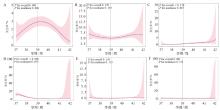
Figure 2
The nonlinear relationship between gestational age and the risk of adverse perinatal outcomes"
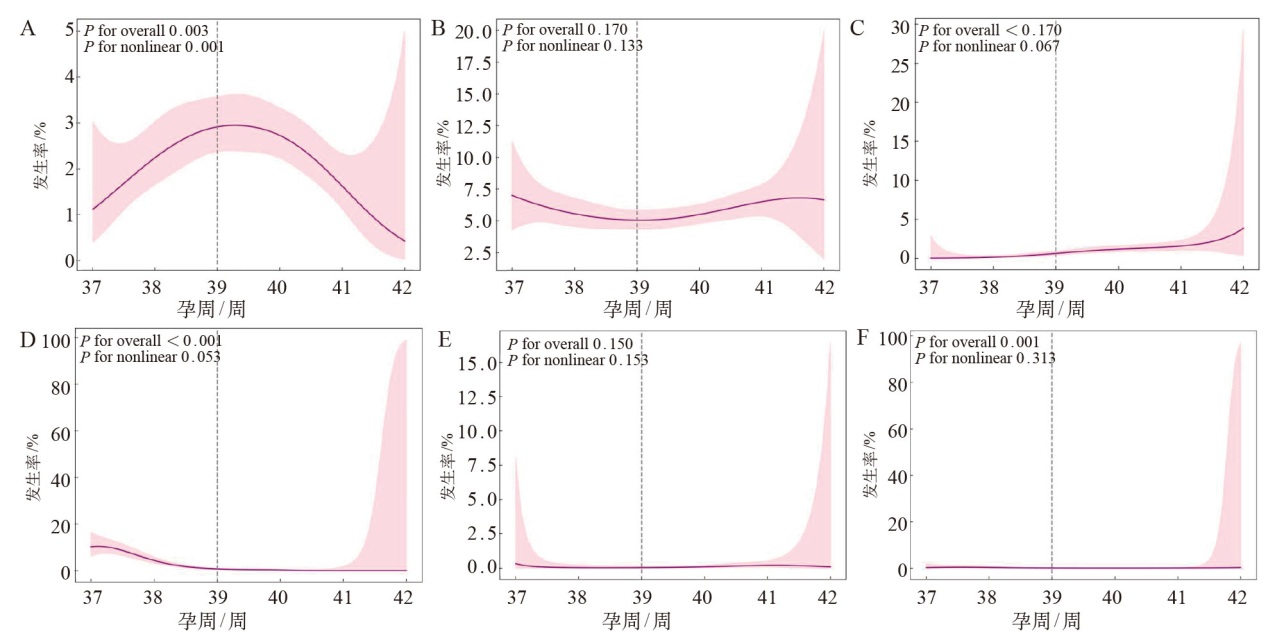
Table 2
The influence of delivery at different gestational weeks on perinatal outcomes by multivariate logistic regression"
| 项目 | 孕37+0~37+6周 | 孕38+0~38+6周 | 孕39+0~39+6周 | 孕40+0~40+6周 | ≥孕41+0周 |
|---|---|---|---|---|---|
| LGA | |||||
| P | <0.001 | <0.001 | 参考值 | 0.642 | <0.001 |
| OR(95%CI) | 0.40(0.30~0.52) | 0.66(0.58~0.76) | 1.08(0.88~1.33) | 0.63(0.50~0.79) | |
| SGA | |||||
| P | <0.001 | <0.001 | 参考值 | 0.073 | 0.001 |
| OR(95%CI) | 2.26(1.84~2.78) | 1.59(1.37~1.84) | 1.08(0.84~1.39) | 1.43(1.16~1.76) | |
| 巨大儿 | |||||
| P | <0.001 | <0.001 | 参考值 | <0.001 | <0.001 |
| OR(95%CI) | 0.11(0.04~0.30) | 0.30(0.22~0.41) | 1.42(1.23~1.64) | 2.08(1.61~2.69) | |
| LBW | |||||
| P | <0.001 | <0.001 | 参考值 | <0.001 | <0.0011) |
| OR(95%CI) | 16.40(12.79~21.07) | 6.30(4.79~8.29) | 0.32(0.22~0.47) | 0.03(0.00~0.19) | |
| 5分钟低Apgar评分 | |||||
| P | 0.584 | 0.852 | 参考值 | 0.177 | 0.029 |
| OR(95%CI) | 1.36(0.68~2.69) | 1.18(0.81~1.71) | 2.26(0.69~7.37) | 4.83(1.17~19.99) | |
| 死产 | |||||
| P | 0.004 | 0.007 | 参考值 | 0.336 | 0.162 |
| OR(95%CI) | 27.14(2.79~263.69) | 18.08(2.21~147.84) | 3.11(0.32~30.02) | 7.43(0.45~123.59) |
| [1] |
Colvin M, McGuire W, Fowlie PW. Neurodevelopmental outcomes after preterm birth[J]. BMJ, 2004, 329(7479): 1390-1393.
doi: 10.1136/bmj.329.7479.1390 |
| [2] |
Linsell L, Johnson S, Wolke D, et al. Cognitive trajectories from infancy to early adulthood following birth before 26 weeks of gestation: a prospective, population-based cohort study[J]. Arch Dis Child, 2018, 103(4):363-370.
doi: 10.1136/archdischild-2017-313414 pmid: 29146572 |
| [3] |
Nakling J, Backe B. Pregnancy risk increases from 41 weeks of gestation[J]. Acta Obstet Gynecol Scand, 2006, 85(6): 663-668.
doi: 10.1080/00016340500543733 |
| [4] |
Lawn JE, Blencowe H, Waiswa P, et al. Stillbirths: rates, risk factors, and acceleration towards 2030[J]. Lancet, 2016, 387(10018): 587-603.
doi: S0140-6736(15)00837-5 pmid: 26794078 |
| [5] |
Carlhäll S, Alsweiler J, Battin M, et al. Neonatal and maternal outcomes at early vs. full term following induction of labor; A secondary analysis of the OBLIGE randomized trial[J]. Acta Obstet Gynecol Scand, 2024, 103(5): 955-964.
doi: 10.1111/aogs.v103.5 |
| [6] | Kennedy EM, O'Nions E. Gestational age at birth and health outcomes: obstetric decisions matter[J]. BMJ, 2021, 372: n94. |
| [7] |
Alterman N, Johnson S, Carson C, et al. Gestational age at birth and child special educational needs: a UK representative birth cohort study[J]. Arch Dis Child, 2021, 106(9): 842-848.
doi: 10.1136/archdischild-2020-320213 pmid: 33483377 |
| [8] |
Kortekaas JC, Scheuer AC, de Miranda E, et al. Perinatal death beyond 41 weeks pregnancy: an evaluation of causes and substandard care factors as identified in perinatal audit in the Netherlands[J]. BMC Pregnancy Childbirth, 2018, 18(1): 380.
doi: 10.1186/s12884-018-1973-0 |
| [9] | Keulen JK, Bruinsma A, Kortekaas JC, et al. Induction of labour at 41 weeks versus expectant management until 42 weeks (INDEX): multicentre, randomised non-inferiority trial[J]. BMJ, 2019, 364: l344. |
| [10] |
Arcangeli T, Thilaganathan B, Hooper R, et al. Neurodevelopmental delay in small babies at term: a systematic review[J]. Ultrasound Obstet Gynecol, 2012, 40(3): 267-275.
doi: 10.1002/uog.11112 pmid: 22302630 |
| [11] |
Sacchi C, Marino C, Nosarti C, et al. Association of intrauterine growth restriction and small for gestational age status with childhood cognitive outcomes: a systematic review and meta-analysis[J]. JAMA Pediatr, 2020, 174(8): 772-781.
doi: 10.1001/jamapediatrics.2020.1097 pmid: 32453414 |
| [12] |
Araujo Júnior E, Peixoto AB, Zamarian AC, et al. Macrosomia[J]. Best Pract Res Clin Obstet Gynaecol, 2017, 38: 83-96.
doi: S1521-6934(16)30076-1 pmid: 27727018 |
| [13] |
Zhang Y, Liu P, Zhou W, et al. Association of large for gestational age with cardiovascular metabolic risks: a systematic review and meta-analysis[J]. Obesity (Silver Spring), 2023, 31(5): 1255-1269.
doi: 10.1002/oby.v31.5 |
| [14] | 中华人民共和国国家卫生健康委员会. 妊娠期妇女体重增长推荐值标准(WS/T 801—2022)[S]. 北京: 国家卫生健康委员会, 2022. https://www.nhc.gov.cn/cms-search/downFiles/3e00de62d92749fbbe749427a5ab75ef.pdf. |
| [15] | ACOG Practice Bulletin No. 190: Gestational Diabetes Mellitus[J]. Obstet Gynecol, 2018, 131(2): e49-e64. |
| [16] |
Brown MA, Magee LA, Kenny LC, et al. Hypertensive disorders of pregnancy: ISSHP classification, diagnosis, and management recommendations for international practice[J]. Hypertension, 2018, 72(1): 24-43.
doi: 10.1161/HYPERTENSIONAHA.117.10803 pmid: 29899139 |
| [17] |
Magee LA, Brown MA, Hall DR, et al. The 2021 International Society for the Study of Hypertension in Pregnancy classification, diagnosis & management recommendations for international practice[J]. Pregnancy Hypertens, 2022, 27: 148-169.
doi: 10.1016/j.preghy.2021.09.008 |
| [18] |
Villar J, Cheikh Ismail L, Victora CG, et al. International standards for newborn weight, length, and head circumference by gestational age and sex: the Newborn Cross-Sectional Study of the INTERGROWTH-21st Project[J]. Lancet, 2014, 384(9946): 857-868.
doi: 10.1016/S0140-6736(14)60932-6 pmid: 25209487 |
| [19] | 黄国英, 孙锟, 罗小平. 儿科学[M]. 第10版. 北京: 人民卫生出版社, 2024. |
| Huang GY, Sun K, Luo XP. Pediatrics[M]. 10th ed. Beijing: People's Medical Publishing House, 2024. | |
| [20] | 孔北华, 马丁, 段涛. 妇产科学[M]. 第10版. 北京: 人民卫生出版社, 2024. |
| Kong BH, Ma D, Duan T. Obstetrics and Gynecology[M]. 10th ed. Beijing: People's Medical Publishing House, 2024. | |
| [21] |
American Academy of Pediatrics Committee on Fetus and Newborn; American College of Obstetricians and Gynecologists Committee on Obstetric Practice. The Apgar score[J]. Pediatrics, 2015, 136(4): 819-822.
doi: 10.1542/peds.2015-2651 pmid: 26416932 |
| [22] | Lawn JE, Gravett MG, Nunes TM, et al. Global report on preterm birth and stillbirth (1 of 7): definitions, description of the burden and opportunities to improve data[J]. BMC Pregnancy Childbirth, 2010, 10 (Suppl 1): S1. |
| [23] |
Murzakanova G, Räisänen S, Jacobsen AF, et al. Adverse perinatal outcomes in 665,244 term and post-term deliveries-a Norwegian population-based study[J]. Eur J Obstet Gynecol Reprod Biol, 2020, 247: 212-218.
doi: S0301-2115(20)30096-8 pmid: 32146227 |
| [24] |
Muglu J, Rather H, Arroyo-Manzano D, et al. Risks of stillbirth and neonatal death with advancing gestation at term: a systematic review and meta-analysis of cohort studies of 15 million pregnancies[J]. PLoS Med, 2019, 16(7): e1002838.
doi: 10.1371/journal.pmed.1002838 |
| [25] |
Younes S, Samara M, Al-Jurf R, et al. Incidence, risk factors, and outcomes of preterm and early term births: a population-based register study[J]. Int J Environ Res Public Health, 2021, 18(11): 5865.
doi: 10.3390/ijerph18115865 |
| [26] |
Lawn JE, Ohuma EO, Bradley E, et al. Small babies, big risks: global estimates of prevalence and mortality for vulnerable newborns to accelerate change and improve counting[J]. Lancet, 2023, 401(10389): 1707-1719.
doi: 10.1016/S0140-6736(23)00522-6 pmid: 37167989 |
| [27] | Suárez-Idueta L, Blencowe H, Okwaraji YB, et al. Neonatal mortality risk for vulnerable newborn types in 15 countries using 125.5 million nationwide birth outcome records, 2000-2020[J]. BJOG, 2023. doi: 10.1111/1471-0528.17506. |
| [28] |
Martín-Calvo N, Goni L, Tur JA, et al. Low birth weight and small for gestational age are associated with complications of childhood and adolescence obesity: systematic review and meta-analysis[J]. Obes Rev, 2022, 23 (Suppl 1): e13380.
doi: 10.1111/obr.v23.S1 |
| [29] |
Adair LS, Fall CH, Osmond C, et al. Associations of linear growth and relative weight gain during early life with adult health and human capital in countries of low and middle income: findings from five birth cohort studies[J]. Lancet, 2013, 382(9891): 525-534.
doi: 10.1016/S0140-6736(13)60103-8 pmid: 23541370 |
| [30] |
Goldstein RF, Abell SK, Ranasinha S, et al. Association of gestational weight gain with maternal and infant outcomes: a systematic review and meta-analysis[J]. JAMA, 2017, 317(21): 2207-2225.
doi: 10.1001/jama.2017.3635 pmid: 28586887 |
| [31] |
De Los Santos-Garate AM, Villa-Guillen M, Villanueva-García D, et al. Perinatal morbidity and mortality in late-term and post-term pregnancy. NEOSANO perinatal network's experience in Mexico[J]. J Perinatol, 2011, 31(12): 789-793.
doi: 10.1038/jp.2011.43 pmid: 21681180 |
| [32] |
Weissmann-Brenner A, Simchen MJ, Zilberberg E, et al. Maternal and neonatal outcomes of large for gestational age pregnancies[J]. Acta Obstet Gynecol Scand, 2012, 91(7): 844-849.
doi: 10.1111/aog.2012.91.issue-7 |
| [33] |
Harris DL, Weston PJ, Harding JE. Incidence of neonatal hypoglycemia in babies identified as at risk[J]. J Pediatr, 2012, 161(5): 787-791.
doi: 10.1016/j.jpeds.2012.05.022 |
| [34] | 高婧, 秦飞, 李敏, 等. 妊娠妇女孕前体重指数和孕期增重现状及其对新生儿出生结局的影响[J]. 临床儿科杂志, 2025, 43(4): 243-250. |
| Gao J, Qin F, Li M, et al. The current status of pre-pregnancy body mass index and gestational weight gain in pregnant women and their impact on neonatal birth outcomes[J]. Linchuang Erke Zazhi, 2025, 43(4): 243-250. | |
| [35] |
Ehrenstein V. Association of Apgar scores with death and neurologic disability[J]. Clin Epidemiol, 2009, 1: 45-53.
pmid: 20865086 |
| [36] |
Wainstock T, Sheiner E. Low five-minute Apgar score and neurological morbidities: does prematurity modify the association?[J]. J Clin Med, 2022, 11(7): 1922.
doi: 10.3390/jcm11071922 |
| [1] | ZHANG Jun. The value and limitations of retrospective studies [J]. Journal of Clinical Pediatrics, 2026, 44(2): 154-155. |
| [2] | . Expert consensus on pre-symptomatic treatment for pediatric spinal muscular atrophy (2025 edition) [J]. Journal of Clinical Pediatrics, 2025, 43(9): 643-651. |
| [3] | XU Die, LU Chunxia, LI Wei, DONG Wenbin, KANG Lan, LEI Xiaoping. Effect of gestational diabetes mellitus on maternal and fetal lipid metabolism and placental lipid transport enzymes [J]. Journal of Clinical Pediatrics, 2025, 43(4): 251-256. |
| [4] | GAO Xiaolan, LIANG Huan, CHEN Guoqing, ZHANG Huiwen, HAN Lianshu, QIU Wenjuan, GU Xuefan. Exploring the feasibility of enzyme activity assay of dried blood spots for newborn screening of mucopolysaccharidosis type Ⅱ [J]. Journal of Clinical Pediatrics, 2025, 43(3): 191-198. |
| [5] | DING Wenwen, ZHU Feng, LUO Yujia, WEI Li. Clinical progress in prevention and treatment of early parenteral nutrition-related "refeeding syndrome" in high-risk newborns [J]. Journal of Clinical Pediatrics, 2025, 43(1): 56-60. |
| [6] | LIU Qingyu, WANG Liwei, LIN Yilin, XIAO Rui, ZHOU Hui, ZHANG Xiaoqian, FU Mengran, MI Hongying. Genetic variation analysis of neonatal hyperbilirubinemia: a single-center retrospective study [J]. Journal of Clinical Pediatrics, 2024, 42(9): 782-786. |
| [7] | LI Qiang, CHEN Chi, ZHOU Ying, MAO Huaqing, XU Yihong, XU Yanhua. Analysis of the effect of optimized quality control system and evaluation indicators on the screening efficiency of neonatal genetic metabolic diseases [J]. Journal of Clinical Pediatrics, 2024, 42(6): 515-519. |
| [8] | ZHOU Meijuan, LI Hong, WANG Qing. Clinical analysis of neonatal lupus erythematosus [J]. Journal of Clinical Pediatrics, 2024, 42(6): 543-546. |
| [9] | SUN Yuning, LIANG Lili, DING Si, LIU Yuchao, CHEN Ting, GONG Zhuwen, QIU Wenjuan, ZHANG Huiwen, GU Xuefan, HAN Lianshu. Clinical characteristics, genotypes and follow-up analysis of children with isovaleric academia [J]. Journal of Clinical Pediatrics, 2024, 42(3): 224-229. |
| [10] | HUANG Cidan, XU Haizhu, WEN Yingmei, LIU Xiulian. Analysis of the results of newborn screening for fatty acid oxidative metabolic diseases in ethnic minority areas of Hainan Province [J]. Journal of Clinical Pediatrics, 2024, 42(2): 133-138. |
| [11] | ZHAO Zhengyan. The forty-three year development of newborn screening in china: starting with Chen Ruiguan [J]. Journal of Clinical Pediatrics, 2024, 42(2): 89-92. |
| [12] | CHEN Wenwen, DAI Shuzhen, XU Liping. Clinical features, treatments, and outcomes of neonatal arrhythmia [J]. Journal of Clinical Pediatrics, 2023, 41(7): 507-513. |
| [13] | HUANG Lilian, CHEN Jielin, LI Yingqiao, PANG Xialing, TAN Jie, HUANG Huiping, FENG Yanhua, Qin Min, LUO Jingsi. Clinical and genetic analysis of neonatal onset chronic granulomatous disease [J]. Journal of Clinical Pediatrics, 2023, 41(6): 464-469. |
| [14] | CHEN Yan, WANG Lin. Attention should be paid to neonatal hyperammonemia [J]. Journal of Clinical Pediatrics, 2023, 41(4): 247-251. |
| [15] | LIANG Lili. Genetic classification, diagnosis, and treatment of hyperphenylalaninemia [J]. Journal of Clinical Pediatrics, 2023, 41(2): 92-97. |
|
||
