

Journal of Clinical Pediatrics ›› 2026, Vol. 44 ›› Issue (6): 524-531.doi: 10.12372/jcp.2026.26e0297
• Original Article • Previous Articles Next Articles
WANG Yanrui1, SHI Yijie1, ZHANG Kaichuang2, WANG Xiaoqiang3, XIAO Bing1, SUN Yu1( )
)
Received:2026-01-17
Revised:2026-04-01
Accepted:2026-04-22
Published:2026-06-15
Online:2026-06-04
Contact:
SUN Yu
E-mail:sunyu@xinhuamed.com.cn
CLC Number:
WANG Yanrui, SHI Yijie, ZHANG Kaichuang, WANG Xiaoqiang, XIAO Bing, SUN Yu. Rubinstein-Taybi syndrome caused by truncating variants in the last exon of CREBBP gene: clinical phenotypic characteristics and comparative analysis[J].Journal of Clinical Pediatrics, 2026, 44(6): 524-531.

Table 1
Phenotypic assessment of three patients using the Rubinstein-Taybi syndrome clinical scoring system"
| 类型 | 类别 | 评分 | 项目 | 例1 | 例2 | 例3 |
|---|---|---|---|---|---|---|
| 核心特征 | 面部特征 | 6项中≥3项阳性,若存在d或f为4分;否则为3分 | a)高拱眉 | |||
| b)眼裂下斜 | √ | |||||
| c)鼻梁凸起 | √ | |||||
| d)鼻小柱低于鼻翼 | ||||||
| e)高腭弓 | √ | √ | ||||
| f)典型“微笑样表情” | ||||||
| 面部特征得分 | 3 | 0 | 0 | |||
| 骨骼异常 | 若存在a为4分;若仅存在b或c为3分 | a)拇指或拇趾成角畸形 | ||||
| b)宽拇指 | √ | |||||
| c)宽拇趾 | √ | |||||
| 骨骼异常得分 | 3 | 0 | 0 | |||
| 生长异常 | 任一存在为2分 | a)小头畸形 | √ | √ | ||
| b)出生后发育迟缓 | √ | √ | √ | |||
| 生长异常得分 | 2 | 2 | 2 | |||
| 发育异常 | 2分 | 发育迟缓/智力障碍 | √ | √ | √ | |
| 发育异常得分 | 2 | 2 | 2 | |||
| 支持特征 | 仅c为1分; a或b(可伴或不伴c)为3分 | a)母体子痫前期 | ||||
| b)瘢痕疙瘩 | ||||||
| c)多毛 | ||||||
| 支持特征得分 | 0 | 0 | 0 | |||
| 总得分 | 10 | 4 | 4 |
Table 2
CREBBP (NM_004380.3) variants and ACMG pathogenicity classification in three patients"
| 患儿 | 基因 | 核苷酸变异 (c.) | 蛋白变异 (p.) | 外显子 | 变异 类型 | 新发 变异 | GnomAD 频率 | 文献 已报道 | ACMG评级 |
|---|---|---|---|---|---|---|---|---|---|
| 例1 | CREBBP | c.5905C>T | p.(Gln1969Ter) | 31 | 无义 变异 | 是 | 未见收录 | 是[ | P(PVS1_Moderate+PM2_Supporting+ PS4_Supporting+PP4+PS2) |
| 例2 | CREBBP | c.5686C>T | p.(Gln1896Ter) | 31 | 无义 变异 | 是 | 未见收录 | 否 | LP(PVS1_Moderate+PM2_Supporting+ PS2_Moderate) |
| 例3 | CREBBP | c.6010C>T | p.(Arg2004Ter) | 31 | 无义 变异 | 是 | 未见收录 | 是[ | LP(PVS1_Moderate+PM2_Supporting+ PS2_Moderate) |
Figure 1
Distribution of truncating variants in the last exon of CREBBP"
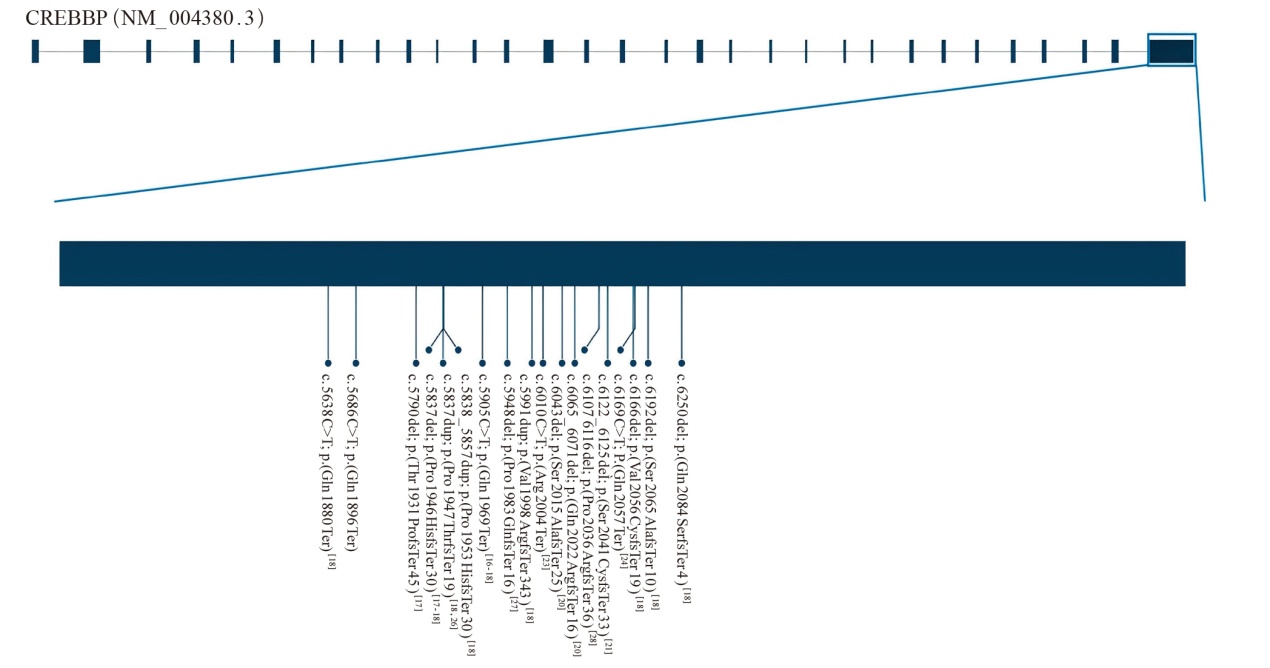
Table 3
Comparison of clinical features between RSTS patients with truncating variants in the last exon of CREBBP and those with classical RSTS"
| 项 目 | 末端截断变异 | 经典型RSTS[ |
|---|---|---|
| 例数 | 22 | 308 |
| 生长发育 | ||
| 宫内生长受限 | 4/10(40%) | 49% |
| 出生后生长迟缓 | 9/18(50%) | 75% |
| 肥胖 | 1/11(9%) | 29% |
| 小头畸形 | 15/16(94%) | 54% |
| 颅面部特征 | ||
| 高拱眉 | 8/13(62%) | 85% |
| 长睫毛 | 1/1(100%) | 89% |
| 内眦赘皮 | N/A | 44% |
| 斜视 | 2/11(18%) | 71% |
| 近视 | 1/5(20%) | 56% |
| 眼裂下斜 | 13/15(87%) | 79% |
| 鼻梁凸起(喙鼻) | 13/15(87%) | 81% |
| 鼻小柱低于鼻翼 | 7/8(88%) | 88% |
| 典型“诡秘微笑” | 8/10(80%) | 94% |
| 高拱腭 | 6/7(86%) | 77% |
| 爪形切牙 | 0/4(0%) | 73% |
| 小下颌 | 10/13(77%) | 61% |
| 低位耳 | 6/12(50%) | 44% |
| 躯干及四肢特征 | ||
| 宽拇指 | 15/17(88%) | 96% |
| 拇指偏斜(桡侧偏斜) | 6/12(50%) | 49% |
| 指端增宽 | 9/10(90%) | 87% |
| 宽大脚趾 | 15/17(88%) | 95% |
| 多毛 | 1/7(14%) | 76% |
| 瘢痕疙瘩 | 0/7(0%) | 23% |
| 脊柱侧弯 | 4/8(50%) | 18% |
| 心血管异常 | 9/16(56%) | 35% |
| 便秘 | 1/3(33%) | 76% |
| 泌尿系统异常 | 3/5(60%) | 28% |
| 神经肌肉系统 | ||
| 癫痫 | 1/9(11%) | 25% |
| 认知与行为 | ||
| 智力障碍 | 16/16(100%) | 99% |
| 孤独症谱系障碍 | 2/6(33%) | 49% |
| [1] | Stevens CA. Rubinstein-Taybi syndrome. 2002 Aug 30 [updated 2023 Nov 9]. In: Adam MP, Bick S, Mirzaa GM, et al, editors. GeneReviews® [Internet]. Seattle (WA): University of Washington, Seattle, 1993-2026. |
| [2] |
Rubinstein JH, Taybi H. Broad thumbs and toes and facial abnormalities. A possible mental retardation syndrome[J]. Am J Dis Child, 1963, 105: 588-608.
pmid: 13983033 |
| [3] |
Petrij F, Giles RH, Dauwerse HG, et al. Rubinstein-Taybi syndrome caused by mutations in the transcriptional co-activator CBP[J]. Nature, 1995, 376(6538): 348-351.
doi: 10.1038/376348a0 |
| [4] |
Kalkhoven E, Roelfsema JH, Teunissen H, et al. Loss of CBP acetyltransferase activity by PHD finger mutations in Rubinstein-Taybi syndrome[J]. Hum Mol Genet, 2003, 12(4): 441-450.
pmid: 12566391 |
| [5] |
Jin E, Le H, Jewell A, et al. Genotype-phenotype analysis of ocular findings in Rubinstein-Taybi syndrome - A case report and review of literature[J]. Ophthalmic Genet, 2024, 45(1): 51-58.
doi: 10.1080/13816810.2023.2196341 |
| [6] |
Wang J, Weaver IC, Gauthier-Fisher A, et al. CBP histone acetyltransferase activity regulates embryonic neural differentiation in the normal and Rubinstein-Taybi syndrome brain[J]. Dev Cell, 2010, 18(1): 114-125.
doi: 10.1016/j.devcel.2009.10.023 pmid: 20152182 |
| [7] |
Carrard J, Lejeune F. Nonsense-mediated mRNA decay, a simplified view of a complex mechanism[J]. BMB Rep, 2023, 56(12): 625-632.
pmid: 38052423 |
| [8] |
Khajavi M, Inoue K, Lupski JR. Nonsense-mediated mRNA decay modulates clinical outcome of genetic disease[J]. Eur J Hum Genet, 2006, 14(10): 1074-1081.
pmid: 16757948 |
| [9] | Tang Y, Ye X, Zhan Y, et al. Correlations between phenotype and gene region-specific episignatures in Rubinstein-Taybi syndrome and Menke-Hennekam syndrome[J]. Hum Mol Genet, 2026, 35(5): ddag006. |
| [10] | Van der Auwera GA, Carneiro MO, Hartl C, et al. From FastQ data to high confidence variant calls: the Genome Analysis Toolkit best practices pipeline[J]. Curr Protoc Bioinformatics, 2013, 43(1110): 11.10. 1-11.10.33. |
| [11] |
Sun Y, Ye X, Fan Y, et al. High detection rate of copy number variations using capture sequencing data: a retrospective study[J]. Clin Chem, 2020, 66(3): 455-462.
doi: 10.1093/clinchem/hvz033 pmid: 32031585 |
| [12] |
Fromer M, Moran JL, Chambert K, et al. Discovery and statistical genotyping of copy-number variation from whole-exome sequencing depth[J]. Am J Hum Genet, 2012, 91(4): 597-607.
doi: 10.1016/j.ajhg.2012.08.005 pmid: 23040492 |
| [13] |
Talevich E, Shain AH, Botton T, et al. CNVkit: genome-wide copy number detection and visualization from targeted DNA sequencing[J]. PLoS Comput Biol, 2016, 12(4): e1004873.
doi: 10.1371/journal.pcbi.1004873 |
| [14] |
Geoffroy V, Herenger Y, Kress A, et al. AnnotSV: an integrated tool for structural variations annotation[J]. Bioinformatics, 2018, 34(20): 3572-3574.
doi: 10.1093/bioinformatics/bty304 pmid: 29669011 |
| [15] |
Richards S, Aziz N, Bale S, et al. Standards and guidelines for the interpretation of sequence variants: a joint consensus recommendation of the American College of Medical Genetics and Genomics and the Association for Molecular Pathology[J]. Genet Med, 2015, 17(5): 405-424.
doi: 10.1038/gim.2015.30 pmid: 25741868 |
| [16] |
Cross E, Duncan-Flavell PJ, Howarth RJ, et al. Screening of a large Rubinstein-Taybi cohort identified many novel variants and emphasizes the importance of the CREBBP histone acetyltransferase domain[J]. Am J Med Genet A, 2020, 182(11): 2508-2520.
doi: 10.1002/ajmg.a.v182.11 |
| [17] |
Spena S, Milani D, Rusconi D, et al. Insights into genotype-phenotype correlations from CREBBP point mutation screening in a cohort of 46 Rubinstein-Taybi syndrome patients[J]. Clin Genet, 2015, 88(5): 431-440.
doi: 10.1111/cge.12537 pmid: 25388907 |
| [18] |
Yu S, Wu B, Qian Y, et al. Clinical exome sequencing identifies novel CREBBP variants in 18 Chinese Rubinstein-Taybi Syndrome kids with high frequency of polydactyly[J]. Mol Genet Genomic Med, 2019, 7(12): e1009.
doi: 10.1002/mgg3.v7.12 |
| [19] |
Bartsch O, Schmidt S, Richter M, et al. DNA sequencing of CREBBP demonstrates mutations in 56% of patients with Rubinstein-Taybi syndrome (RSTS) and in another patient with incomplete RSTS[J]. Hum Genet, 2005, 117(5): 485-493.
pmid: 16021471 |
| [20] |
Bentivegna A, Milani D, Gervasini C, et al. Rubinstein-Taybi syndrome: spectrum of CREBBP mutations in Italian patients[J]. BMC Med Genet, 2006, 7: 77.
pmid: 17052327 |
| [21] |
Chiang PW, Lee NC, Chien N, et al. Somatic and germ-line mosaicism in Rubinstein-Taybi syndrome[J]. Am J Med Genet A, 2009, 149a(7): 1463-1467.
doi: 10.1002/ajmg.a.v149a:7 |
| [22] |
Coupry I, Roudaut C, Stef M, et al. Molecular analysis of the CBP gene in 60 patients with Rubinstein-Taybi syndrome[J]. J Med Genet, 2002, 39(6): 415-421.
pmid: 12070251 |
| [23] |
Roelfsema JH, White SJ, Ariyürek Y, et al. Genetic heterogeneity in Rubinstein-Taybi syndrome: mutations in both the CBP and EP300 genes cause disease[J]. Am J Hum Genet, 2005, 76(4): 572-580.
pmid: 15706485 |
| [24] |
Elalaoui SC, Smaili W, Van-Gils J, et al. Clinical description and mutational profile of a Moroccan series of patients with Rubinstein Taybi syndrome[J]. Afr Health Sci, 2021, 21(2): 960-967.
doi: 10.4314/ahs.v21i2.58 pmid: 34795756 |
| [25] |
Hu X, Li N, Xu Y, et al. Proband-only medical exome sequencing as a cost-effective first-tier genetic diagnostic test for patients without prior molecular tests and clinical diagnosis in a developing country: the China experience[J]. Genet Med, 2018, 20(9): 1045-1053.
doi: 10.1038/gim.2017.195 pmid: 29095814 |
| [26] |
Yang Y, Xiao J, Ye Y, et al. Case report: a preterm infant with Rubinstein-Taybi syndrome and marmorata telangiectatica harboring a frameshift mutation in the CREBBP gene[J]. Front Pediatr, 2023, 11: 1059658.
doi: 10.3389/fped.2023.1059658 |
| [27] |
Lee JS, Byun CK, Kim H, et al. Clinical and mutational spectrum in Korean patients with Rubinstein-Taybi syndrome: the spectrum of brain MRI abnormalities[J]. Brain Dev, 2015, 37(4): 402-408.
doi: 10.1016/j.braindev.2014.07.007 |
| [28] |
Pérez-Grijalba V, García-Oguiza A, López M, et al. New insights into genetic variant spectrum and genotype-phenotype correlations of Rubinstein-Taybi syndrome in 39 CREBBP-positive patients[J]. Mol Genet Genomic Med, 2019, 7(11): e972.
doi: 10.1002/mgg3.v7.11 |
| [29] |
Murata T, Kurokawa R, Krones A, et al. Defect of histone acetyltransferase activity of the nuclear transcriptional coactivator CBP in Rubinstein-Taybi syndrome[J]. Hum Mol Genet, 2001, 10(10): 1071-1076.
pmid: 11331617 |
| [30] |
Udaka T, Samejima H, Kosaki R, et al. Comprehensive screening of CREB-binding protein gene mutations among patients with Rubinstein-Taybi syndrome using denaturing high-performance liquid chromatography[J]. Congenit Anom (Kyoto), 2005, 45(4): 125-131.
doi: 10.1111/cga.2005.45.issue-4 |
| [31] |
Schorry EK, Keddache M, Lanphear N, et al. Genotype-phenotype correlations in Rubinstein-Taybi syndrome[J]. Am J Med Genet A, 2008, 146a(19): 2512-2519.
doi: 10.1002/ajmg.a.32424 pmid: 18792986 |
| [32] |
Lacombe D, Bloch-Zupan A, Bredrup C, et al. Diagnosis and management in Rubinstein-Taybi syndrome: first international consensus statement[J]. J Med Genet, 2024, 61(6): 503-519.
doi: 10.1136/jmg-2023-109438 pmid: 38471765 |
| [33] |
Stojanovic JR, Miletic A, Peterlin B, et al. Diagnostic and clinical utility of clinical exome sequencing in children with moderate and severe global developmental delay/intellectual disability[J]. J Child Neurol, 2020, 35(2): 116-131.
doi: 10.1177/0883073819879835 pmid: 31623504 |
| [34] |
Nagy E, Maquat LE. A rule for termination-codon position within intron-containing genes: when nonsense affects RNA abundance[J]. Trends Biochem Sci, 1998, 23(6): 198-199.
doi: 10.1016/s0968-0004(98)01208-0 pmid: 9644970 |
| [35] |
Kerr TP, Sewry CA, Robb SA, et al. Long mutant dystrophins and variable phenotypes: evasion of nonsense-mediated decay?[J]. Hum Genet, 2001, 109(4): 402-407.
pmid: 11702221 |
| [36] |
Hall GW, Thein S. Nonsense codon mutations in the terminal exon of the beta-globin gene are not associated with a reduction in beta-mRNA accumulation: a mechanism for the phenotype of dominant beta-thalassemia[J]. Blood, 1994, 83(8): 2031-2037.
pmid: 8161774 |
| [37] |
Hiroi M, Ohmori Y. The transcriptional coactivator CREB-binding protein cooperates with STAT1 and NF-kappa B for synergistic transcriptional activation of the CXC ligand 9/monokine induced by interferon-gamma gene[J]. J Biol Chem, 2003, 278(1): 651-660.
doi: 10.1074/jbc.M204544200 pmid: 12403783 |
| [1] | TANG Yanan, YE Xiantao, GU Xuefan, YU Yongguo, XIAO Bing, SUN Yu. Clinical characteristics and genetic analysis in Chinese patients with Menke-Hennekam syndrome [J]. Journal of Clinical Pediatrics, 2023, 41(8): 613-617. |
| [2] | LI Jianjian, FENG Qingxiang, LEI Yu, LIU Zhenzhen, LI Tao, ZHOU Qian, CHENG Xue . Rubinstein-Taybi syndrome induced by CREBBP gene mutation: a case report [J]. , 2018, 36(9): 683-. |
| [3] | CHENG Yanyang, LIU Aojie, WEI Li, ZHANG Jing, XU Zhiliang. The clinical characteristics and gene diagnosis of Rubinstein-Taybi syndrome [J]. , 2018, 36(3): 207-. |
| [4] | WANG Yan, HONG Xiaoyang, PENG Wei, ZHANG Xiaojuan, YANG Xiao, FENG Zhichun . Application of single nucleotide polymorphism microarray technology in diagnosis of Rubinstein-Taybi syndrome: one case report [J]. , 2016, 34(9): 686-. |
|
||
