临床儿科杂志 ›› 2026, Vol. 44 ›› Issue (7): 660-664.doi: 10.12372/jcp.2026.25e1445

• 短篇论著 • 上一篇    下一篇

来自相同变异的不同表型:ATP1A3基因变异相关发热诱导阵发性无力及脑病一家系报告

李娟(), 刘勇, 金瑞峰   

  1. 山东大学附属儿童医院神经内科(山东济南 250000)
  • 收稿日期:2025-11-17 修回日期:2026-02-02 录用日期:2026-05-16 出版日期:2026-07-15 发布日期:2026-07-12
  • 通讯作者: 李娟 E-mail:zhss0427@qq.com

Phenotypic diversity from the same mutation: a family report on ATP1A3 gene mutation-related febrile-induced paroxysmal weakness and encephalopathy

LI Juan(), LIU Yong, JIN Ruifeng   

  1. Department of Neurology, Children's Hospital Affiliated to Shandong University, Jinan 250000, Shandong, China
  • Received:2025-11-17 Revised:2026-02-02 Accepted:2026-05-16 Published:2026-07-15 Online:2026-07-12
  • Contact: LI Juan E-mail:zhss0427@qq.com

摘要:

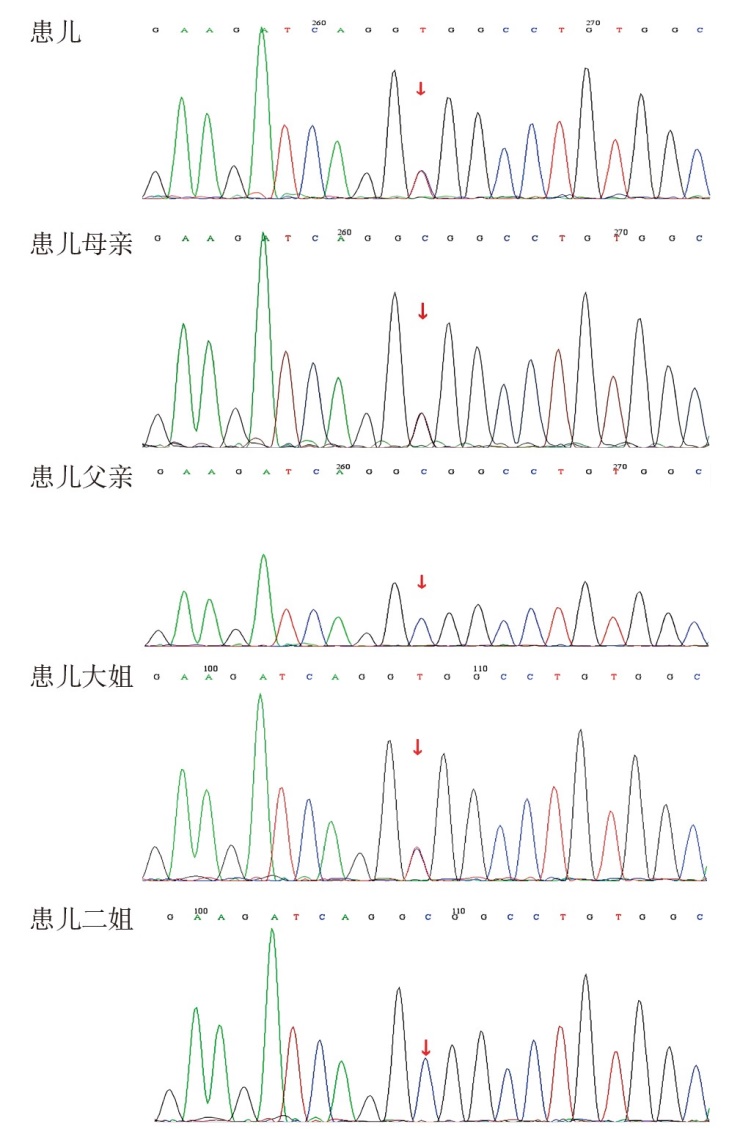
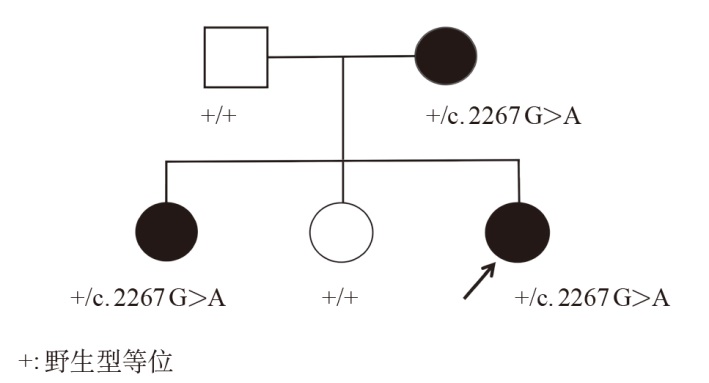
目的 ATP1A3基因变异可导致一组谱系疾病,发热诱导阵发性无力及脑病是其中之一。目前,对ATP1A3变异的基因型-表型关联尚存在较多疑问。方法 回顾性分析一个发热诱导阵发性肢体无力及脑病(FIPWE)家系,研究先证者、姐姐和母亲的临床特征和基因型-表型关联。结果 先证者为女童,3岁4月龄首发,于发热后出现进行性肢体无力,并迅速累及延髓及呼吸相关功能,查体提示弛缓性瘫痪表现,伴腹壁反射及膝腱反射消失、左侧Babinski征阳性。全外显子测序显示先证者存在ATP1A3基因错义突变NM_152296.5: c.2267G>A, p.(Arg756His),核苷酸c.2267G>A导致756位精氨酸发生变异。患儿母亲及大姐均分别于学龄前期和学龄期在感染后出现与先证者相似的急性神经功能受累,遗留不同程度运动障碍和构音障碍。Sanger测序证实其母亲及大姐均存在ATP1A3基因相同位点致病性变异。该家系表现出感染诱发、家族聚集性发病及基因型共分离特征。结论 对于发热后出现急性发作的肢体无力及脑病的患儿,同时具备上运动神经元和下运动神经元受累的体征,需高度警惕FIPWE综合征。ATP1A3基因变异的基因型-表型关联复杂,尚有待进一步研究。

关键词: 脑病, 肢体无力, ATP1A3基因

Abstract:

Objective Variations in the ATP1A3 gene are associated with a spectrum of neurological disorders, including fever-induced paroxysmal weakness and encephalopathy (FIPWE). However, genotype-phenotype correlations related to ATP1A3 variants remain incompletely understood. Method This study retrospectively analyzed a family affected by FIPWE, the clinical features and genotype-phenotype correlations of the proband, her elder sister and her mother were reviewed. Results The proband was a girl who first presented at the age of 3 years and 4 months with progressive limb weakness following fever. The weakness rapidly involved bulbar and respiratory functions. Neurological examination revealed flaccid paralysis, absent abdominal reflexes and knee-jerk reflexes, and a Babinski sign on the left side. Whole-exome sequencing identified a missense variant in ATP1A3 in the proband, NM_152296.5:c.2267G>A, p.(Arg756His), in which the nucleotide substitution c.2267G>A results in the replacement of arginine by histidine at residue 756. Both the mother and elder sister presented acute neurological impairment similar to that of the proband after infection at preschool and school age respectively, with residual motor dysfunction and dysarthria of varying severity. Sanger sequencing confirmed that both the mother and elder sister carried the same pathogenic ATP1A3 variant. This family demonstrated infection-triggered onset, familial aggregation and genotype-phenotype co-segregation. Conclusion Clinicians should highly suspect FIPWE syndrome in pediatric patients presenting with acute-onset limb weakness and encephalopathy following fever, combined with signs involving both upper and lower motor neurons. The genotype-phenotype correlation of ATP1A3 related disorders is complicated and warrants further investigation.

Key words: encephalopathy, limb weakness, ATP1A3 gene

中图分类号: 

  • R72