

Journal of Clinical Pediatrics ›› 2026, Vol. 44 ›› Issue (6): 573-578.doi: 10.12372/jcp.2026.25e1558
• Clinical Report • Previous Articles Next Articles
ZHU Linmin, KANG Lili, LIU Chen, HAN Yujie, YAN Beibei, XU Qun, LI Xiaomei, LI Xiaoying( )
)
Received:2025-10-10
Revised:2026-01-27
Accepted:2026-04-21
Published:2026-06-15
Online:2026-06-04
Contact:
LI Xiaoying
E-mail:lxy_jn@email.sdu.edu.cn
CLC Number:
ZHU Linmin, KANG Lili, LIU Chen, HAN Yujie, YAN Beibei, XU Qun, LI Xiaomei, LI Xiaoying. Neonatal-onset hereditary thrombotic thrombocytopenic purpura: a report of two cases[J].Journal of Clinical Pediatrics, 2026, 44(6): 573-578.
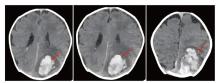
Figure 1
CT findings of Case 2"
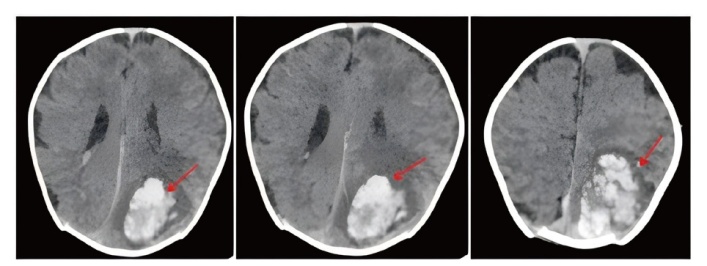
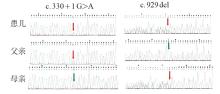
Figure 2
Sanger sequencing of ADAMTS13 gene variation in Case 1"
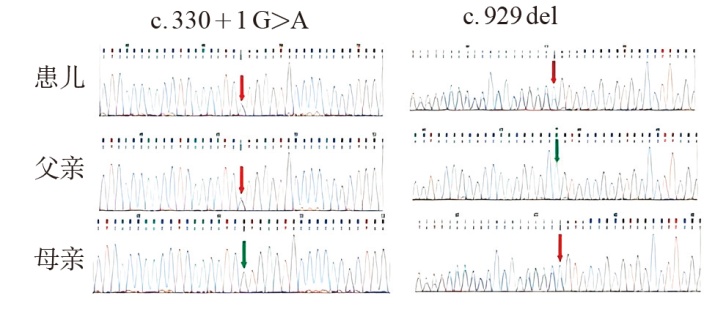
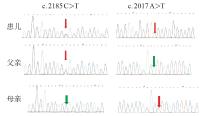
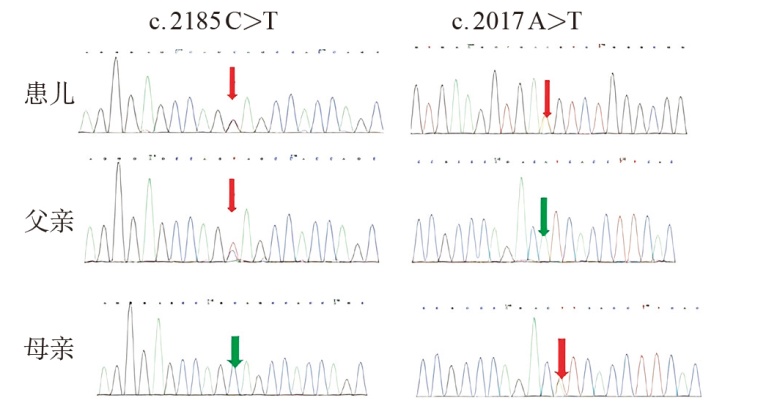
Figure 3
Sanger sequencing ofADAMTS13 gene variation in Case 2"
| [1] |
Kremer Hovinga JA, George JN. Hereditary thrombotic thrombocytopenic purpura[J]. N Engl J Med, 2019, 381(17): 1653-1662.
doi: 10.1056/NEJMra1813013 |
| [2] | Sukumar S, Lämmle B, Cataland SR. Thrombotic thrombocytopenic purpura: pathophysiology, diagnosis, and management[J]. J Clin Med, 2021, 10(3). |
| [3] |
Staley EM, Cao W, Pham HP, et al. Clinical factors and biomarkers predict outcome in patients with immune-mediated thrombotic thrombocytopenic purpura[J]. Haematologica, 2019, 104(1): 166-175.
doi: 10.3324/haematol.2018.198275 pmid: 30171022 |
| [4] |
Scully M, Cataland S, Coppo P, et al. Consensus on the standardization of terminology in thrombotic thrombocytopenic purpura and related thrombotic microangiopathies[J]. J Thromb Haemost, 2017, 15(2): 312-322.
doi: 10.1111/jth.13571 pmid: 27868334 |
| [5] |
van Dorland HA, Taleghani MM, Sakai K, et al. The International hereditary thrombotic thrombocytopenic purpura registry: key findings at enrollment until 2017[J]. Haematologica, 2019, 104(10): 2107-2115.
doi: 10.3324/haematol.2019.216796 pmid: 30792199 |
| [6] |
Liu J, Zhang Y, Li Z, et al. Early indicators of neonatal-onset hereditary thrombotic thrombocytopenia purpura[J]. Res Pract Thromb Haemost, 2022, 6(7): e12820.
doi: 10.1002/rth2.12820 |
| [7] | 李晨, 陈正, 陈鸣艳, 等. 2日龄新生儿高胆红素血症合并血小板减少[J]. 中国当代儿科杂志, 2016, 21(12): 1218-1222. |
| Li C, Chen Z, Chen MY, et al. Hyperbilirubinemia with thrombocytopenia in a 2-day-old newborn[J]. Zhongguo Dangdai Erke, 2016, 21(12): 1218-1222. | |
| [8] | 李烨姗, 刘玲, 陈超洪, 等. ADAMTS13基因突变致新生儿遗传性血栓性血小板减少性紫癜1例[J]. 中国优生与遗传杂志, 2025, 33(6): 1398-1402. |
| Li YS, Liu L, Chen CH, et al. hereditary thrombotic thrombocytopenic purpura in a neonate due to ADAMTS13 mutation: a case report[J]. Zhongguo Yousheng Yu yichuan, 2025, 33(6): 1398-1402. | |
| [9] | 傅玲玲, 马洁, 马静瑶, 等. 儿童先天性血栓性血小板减少性紫癜五例分析[J]. 中华儿科杂志, 2019, 57(1): 50-54. |
| Fu LL, Ma J, Ma JY, et al. Analysis of five cases of congenital thrombotic thrombocytopenic purpura in pediatric patients[J]. Zhonghua Erke zaxhi, 2019, 57(1): 50-54. | |
| [10] | 黄抒涵, 党丹, 富鑫, 等. 先天性血栓性血小板减少性紫癜1例报告[J]. 中国实用儿科杂志, 2021, 36(5): 398-400. |
| Huang SH, Dang D, Fu X, et al. Hereditary Thrombotic thrombocytopenic purpura: a case report[J]. Zhongguo Shiyong Erke, 2021, 36(5): 398-400. | |
| [11] | 薛美娟, 石艳, 邵琳琳, 等. 遗传性血栓性血小板减少性紫癜1例并文献复习[J]. 山东大学学报, 2022, 60(3): 121-124. |
| Xue MJ, Shi Y, Shao LL, et al. Hereditary thrombotic thrombocytopenic purpura: a case report and literature review[J]. Shandong Daxue Xuebao, 2022, 60(3): 121-124. | |
| [12] | 施卸丽, 何源远, 张奇. 先天性血栓性血小板减少性紫癜新生儿1例[J]. 中国实用儿科杂志, 2023, 32(2): 261-263. |
| Shi XL, He YY, Zhang Q. Hereditary thrombotic thrombocytopenic purpura in a neonate: a case report[J]. Zhongguo Shiyong Erke zaxhi, 2023, 32(2): 261-263. | |
| [13] | 徐颖, 王春莉, 朱雯, 等. 新生儿期发病的遗传性血栓性血小板减少性紫癜一例[J]. 中华围产医学杂志, 2020, 23(12): 838-842. |
| Xu Y, Wang CL, Zhu W, et al. Neonatal-onset hereditary thrombotic thrombocytopenic purpura: a case report[J]. Zhonghua Weichan Yixue, 2020, 23(12): 838-842. | |
| [14] | 陈映敏, 张安安, 吴丽花, 等. 儿童遗传性血栓性血小板减少性紫癜1例[J]. 中国临床案例成果数据库, 2025, 7(1). doi:10.3760/cma.j.cmcr20250619-02445. |
| Chen YM, Zhang AA, Wu LH, et al. Hereditary thrombotic thrombocytopenic purpura in a child: a case report[J]. Zhongguo Anli Chengguo, 2025, 7(1). | |
| [15] | 付佳, 司姝宇, 金笛, 等. 新生儿遗传性血栓性血小板减少性紫癜1例[J]. 中华围产医学杂志, 2025, 28(7): 598-600. |
| Fu J, Si SY, Jin D, et al. Hereditary thrombotic thrombocytopenic purpura in a neonate: a case report[J]. Zhonghua Weichan Yixue, 2025, 28(7): 598-600. | |
| [16] | 刘阳, 王娴静. 遗传性血栓性血小板减少性紫癜1例报告并文献复习[J]. 临床血液学杂志, 2019, 32(5): 386-388. |
| Liu Y, Wang XJ. Hereditary thrombotic thrombocytopenic purpura: a case report and literature review[J]. Linchuang Xueyexue, 2019, 32(5): 386-388. | |
| [17] |
Fujimura Y, Matsumoto M, Isonishi A, et al. Natural history of Upshaw-Schulman syndrome based on ADAMTS13 gene analysis in Japan[J]. J Thromb Haemost, 2011, 9 (Suppl 1) : 283-301
doi: 10.1111/j.1538-7836.2011.04341.x |
| [18] |
Alwan F, Vendramin C, Liesner R, et al. Characterization and treatment of congenital thrombotic thrombocytopenic purpura[J]. Blood, 2019, 133(15): 1644-1651.
doi: 10.1182/blood-2018-11-884700 pmid: 30770395 |
| [19] |
Borogovac A, Reese JA, Gupta S, et al. Morbidities and mortality in patients with hereditary thrombotic thrombocytopenic purpura[J]. Blood Adv, 2022, 6(3): 750-759.
doi: 10.1182/bloodadvances.2021005760 |
| [20] |
Loirat C, Coppo P, Veyradier A. Thrombotic thrombocytopenic purpura in children[J]. Curr Opin Pediatr, 2013, 25(2): 216-224.
doi: 10.1097/MOP.0b013e32835e7888 pmid: 23422353 |
| [21] |
Hosler GA, Cusumano AM, Hutchins GM. Thrombotic thrombocytopenic purpura and hemolytic uremic syndrome are distinct pathologic entities. A review of 56 autopsy cases[J]. Arch Pathol Lab Med, 2003, 127(7): 834-839.
doi: 10.5858/2003-127-834-TTPAHU pmid: 12823037 |
| [22] | Maragliano R, Perrot A, Loget P, et al. Characterization of autopsy findings including multivisceral glomeruloid vascular bodies in hereditary thrombotic thrombocytopenic purpura with two new variants in ADAMTS13 gene[J]. Virchows Arch, 2025. https: //doi.org/10.1007/s00428-025-04200-8 |
| [23] |
Manea M, Kristoffersson A, Schneppenheim R, et al. Podocytes express ADAMTS13 in normal renal cortex and in patients with thrombotic thrombocytopenic purpura[J]. Br J Haematol, 2007, 138(5): 651-662.
doi: 10.1111/bjh.2007.138.issue-5 |
| [24] |
Levy GG, Nichols WC, Lian EC, et al. Mutations in a member of the ADAMTS gene family cause thrombotic thrombocytopenic purpura[J]. Nature, 2001, 413(6855): 488-494.
doi: 10.1038/35097008 |
| [25] |
Lotta LA, Garagiola I, Palla R, et al. ADAMTS13 mutations and polymorphisms in congenital thrombotic thrombocytopenic purpura[J]. Hum Mutat, 2010, 31(1): 11-19.
doi: 10.1002/humu.21143 pmid: 19847791 |
| [26] |
Kremer Hovinga JA, Heeb SR, Skowronska M, et al. Pathophysiology of thrombotic thrombocytopenic purpura and hemolytic uremic syndrome[J]. J Thromb Haemost, 2018, 16(4): 618-629.
doi: 10.1111/jth.13956 pmid: 29356300 |
| [27] |
von Krogh AS, Quist-Paulsen P, Waage A, et al. High prevalence of hereditary thrombotic thrombocytopenic purpura in central Norway: from clinical observation to evidence[J]. J Thromb Haemost, 2016, 14(1): 73-82.
doi: 10.1111/jth.13186 pmid: 26566785 |
| [28] |
Lotta LA, Wu HM, Mackie IJ, et al. Residual plasmatic activity of ADAMTS13 is correlated with phenotype severity in congenital thrombotic thrombocytopenic purpura[J]. Blood, 2012, 120(2): 440-448.
doi: 10.1182/blood-2012-01-403113 pmid: 22529288 |
| [29] |
Tarasco E, Bütikofer L, Friedman KD, et al. Annual incidence and severity of acute episodes in hereditary thrombotic thrombocytopenic purpura[J]. Blood, 2021, 137(25): 3563-3575.
doi: 10.1182/blood.2020009801 pmid: 33649760 |
| [30] |
Zheng XL, Al-Housni Z, Cataland SR, et al. 2025 focused update of the 2020 ISTH Guidelines for Management of Thrombotic Thrombocytopenic Purpura[J]. J Thromb Haemost, 2025, 23(11): 3711-3732.
doi: 10.1016/j.jtha.2025.06.002 pmid: 40533296 |
| [31] |
Sakai K, Hamamura A, Yoshimura Y, et al. Therapeutic switch from plasma to recombinant ADAMTS13 for patients with congenital TTP from Japanese real-world data[J]. Blood, 2025, 145(20): 2390-2395.
doi: 10.1182/blood.2024027516 |
| [1] | GAO Yufei, QIAN Naisi, JIN Shan, YANG Zhiyu, LU Huiping, SONG Hualing, WU Cheng, YU Huiting. Newborn birth weight curves for different gestational ages in Shanghai : a retrospective study based on population data from 2004 to 2023 [J]. Journal of Clinical Pediatrics, 2026, 44(7): 651-659. |
| [2] | QIN Sijia, CUI Mengxing, ZHANG Yue, ZHANG Guiyuan, LANG Pengxiang, CHEN Gang, LIANG Bo. A genetic study of three families with epidermolysis bullosa simplex [J]. Journal of Clinical Pediatrics, 2026, 44(5): 431-437. |
| [3] | DOU Limin, ZHAO Piaoping, TANG Weitao, MA Yangyang, DONG Kuiran, WANG Liuhui, YE Ying, LI Ming. A case report of a newborn neuroblastoma presenting with a single light blue nodule on the top of the head as the initial manifestation [J]. Journal of Clinical Pediatrics, 2026, 44(5): 460-464. |
| [4] | HUANG Haiting, ZHANG Hui, TUOHETI Aerziguli, SU Yajie, LI Long. Correlation between splanchnic tissue oxygen saturation and superior mesenteric artery hemodynamics during red blood cell transfusion in neonates: a prospective cohort study [J]. Journal of Clinical Pediatrics, 2026, 44(4): 323-330. |
| [5] | CUI Yafei, HU Jing, WANG Fei, WANG Yingyuan, YANG Junmei, ZHANG Liming. Clinical analysis of hepatic hemangioma with arteriovenous fistula in neonates [J]. Journal of Clinical Pediatrics, 2026, 44(3): 217-221. |
| [6] | HU Xiangsong, LIN Yating, ZHU Tianwen. Natural history of six neonates with severe MTM1-related X-linked myotubular myopathy [J]. Journal of Clinical Pediatrics, 2026, 44(2): 124-131. |
| [7] | ZHANG Wenjing, WANG Fan, ZHANG Li, LI Lan. Advances in risk factors and novel biomarkers for neonatal acute kidney injury [J]. Journal of Clinical Pediatrics, 2026, 44(1): 71-78. |
| [8] | FU Mengzhen, SHI Kaili, GAO Chunlin, SHI Zhuo, ZHANG Pei, JIA Lili, MA Chenxi, LIU Jiuyu, XIA Zhengkun. Eculizumab treatment for thrombotic thrombocytopenic purpura associated with systemic lupus erythematosus in children: a case report [J]. Journal of Clinical Pediatrics, 2025, 43(6): 464-469. |
| [9] | HUANG Jing, LIU Xiaochen, GAO Xiong, LI Xiaowen, LI Guanghong, LI Luquan. The value of measuring trace elements and oxidative/antioxidant factors in umbilical blood in predicting the onset and evaluation of neonatal respiratory distress syndrome [J]. Journal of Clinical Pediatrics, 2025, 43(3): 204-210. |
| [10] | HE Ying, LIU Zhiyong, YANG Hansong, CAI Yali, XU Jinglin, CHEN Dongmei. Clinical analysis of 153 neonatal enterovirus infections and antibiotic management improvement study [J]. Journal of Clinical Pediatrics, 2025, 43(2): 128-134. |
| [11] | CHEN Chao. Significance of introducing the concept of “small vulnerable newborns” [J]. Journal of Clinical Pediatrics, 2025, 43(11): 803-806. |
| [12] | LI Jing, LIANG Xuxia, ZHANG Jihong, ZHANG Chun, LU Yanqun, WU Hua. Parental factors associated with singleton small vulnerable neonates: a 5-year retrospective cohort study [J]. Journal of Clinical Pediatrics, 2025, 43(11): 807-815. |
| [13] | ZHENG Ruixue, SUN Xiaodong, WU Guilan, SHEN Leilei. Neonatal refractory congenital chylothorax: two case reports and literature review [J]. Journal of Clinical Pediatrics, 2025, 43(10): 775-781. |
| [14] | ZHANG Ruijie, XI Guannan, WANG Xuefeng, LIN Xin’ao, DAI Jiale, FAN Xiaobo, WANG Jimei. Application of simplified lung ultrasound performed shortly after birth in the respiratory support needs of late preterm and term infants [J]. Journal of Clinical Pediatrics, 2024, 42(8): 714-721. |
| [15] | WANG Man, LI Luquan, LI Xiaowen. Analysis of risk factors for early-onset sepsis associated acute kidney injury in neonates [J]. Journal of Clinical Pediatrics, 2024, 42(6): 520-525. |
|
||
