

临床儿科杂志 ›› 2026, Vol. 44 ›› Issue (5): 381-393.doi: 10.12372/jcp.2026.25e1596
• 标准·方案·指南 • 下一篇
中国妇幼保健协会儿童变态反应专业委员会 中华医学会儿科学分会皮肤性病学组 《临床儿科杂志》编辑委员会
收稿日期:2025-12-16
录用日期:2026-04-02
出版日期:2026-05-15
发布日期:2026-05-08
通讯作者:
李明,电子信箱:mingli@fudan.edu.cn; 任韵清,电子信箱:yqren@zju.edu.cn
基金资助:Professional Committee of Child Allergology, China Maternal and Child Health Association; Dermatology and Venereology Group of Pediatric Branch Society, Chinese Medical Association: Editorial Board of the Journal of Clinical Pediatrics
Received:2025-12-16
Accepted:2026-04-02
Published:2026-05-15
Online:2026-05-08
摘要:
特应性皮炎(AD)作为一种慢性、复发性的炎症性皮肤病,自21世纪以来,其在中国及国际范围内的发病率呈持续上升态势,已成为重要的公共卫生议题。AD的综合管理体系主要涵盖药物治疗与非药物干预两大核心内容。尽管近年来AD的药物治疗方法不断丰富,但鉴于AD发病机制的高度复杂性以及显著的临床异质性,单纯依靠药物干预难以实现AD的最佳控制,非药物干预始终是AD防治的关键基础。目前,国内外已发表的AD治疗共识及指南中,干预策略多以药物治疗为核心架构,对非药物干预的系统性关注与整合明显欠缺。基于此背景,中国妇幼保健协会儿童变态反应专业委员会、中华医学会儿科学分会皮肤性病学组和《临床儿科杂志》编辑委员会,组织了来自30家医疗单位的33位皮肤科专家,依据当前国内外最新研究进展及临床实践经验,制定本项共识。本共识系统地阐述了AD的非药物干预管理策略,核心建议包括规避诱发因素、规范皮肤护理以维持皮肤屏障的稳定状态、落实健康教育与心理支持;强调了非药物干预作为AD管理基础措施的重要意义,旨在降低AD的复发率并提升患儿的生活质量;同时明确了各项措施的适用场景与实施要点,为临床工作者、患儿家属及健康管理人员提供了系统且实用的指导。
中图分类号:
中国妇幼保健协会儿童变态反应专业委员会 中华医学会儿科学分会皮肤性病学组 《临床儿科杂志》编辑委员会. 儿童特应性皮炎非药物干预管理专家共识[J]. 临床儿科杂志, 2026, 44(5): 381-393.
Professional Committee of Child Allergology, China Maternal and Child Health Association, Dermatology and Venereology Group of Pediatric Branch Society, Chinese Medical Association: Editorial Board of the Journal of Clinical Pediatrics. Expert consensus on non-pharmacological interventions for atopic dermatitis in children[J]. Journal of Clinical Pediatrics, 2026, 44(5): 381-393.
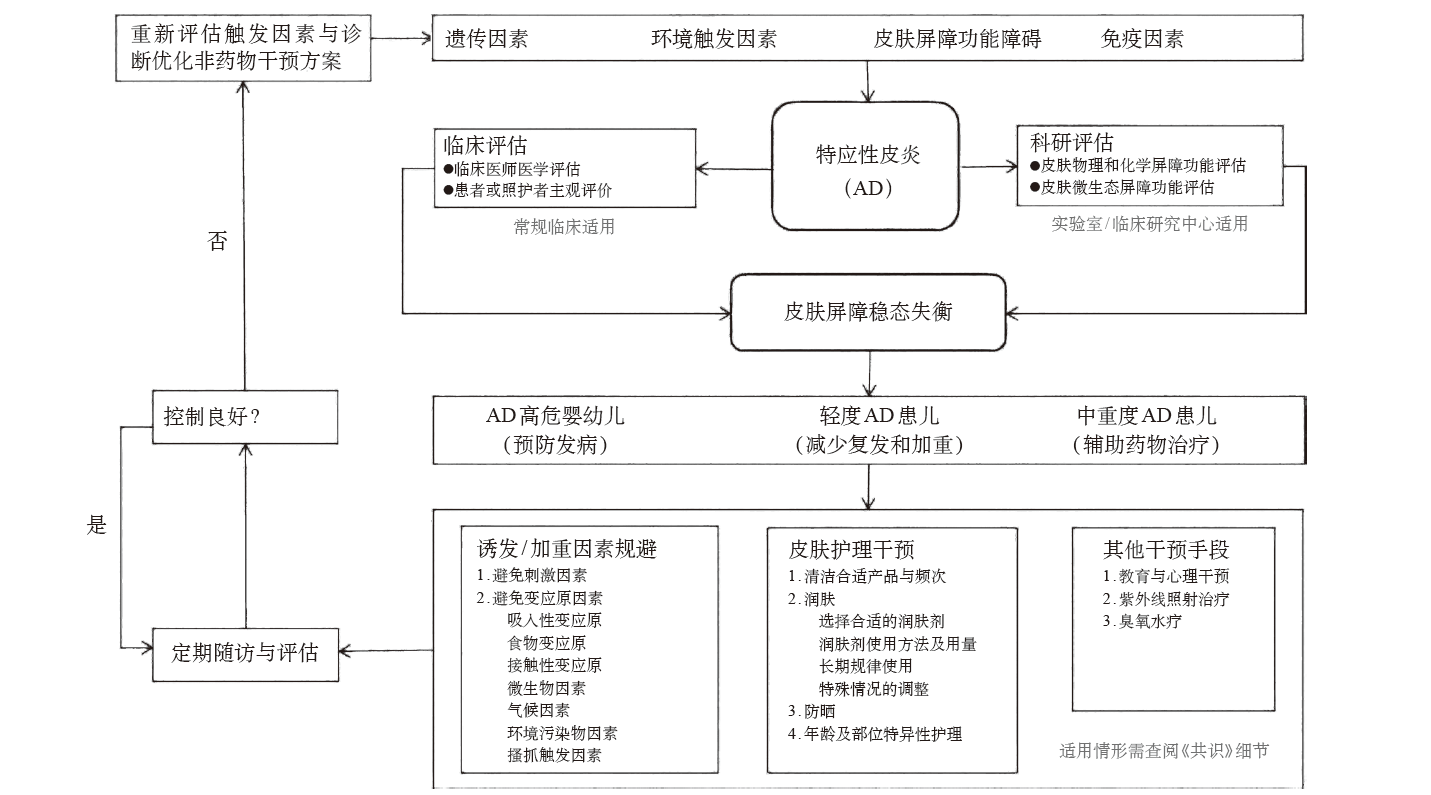
图1
儿童AD非药物干预管理临床路径流程图"
| [1] | 中华医学会皮肤性病学分会免疫学组, 特应性皮炎协作研究中心. 中国特应性皮炎诊疗指南(2020版) [J]. 中华皮肤科杂志, 2020, 53(2): 81-88. |
| Atopic Dermatitis Working Group, Immunology Group, Chinese Society of Dermatology. Chinese guideline for diagnosis and treatment of atopic dermatitis (2020)[J]. Zhonghua Pifuke Zazhi, 2020, 53(2): 81-88. | |
| [2] |
Laughter MR, Maymone MBC, Mashayekhi S, et al. The global burden of atopic dermatitis: lessons from the Global Burden of Disease Study 1990-2017[J]. Br J Dermatol, 2021, 184: 304-309.
doi: 10.1111/bjd.v184.2 |
| [3] | 顾恒, 尤立平, 刘永生, 等. 我国10城市学龄前儿童特应性皮炎现况调查[J]. 中华皮肤科杂志, 2004, 37: 29-31. |
| Gu H, You LP, Liu YS, et al. Prevalence survey of atopic dermatitis in preschool children in 10 cities of China[J]. Zhonghua Pifuke Zazhi, 2004, 37: 29-31. | |
| [4] |
Guo Y, Li P, Tang J, et al. Prevalence of atopic dermatitis in Chinese children aged 1-7 ys[J]. Sci Rep, 2016, 6: 29751.
doi: 10.1038/srep29751 |
| [5] |
Guo Y, Zhang H, Liu Q, et al. Phenotypic analysis of atopic dermatitis in children aged 1-12 months: elaboration of novel diagnostic criteria for infants in China and estimation of prevalence[J]. J Eur Acad Dermatol Venereol, 2019, 33: 1569-1576.
doi: 10.1111/jdv.15618 pmid: 30989708 |
| [6] |
Nie Z, Xiao R, Song J, et al. Economic burden and healthcare resource utilization of childhood atopic dermatitis in China[J]. Journal of Chinese Pharmaceutical Sciences, 2024, 33: 458-469.
doi: 10.5246/10031057 |
| [7] |
Paller AS, Spergel JM, Mina-Osorio P, et al. The atopic march and atopic multimorbidity: Many trajectories, many pathways[J]. J Allergy Clin Immunol, 2019, 143: 46-55.
doi: S0091-6749(18)31638-5 pmid: 30458183 |
| [8] |
Gustafsson D, Sjöberg O, Foucard T. Development of allergies and asthma in infants and young children with atopic dermatitis-a prospective follow-up to 7 years of age[J]. Allergy, 2000, 55: 240-245.
doi: 10.1034/j.1398-9995.2000.00391.x pmid: 10753014 |
| [9] |
Wu KK, Borba AJ, Deng PH, et al. Association between atopic dermatitis and conjunctivitis in adults: a population-based study in the United States[J]. J Dermatol Treat, 2019, 32: 455-459.
doi: 10.1080/09546634.2019.1659480 |
| [10] |
Silverberg JI. Comorbidities and the impact of atopic dermatitis[J]. Ann Allergy Asthma Immunol, 2019, 123: 144-151.
doi: 10.1016/j.anai.2019.04.020 |
| [11] | Russo F, Santi F, Cioppa V, et al. Meeting the needs of patients with atopic dermatitis: a multidisciplinary approach[J]. Dermatitis, 2022, 33: S141-S143. |
| [12] |
Kuo IH, Yoshida T, De Benedetto A, et al. The cutaneous innate immune response in patients with atopic dermatitis[J]. J Allergy Clin Immunol, 2013, 131: 266.
doi: 10.1016/j.jaci.2012.12.1563 pmid: 23374259 |
| [13] |
Boguniewicz M, Leung DY. Atopic dermatitis: a disease of altered skin barrier and immune dysregulation[J]. Immunol Rev, 2011, 242: 233.
doi: 10.1111/j.1600-065X.2011.01027.x pmid: 21682749 |
| [14] |
Tsakok T, Woolf R, Smith CH, et al. Atopic dermatitis: the skin barrier and beyond[J]. Br J Dermatol, 2019, 180: 464.
doi: 10.1111/bjd.16934 pmid: 29969827 |
| [15] |
Ständer S. Atopic dermatitis[J]. N Engl J Med, 2021, 384: 1136.
doi: 10.1056/NEJMra2023911 |
| [16] |
Czarnowicki T, He H, Krueger JG, et al. Atopic dermatitis endotypes and implications for targeted therapeutics[J]. J Allergy Clin Immunol, 2019, 143 (1): 1-11.
doi: S0091-6749(18)31572-0 pmid: 30612663 |
| [17] | 范曼如, 申泉, 王丹琦, 等. 临床实践指南制订方法 - 形成推荐意见的共识方法学[J]. 中国循证心血管医学杂志, 2019, 11 (6): 647-653. |
| Fan MR, Shen Q, Wang DQ. Et. al. Methodology for clinical practice guidelines - consensus methods for building recommendations[J]. Zhongguo Xunzheng Xinxueguanxue Zazhi, 2019, 11(6): 647-653. | |
| [18] | Hemalatha M, Dev A, Mahajan R, et al. Non-pharmacological therapies and their efficacy in atopic dermatitis: A narrative review[J]. Indian J Dermatol Venereol Leprol, 2025, 24:1-9. |
| [19] |
Gangadharan G. Non-pharmacologic therapies for atopic dermatitis[J]. Curr Allergy Asthma Rep, 2013, 13(5): 528-538.
doi: 10.1007/s11882-013-0371-y |
| [20] |
Dajnoki Z, Kapitány A, Eyerich K, et al. Topographical variations in the skin barrier and their role in disease pathogenesis[J]. J Eur Acad Dermatol Venereol, 2025, 39: 1228-1238.
doi: 10.1111/jdv.v39.7 |
| [21] |
Criado PR, Miot HA, Bueno-Filho R, et al. Update on the pathogenesis of atopic dermatitis[J]. An Bras Dermatol, 2024, 99(6): 895-915.
doi: 10.1016/j.abd.2024.06.001 pmid: 39138034 |
| [22] |
Yang G, Seok JK, Kang HC, et al. Skin barrier abnormalities and immune dysfunction in atopic dermatitis[J]. Int J Mol Sci, 2020, 21: 2867.
doi: 10.3390/ijms21082867 |
| [23] |
Fernández-Gallego N, Sánchez-Madrid F, Cibrian D. Role of AHR ligands in skin homeostasis and cutaneous inflammation[J]. Cells, 2021, 10: 3176.
doi: 10.3390/cells10113176 |
| [24] |
Mosca S, Ottaviani M, Briganti S, et al. The sebaceous gland: a key player in the balance between homeostasis and inflammatory skin diseases[J]. Cells, 2025, 14: 747.
doi: 10.3390/cells14100747 |
| [25] | 中华医学会, 中华医学会杂志社, 中华医学会皮肤性病学分会, 等. 儿童特应性皮炎基层诊疗指南[J]. 中华全科医师杂志, 2023, 22: 8-18. |
| Chinese Medical Association, Editorial Office of Chinese Medical Association, Chinese Society of Dermatology and Venereology, et al. Guidelines for the primary care of atopic dermatitis in children[J]. Zhonghua Quanke Yishi Zazhi, 2023, 22: 8-18. | |
| [26] |
Pucci N, Novembre E, Cammarata MG, et al. Scoring atopic dermatitis in infants and young children: distinctive features of the SCORAD index[J]. Allergy, 2005, 60(1): 113-116.
doi: 10.1111/j.1398-9995.2004.00622.x pmid: 15575941 |
| [27] |
Thomas KS, Howells L, Leshem YA, et al. How to use the harmonising outcome measures for eczema core outcome set for atopic dermatitis trials: a users' guide[J]. Br J Dermatol, 2024, 190(4): 527-535.
doi: 10.1093/bjd/ljad497 |
| [28] | 王珊, 马琳. 特应性皮炎严重程度评估[J]. 中国医学文摘皮肤科学, 2016, 33(2): 154-159. |
| Wang S, Ma L. Severity measurement of atopic dermatitis[J]. Zhongguo Yixue Wenzhai Pifukexue, 2016, 33(2): 154-159. | |
| [29] | 中华医学会皮肤性病学分会免疫学组, 特应性皮炎协作研究中心. 中国特应性皮炎诊疗指南(2014版)[J]. 中华皮肤科杂志, 2014, 47(7): 511-514. |
| Atopic Dermatitis Working Group, Immunology Group, Chinese Society of Dermatology. Guideline for diagnosis and treatment of atopic dermatitis in China (2014)[J]. Zhonghua Pifuke Zazhi, 2014, 47(7): 511-514. | |
| [30] |
Horimukai K, Morita K, Narita M, et al. Transepidermal water loss measurement during infancy can predict the subsequent development of atopic dermatitis regardless of filaggrin mutations[J]. Allergol Int, 2016, 65(1): 103-108.
doi: 10.1016/j.alit.2015.09.004 pmid: 26666481 |
| [31] |
Ye Y, Zhao P, Dou L, et al. Dynamic trends in skin barrier function from birth to age 6 months and infantile atopic dermatitis: A Chinese prospective cohort study[J]. Clin Transl Allergy, 2021, 11(5): e12043.
doi: 10.1002/clt2.v11.5 |
| [32] |
Werner Y. The water content of the stratum corneum in patients with atopic dermatitis. Measurement with the Corneometer CM 420[J]. Acta Derm Venereol, 1986, 66(4): 281-284.
doi: 10.2340/0001555566281284 |
| [33] | 中华医学会皮肤性病学分会儿童皮肤病学组. 中国儿童特应性皮炎诊疗共识(2017版)[J]. 中华皮肤科杂志, 2017, 50: 784-789. |
| Chinese Society of Pediatric Dermatology, Chinese Medical Association. Consensus on diagnosis and treatment of atopic dermatitis in Chinese children (2017)[J]. Zhonghua Pifuke Zazhi, 2017, 50: 784-789. | |
| [34] | Firooz A, Gorouhi F, Davari P, et al. Comparison of hydration, sebum and pH values in clinically normal skin of patients with atopic dermatitis and healthy controls[J]. Clin Exp Dermatol, 2008, 22(3): 321-322. |
| [35] |
Panther DJ, Jacob SE. The Importance of acidification in atopic eczema: an underexplored avenue for treatment[J]. J Clin Med, 2015, 4(5): 970-978.
doi: 10.3390/jcm4050970 pmid: 26239459 |
| [36] |
Kong HH, Oh J, Deming C, et al. Temporal shifts in the skin microbiome associated with disease flares and treatment in children with atopic dermatitis[J]. Genome Res, 2012, 22(5): 850-859.
doi: 10.1101/gr.131029.111 pmid: 22310478 |
| [37] |
Totte JE, Feltz WT, Hennekam M, et al. Prevalence and odds of staphylococcus aureus carriage in atopic dermatitis: a systematic review and meta-analysis[J]. Br J Dermatol, 2016, 175(3): 687-695.
doi: 10.1111/bjd.2016.175.issue-4 |
| [38] | Fleury OM, McAleer MA, Feuillie C, et al. Clumping factor B promotes adherence of staphylococcus aureus to corneocytes in atopic dermatitis[J]. Infect Immun, 2017, 85(11): e00994-16. |
| [39] | 中国抗衰老促进会. T/ZGKSL 002—2023 皮肤微生态调节型化妆品功效评价团体标准[S]. [2023-03-31]. https://www.ttbz.org.cn/StandardManage/BuyDetail/79499/ |
| China Anti-Aging Promotion Association. T/ZGKSL 002—2023 group standard for efficacy evaluation of skin microbiome-regulating cosmetics[S]. [2023-03-31]. https://www.ttbz.org.cn/StandardManage/BuyDetail/79499/ | |
| [40] |
Mobolaji-Lawal M, Nedorost S. The role of textiles in dermatitis: an update[J]. Curr Allergy Asthma Rep, 2015, 15: 17.
doi: 10.1007/s11882-015-0518-0 |
| [41] |
Ricci G, Patrizi A, Bendandi B, et al. Clinical effectiveness of a silk fabric in the treatment of atopic dermatitis[J]. Br J Dermatol, 2004, 150: 127-131.
doi: 10.1111/bjd.2004.150.issue-1 |
| [42] |
Jaros J, Wilson C, Shi V. Fabric selection in atopic dermatitis: an evidence-based review[J]. Am J Clin Dermatol, 2020, 21: 467-482.
doi: 10.1007/s40257-020-00516-0 pmid: 32440827 |
| [43] |
Amin M, Elkady H. Prevalence of common sensitizing aeroallergens in patients with atopic dermatitis[J]. Cytokine, 2023, 162: 156087.
doi: 10.1016/j.cyto.2022.156087 |
| [44] |
Akar-Ghibril N, Casale T, Custovic A, et al. Allergic endotypes and phenotypes of asthma[J]. J Allergy Clin Immunol Pract, 2020, 8: 429-440.
doi: S2213-2198(19)30947-X pmid: 32037107 |
| [45] | Farrokhi S, Gheybi M, Movahed A, et al. Common aeroallergens in patients with asthma and allergic rhinitis living in southwestern part of Iran: Based on skin prick test reactivity[J]. Iran J Allergy Asthma Immunol, 2015, 14: 133-138. |
| [46] |
Craig T. Aeroallergen sensitization in asthma: prevalence and correlation with severity[J]. Allergy Asthma Proc, 2010, 31: 96-102.
doi: 10.2500/aap.2010.31.3310 pmid: 20406591 |
| [47] |
Eiringhaus K, Renz H, Matricardi P, et al. Component-resolved diagnosis in allergic rhinitis and asthma[J]. J Appl Lab Med, 2019, 3: 883-898.
doi: 10.1373/jalm.2018.026526 pmid: 31639763 |
| [48] |
Criton S, Gangadharan G. Nonpharmacological management of atopic dermatitis[J]. Indian Journal of Paediatric Dermatology, 2017, 18: 166-173.
doi: 10.4103/2319-7250.207605 |
| [49] | Nankervis H, Pynn E, BoyleR, et al. House dust mite reduction and avoidance measures for treating eczema[J]. Cochrane Database Syst Rev, 2015, 1: CD008426. |
| [50] |
Wilson J, Platts-Mills T. Home environmental interventions for house dust mite[J]. J Allergy Clin Immunol Pract, 2018, 6: 1-7.
doi: S2213-2198(17)30753-5 pmid: 29310755 |
| [51] | Klimek L, Brehler R, Bergmann K, et al. Avoidance measures for mite allergy-an update[J]. Allergo J Int, 2023, 32. |
| [52] |
Zuiani C, Custovic A. Update on house dust mite allergen avoidance measures for asthma[J]. Curr Allergy Asthma Rep, 2020, 20: 50.
doi: 10.1007/s11882-020-00948-y |
| [53] |
Popescu F, Ganea C, Panaitescu C, et al. Molecular diagnosis in cat allergy[J]. World J Methodol, 2021, 11: 46-60.
doi: 10.5662/wjm.v11.i3.46 |
| [54] |
Chan S, Leung D. Dog and cat allergies: Current state of diagnostic approaches and challenges[J]. Allergy Asthma Immunol Res, 2018, 10: 97-105.
doi: 10.4168/aair.2018.10.2.97 |
| [55] |
Krämer U, Weidinger S, Darsow U, et al. Seasonality in symptom severity influenced by temperature or grass pollen: Results of a panel study in children with eczema[J]. J Invest Dermatol, 2005, 124: 514-523.
doi: 10.1111/j.0022-202X.2005.23625.x pmid: 15737191 |
| [56] |
Werfel T, Heratizadeh A, Niebuhr M, et al. Exacerbation of atopic dermatitis on grass pollen exposure in an environmental challenge chamber[J]. J Allergy Clin Immunol, 2015, 136: 96-103.
doi: 10.1016/j.jaci.2015.04.015 pmid: 26044854 |
| [57] |
Dhar S, Malakar R, Banerjee R, et al. An uncontrolled open pilot study to assess the role of dietary eliminations in reducing the severity of atopic dermatitis in infants and children[J]. Indian J Dermatol 2009, 54: 183-185.
doi: 10.4103/0019-5154.53187 pmid: 20101317 |
| [58] |
Oykhman P, Dookie J, Al-Rammahy H, et al. Dietary elimination for the treatment of atopic dermatitis: a systematic review and meta-analysis[J]. J Allergy Clin Immunol Pract, 2022, 10: 2657.
doi: 10.1016/j.jaip.2022.06.044 pmid: 35987995 |
| [59] |
Du Toit G, Roberts G, Sayre P, et al. Randomized trial of peanut consumption in infants at risk for peanut allergy[J]. N Engl J Med, 2015, 372: 803-813.
doi: 10.1056/NEJMoa1414850 |
| [60] |
Skjerven H, Lie A, Vettukattil R, et al. Early food intervention and skin emollients to prevent food allergy in young children (PreventADALL): a factorial, multicentre, cluster-randomised trial[J]. Lancet, 2022, 399: 2398-2311.
doi: 10.1016/S0140-6736(22)00687-0 pmid: 35753340 |
| [61] |
Perkin M, Logan K, Marrs T, et al. Enquiring about tolerance (EAT) study: Feasibility of an early allergenic food introduction regimen[J]. J Allergy Clin Immunol, 2016, 137: 1477-1486.
doi: 10.1016/j.jaci.2015.12.1322 pmid: 26896232 |
| [62] |
Shaughnessy CN, Malajian D, Belsito DV. Cutaneous delayed-type hypersensitivity in patients with atopic dermatitis: reactivity to topical preservatives[J]. J Am Acad Dermatol, 2014, 70: 102.
doi: 10.1016/j.jaad.2013.08.046 pmid: 24220722 |
| [63] |
Malajian D, Belsito DV. Cutaneous delayed-type hypersensitivity in patients with atopic dermatitis[J]. J Am Acad Dermatol, 2013, 69: 232.
doi: 10.1016/j.jaad.2013.03.012 pmid: 23583066 |
| [64] |
Eichenfield LF, Tom WL, Berger TG, et al. Guidelines of care for the management of atopic dermatitis: section 2. Management and treatment with topical therapies[J]. J Am Acad Dermatol, 2014, 71(1): 116-132.
doi: 10.1016/j.jaad.2014.03.023 pmid: 24813302 |
| [65] |
Harkins CP, Holden MTG, Irvine AD. Antimicrobial resistance in atopic dermatitis: need for an urgent rethink[J]. Ann Allergy Asthma Immunol, 2019, 122(3): 236-240.
doi: 10.1016/j.anai.2018.11.027 |
| [66] |
Shah RA, Hsu JI, Patel RR, et al. Antibiotic resistance in dermatology: the scope of the problem and strategies to address it[J]. J Am Acad Dermatol, 2022, 86(6): 1337-1345.
doi: 10.1016/j.jaad.2021.09.024 |
| [67] |
Kantor R, Silverberg JI. Environmental risk factors and their role in the management of atopic dermatitis[J]. Expert Rev Clin Immunol, 2017, 13(1): 15-26.
doi: 10.1080/1744666X.2016.1212660 |
| [68] |
Murota H, Yamaga K, Ono E, et al. Sweat in the pathogenesis of atopic dermatitis[J]. Allergol Int, 2018, 67(4): 455-459.
doi: S1323-8930(18)30088-1 pmid: 30082151 |
| [69] | Wollenberg A, Barbarot S, Bieber T, et al. Consensus-based European guidelines for treatment of atopic eczema (atopic dermatitis) in adults and children: Part I[J]. J EurAcad Dermatol Venereol, 2018, 32: 657-682. |
| [70] |
Kantor R, Kim A, Thyssen J, et al. Association of atopic dermatitis with smoking: a systematic review and meta-analysis[J]. J Am Acad Dermatol, 2016, 75: 1119-1125.
doi: S0190-9622(16)30495-9 pmid: 27542586 |
| [71] |
Lavda AC, Webb TL, Thompson AR. A meta-analysis of the effectiveness of psychological interventions for adults with skin conditions[J]. Br J Dermatol, 2012, 167: 970.
doi: 10.1111/j.1365-2133.2012.11183.x pmid: 22924999 |
| [72] |
Schut C, Mollanazar NK, Kupfer J, et al. Psychological Interventions in the treatment of chronic itch[J]. Acta Derm Venereol, 2016, 96: 157.
doi: 10.2340/00015555-2177 |
| [73] |
Bae BG, Oh SH, Park CO, et al. Progressive muscle relaxation therapy for atopic dermatitis: objective assessment of efficacy[J]. Acta Derm Venereol, 2012, 92: 57.
doi: 10.2340/00015555-1189 |
| [74] | Singleton H, Hodder A, Almilaji O, et al. Educational and psychological interventions for managing atopic dermatitis (eczema)[J]. Cochrane Database Syst Rev, 2024, 8: CD014932. |
| [75] |
Kengmo TA, Kretschmer D, Schittek B, et al. The epidermal lipid barrier in microbiome-skin interaction[J]. Trends Microbiol, 2023, 31(7): 723-734.
doi: 10.1016/j.tim.2023.01.009 pmid: 36822953 |
| [76] |
Pagliaro M, Pecoraro L, Stefani C, et al. Bathing in Atopic Dermatitis in Pediatric Age: Why, How and When[J]. Pediatric Reports, 2024, 16(1): 57-68.
doi: 10.3390/pediatric16010006 pmid: 38251315 |
| [77] |
Brar KK, Nicol NH, Boguniewicz M. Strategies for successful management of severe atopic dermatitis[J]. J Allergy Clin Immunol Pract, 2019, 7(1): 1-16.
doi: S2213-2198(18)30678-0 pmid: 30598172 |
| [78] |
Salminen S, Collado M C, Endo A, et al. The international scientific association of probiotics and prebiotics (ISAPP) consensus statement on the definition and scope of postbiotics[J]. Nat Rev Gastroenterol Hepatol, 2021, 18(9): 649-667.
doi: 10.1038/s41575-021-00440-6 pmid: 33948025 |
| [79] | 中国人体健康科技促进会皮肤病专业委员会, 中国非公立医疗机构协会皮肤专业委员会. 皮肤微生态与皮肤健康专家共识(第 3 部分:皮肤微生态与科学护肤)[J]. 临床皮肤科杂志, 2024, 53, 114-117. |
| Dermatology Professional Committee of the China Association for the Promotion of Human Health Science and Technology, Dermatology Professional Committee of the China Association of Non-public Medical Institutions. Experts' consensus on skin microecology and skin health (partⅢ: skin microecology and scientific skin care)[J]. Linchuang Pifuke Zazhi, 2024, 53: 114-117. | |
| [80] |
Rusu E, Enache G, Cursaru R, et al. Prebiotics and probiotics in atopic dermatitis[J]. Exp Ther Med, 2019, 18(2): 926-931.
doi: 10.3892/etm.2019.7678 pmid: 31384325 |
| [81] |
Umborowati MA, Damayanti D, Anggraeni S, et al. The role of probiotics in the treatment of adult atopic dermatitis: a meta-analysis of randomized controlled trials[J]. J Health Popul Nutr, 2022, 41(1): 37.
doi: 10.1186/s41043-022-00318-6 pmid: 35978397 |
| [82] | Hemalatha M, Dev A, Mahajan R, et al. Non-pharmacological therapies and their efficacy in atopic dermatitis: a narrative review[J]. Indian J Dermatol Venereol Leprol, 2025, 24: 1-9. |
| [83] |
Hebert AA, Rippke F, Weber TM, et al. Efficacy of nonprescription moisturizers for atopic dermatitis: an updated review of clinical evidence[J]. Am J Clin Dermatol, 2020, 21(4): 641-655.
doi: 10.1007/s40257-020-00529-9 |
| [84] |
Purnamawati S, Indrastuti N, Danarti R, et al. The role of moisturizers in addressing various kinds of dermatitis: a review[J]. Clin Med Res, 2017, 15(3-4): 75-87.
doi: 10.3121/cmr.2017.1363 pmid: 29229630 |
| [85] |
Hon K, Wong K, Cheung L, et al. Efficacy and problems associated with using a wet-wrap garment for children with severe atopic dermatitis[J]. J Dermatolog Treat, 2007, 18: 301-305.
doi: 10.1080/09546630701567386 |
| [86] | 中华医学会皮肤性病学分会儿童学组, 中国医师协会皮肤科医师分会儿童皮肤病专业委员会. 功效性护肤品在儿童特应性皮炎中的应用指南[J]. 中国皮肤性病学杂志, 2020, 34(9): 977-981. |
| Pediatric Dermatology Group of Chinese Society of Dermatology, Pediatric Dermatology Committee of Dermatologist Branch of Chinese Medical Doctor Association. Guidelines for the application of functional skin care products in children with atopic dermatitis[J]. Zhongguo Pifuxingbingxue Zazhi, 2020, 34(9): 977-981. | |
| [87] |
Goh CL, Wu Y, Welsh B, et al. Expert consensus on holistic skin care routine: Focus on acne, rosacea, atopic dermatitis, and sensitive skin syndrome[J]. J Cosmet Dermatol, 2023, 22 (1): 45-54.
doi: 10.1111/jocd.v22.1 |
| [88] |
中国药学会医院药学专业委员会, 《特应性皮炎药物治疗与药学监护中国专家共识》编写组. 特应性皮炎药物治疗与药学监护中国专家共识[J]. 中国医院药学杂志, 2024, 44(20): 2315-2333.
doi: 10.13286/j.1001-5213.2024.20.01 |
| Hospital Pharmacy Professional Committee of Chinese Pharmaceutical Association, Working Group of Chinese Expert Consensus on Drug Therapy and Pharmaceutical Care of Atopic Dermatitis. Chinese expert consensus on drug therapy and pharmaceutical care of atopic dermatitis[J]. Zhongguo Yiyuan Yaoxu Zazhi, 2024, 44(20): 2315-2333. | |
| [89] |
Chu DK, Schneider L, Asiniwasis RN, et al. Atopic dermatitis (eczema) guidelines: 2023 American Academy of Allergy, Asthma and Immunology/American College of Allergy, Asthma and Immunology Joint Task Force on Practice Parameters GRADE- and Institute of Medicine-based recommendations[J]. Ann Allergy Asthma Immunol, 2024, 132: 274-312.
doi: 10.1016/j.anai.2023.11.009 |
| [90] |
Ní Chaoimh C, Lad D, Nico C, et al. Early initiation of short-term emollient use for the prevention of atopic dermatitis in high-risk infants-The STOP-AD randomised controlled trial[J]. Allergy, 2023, 78: 984-994.
doi: 10.1111/all.v78.4 |
| [91] | Simpson EL, Michaels LC, Ramsey K, et al. Emollients to prevent pediatric eczema: a randomized clinical trial[J]. JAMA Dermatology, 2025, e252357. |
| [92] | Ersser SJ, Cowdell F, Latter S, et al. Psychological and educational interventions for atopic eczema in children[J]. Cochrane Database Syst Rev, 2014, (3): CD004054 |
| [93] |
Staab D, Diepgen TL, Fartasch M, et al. Age related, structured educational programmes for the management of atopic dermatitis in children and adolescents: multicentre, randomised controlled trial[J]. BMJ, 2006, 332: 933.
doi: 10.1136/bmj.332.7547.933 |
| [94] | Lee Y, Oh J. Educational programs for the management of childhood atopic dermatitis: an integrative review[J]. Asian Nurs Res (Korean Soc Nurs Sci), 2015, 9: 185-193. |
| [95] |
Grillo M, Gassner L, Marshman G, et al. Pediatric atopic eczema: the impact of an educational intervention[J]. Pediatr Dermatol, 2006, 23: 428-436.
doi: 10.1111/j.1525-1470.2006.00277.x pmid: 17014636 |
| [96] |
Senra M, Wollenberg A. Psychodermatological aspects of atopic dermatitis[J]. Br J Dermatol, 2014, 170 Suppl 1:38-43.
doi: 10.1111/bjd.13084 pmid: 24930567 |
| [97] |
Cai XC, Wang SH, Wang CX, et al. Epidemiology of mental health comorbidity in patients with atopic dermatitis: an analysis of global trends from 1998 to 2022[J]. J Eur Acad Dermatol Venereol, 2024, 38(3): 496-512.
doi: 10.1111/jdv.v38.3 |
| [98] |
Wollenberg A, Oranje A, Deleuran M, et al. ETFAD/EADV Eczema task force 2015 position paper on diagnosis and treatment of atopic dermatitis in adult and paediatric patients[J]. J Eur Acad Dermatol Venereol, 2016, 30: 729-747.
doi: 10.1111/jdv.13599 pmid: 27004560 |
| [99] |
Zeng J, Dou J, Gao J, et al. Topical ozone therapy restores microbiome diversity in atopic dermatitis[J]. Int Immunopharmacol, 2020, 80: 106191.
doi: 10.1016/j.intimp.2020.106191 |
| [1] | 赵欣荣, 徐子刚. CARD14变异相关皮肤病的分子机制与诊治进展[J]. 临床儿科杂志, 2026, 44(5): 399-404. |
| [2] | 唐淇钧, 罗晓燕. 中性粒细胞与特应性皮炎:从病理机制到研究进展[J]. 临床儿科杂志, 2026, 44(5): 405-411. |
| [3] | 郝延召, 李弯月, 李建国, 窦进法, 禹卉千, 王建波. 度普利尤单抗治疗儿童中重度特应性皮炎短期疗效与复发风险: 一项单中心回顾性研究[J]. 临床儿科杂志, 2026, 44(5): 412-417. |
| [4] | 董瑛, 曹婷婷, 吴健平, 张莉, 葛宏松. 儿童和青少年掌跖黑素细胞痣的皮肤镜下特征分析[J]. 临床儿科杂志, 2026, 44(5): 418-423. |
| [5] | 黄书越, 程明, 王稀欧, 宋弋, 杜牧, 宋福英, 曹冰燕. 儿童果糖-1,6-二磷酸酶缺乏症4例临床特征与文献复习[J]. 临床儿科杂志, 2026, 44(5): 438-444. |
| [6] | 潘超兰, 程文婕, 张佳. KRT10基因嵌合变异致罕见儿童表皮松解性痣1例报告[J]. 临床儿科杂志, 2026, 44(5): 456-459. |
| [7] | 王李慧, 马鸣. 神经性厌食症患儿营养支持的临床挑战与研究进展[J]. 临床儿科杂志, 2026, 44(5): 478-484. |
| [8] | 黄丽素, 李嫣, 杨华珍, 刘瀚旻. 《儿童淋巴结肿大临床诊治专家共识(2026)》解读与临床实践再思考[J]. 临床儿科杂志, 2026, 44(4): 277-282. |
| [9] | 黄涛, 曹科, 付笑迎, 陈运生, 罗小娟. 708例百日咳住院患儿临床特征及合并重症肺炎危险因素分析[J]. 临床儿科杂志, 2026, 44(4): 283-290. |
| [10] | 隋铭泽, 宋丹, 陈泽福. 儿童紫色色杆菌感染临床特征及远期预后分析[J]. 临床儿科杂志, 2026, 44(4): 291-295. |
| [11] | 龙小慧, 廖英蓝, 贾金荣. 65例儿童基孔肯雅热临床分析[J]. 临床儿科杂志, 2026, 44(4): 296-301. |
| [12] | 赵小佩, 宋思瑞, 肖婷婷. 儿童左室心肌致密化不全的临床特征、基因变异及预后分析[J]. 临床儿科杂志, 2026, 44(4): 302-307. |
| [13] | 李鹤婷, 孙瑞迪, 江军. 伴自主神经功能障碍吉兰-巴雷综合征患儿的临床表现及神经功能恢复随访研究[J]. 临床儿科杂志, 2026, 44(4): 308-313. |
| [14] | 陈秋霞, 朱春华, 赵非, 吴红梅, 张爱华. 三种改良经皮穿刺置管术在儿童腹膜透析中的应用与比较:基于单中心8年回顾性研究[J]. 临床儿科杂志, 2026, 44(4): 314-322. |
| [15] | 刘慧, 孙莹莹, 刘淼, 张君, 王营, 张文乾, 冯明彩, 刘晓珂, 王媛, 马燕丽. TRIT1相关联合氧化磷酸化缺陷症35型3例报告[J]. 临床儿科杂志, 2026, 44(4): 331-336. |
|
||
 沪公网安备 31011002000392号
