

Journal of Clinical Pediatrics ›› 2026, Vol. 44 ›› Issue (6): 546-555.doi: 10.12372/jcp.2026.25e1478
• Original Article • Previous Articles Next Articles
GU Xinjia1, ZHENG Zhihui1, MEI Lingli1, ZHENG Jinxin2,3, LIU Taixiang1, ZHU Jihua1( )
)
Received:2025-11-24
Revised:2026-01-22
Accepted:2026-04-21
Published:2026-06-15
Online:2026-06-04
Contact:
ZHU Jihua
E-mail:jihuazhu@zju.edu.cn
CLC Number:
GU Xinjia, ZHENG Zhihui, MEI Lingli, ZHENG Jinxin, LIU Taixiang, ZHU Jihua. Burden of urinary system diseases in children and adolescents in China, 1990-2023[J].Journal of Clinical Pediatrics, 2026, 44(6): 546-555.

Table 1
The burden and trend of six urinary system diseases among children and adolescents under 20 years old in China from 1990 to 2023"
| 项目 | 1990年 | 2023年 | 1990—2023年 | ||
|---|---|---|---|---|---|
| 发病人数 | 发病率/10万 | 发病人数 | 发病率/10万 | 发病人数总变化 百分比(%) | |
| 总体 | 1 711 739 (1 264 132~2 314 199) | 384.70 (284.10~520.09) | 949 361 (709 979~1 280 017) | 285.38 (213.42~384.78) | -44.54 (-69.32~1.26) |
| 性别 | |||||
| 女性 | 1 129 910 (837 315~1 510 942) | 527.88 (391.18~705.89) | 643 485 (475 565~861 497) | 413.95 (305.93~554.19) | -43.05 (-68.53~2.89) |
| 男性 | 581 829 (405 311~826 316) | 251.97 (175.53~357.85) | 305 875 (221 736~423 163) | 172.61 (125.13~238.79) | -47.43 (-73.17~4.40) |
| 疾病亚型 | |||||
| 急性肾小球肾炎 | 85 998 (57 998~120 006) | 19.33 (13.03~26.97) | 29 786 (22 664~39 534) | 8.95 (6.81~11.88) | -65.36 (-71.63~-57.02) |
| 慢性肾脏病 | 86 827 (68 685~104 538) | 19.51 (15.44~23.49) | 58 281 (47 608~69 814) | 17.52 (14.31~20.99) | -32.88 (-37.61~-28.17) |
| 肾癌 | 5 378 (3 582~7 037) | 1.21 (0.80~1.58) | 4 389 (3 222~6 629) | 1.32 (0.97~1.99) | -18.39 (-46.43~28.22) |
| 尿路感染和间质性肾炎 | 1 023 471 (816 506~1 296 959) | 230.02 (183.50~291.48) | 652 114 (506 673~856 995) | 196.03 (152.31~257.62) | -36.28 (-40.06~-31.45) |
| 先天性泌尿生殖系统异常 | 153 936 (111 079~206 676) | 34.60 (24.96~46.45) | 51 786 (37 305~70 466) | 15.57 (11.21~21.18) | -66.36 (-68.58~-64.11) |
| 尿石症 | 356 130 (206 282~578 982) | 80.04 (46.36~130.12) | 153 005 (92 507~236 578) | 45.99 (27.81~71.12) | -57.04 (-63.24~-48.28) |
Table 2
The burden of six urinary system DALYs among children and adolescents under 20 years old in China from 1990 to 2023 and the trend of change"
| 项目 | 1990年 | 2023年 | 1990—2023年 | ||
|---|---|---|---|---|---|
| DALYs | DALY率 /10万 | DALYs | DALY率/10万 | DALYs总变化 百分比(%) | |
| 总体 | 715 577 (487 193~1 024 664) | 160.82 (109.49~230.28) | 132 422 (96 241~183 923) | 39.81 (28.93~55.29) | -81.49 (-90.61~-62.25) |
| 性别 | |||||
| 女性 | 340 720 (205 315~528 520) | 159.18 (95.92~246.92) | 60 672 (39 047~94 372) | 39.03 (25.12~60.71) | -82.19 (-92.61~-54.04) |
| 男性 | 374 857 (216 713~607 668) | 162.34 (93.85~263.16) | 71 750 (47 891~106 089) | 40.49 (27.02~59.87) | -80.86 (-92.12~-51.05) |
| 疾病亚型 | |||||
| 急性肾小球肾炎 | 123 045 (67 339~210 468) | 27.65 (15.13~47.30) | 8 039 (4 403~13 127) | 2.42 (1.32~3.95) | -93.47 (-96.76~-86.49) |
| 慢性肾脏病 | 392 238 (282 206~525 309) | 88.15 (63.42~118.06) | 64 370 (48 518~83 484) | 19.35 (14.58~25.10) | -83.59 (-89.56~-76.17) |
| 肾癌 | 88 024 (62 564~108 634) | 19.78 (14.06~24.41) | 34 473 (26 861~49 537) | 10.36 (8.07~14.89) | -60.84 (-71.50~-45.56) |
| 尿路感染和间质性肾炎 | 51 001 (39 514~62 584) | 11.46 (8.88~14.07) | 5 451 (4 551~6 457) | 1.64 (1.37~1.94) | -89.31 (-91.84~-85.58) |
| 先天性泌尿生殖系统异常 | 45 847 (24 854~94 931) | 10.30 (5.59~21.33) | 18 926 (11 122~29 568) | 5.69 (3.34~8.89) | -58.72 (-74.55~-42.44) |
| 尿石症 | 15 421 (10 715~22 737) | 3.47 (2.41~5.11) | 1 165 (785~1 749) | 0.35 (0.24~0.53) | -92.45 (-94.68~-88.83) |
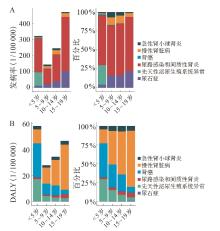
Figure 1
The age distribution characteristics of the incidence of six urinary system diseases (Chart A) and the DALY rate (Chart B) among children and adolescents under 20 years old in China in 2023"
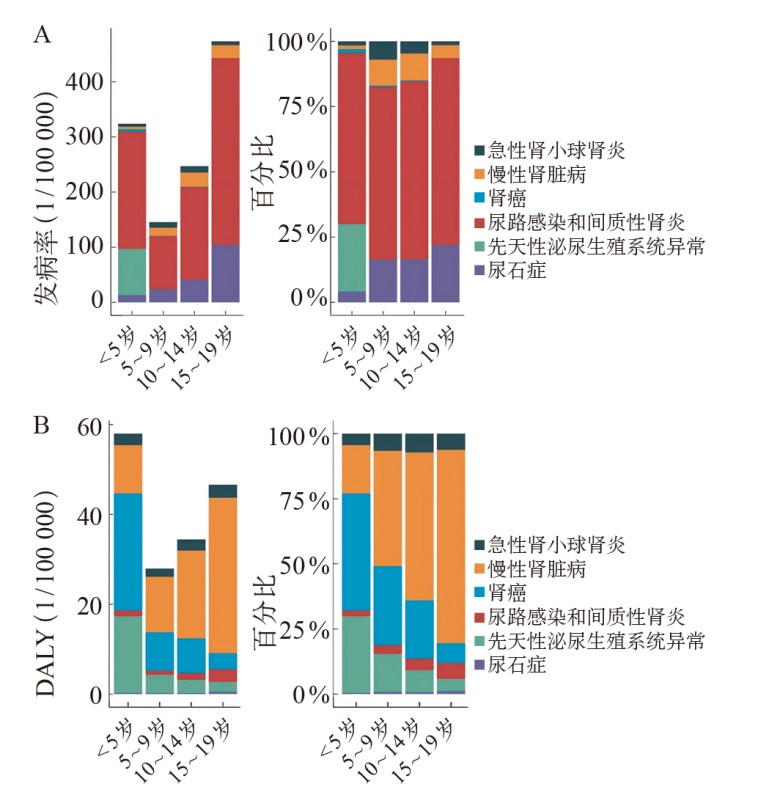
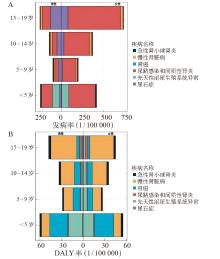
Figure 2
Characteristics of the gender distribution of incidence rates (Chart A) and DALY rates (Chart B) for six urinary system diseases among children and adolescents under 20 years old in China in 2023"
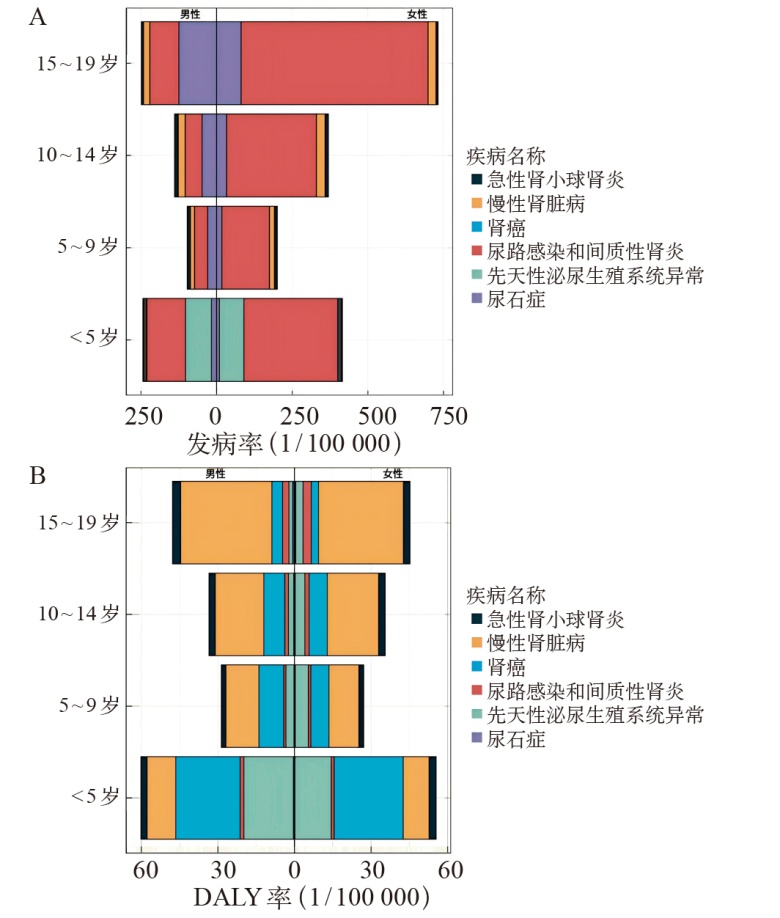
Figure 3
Trends in the incidence of six urinary system diseases (Chart A) and DALY rates (Chart B) among children and adolescents under 20 years old in China from 1990 to 2023"
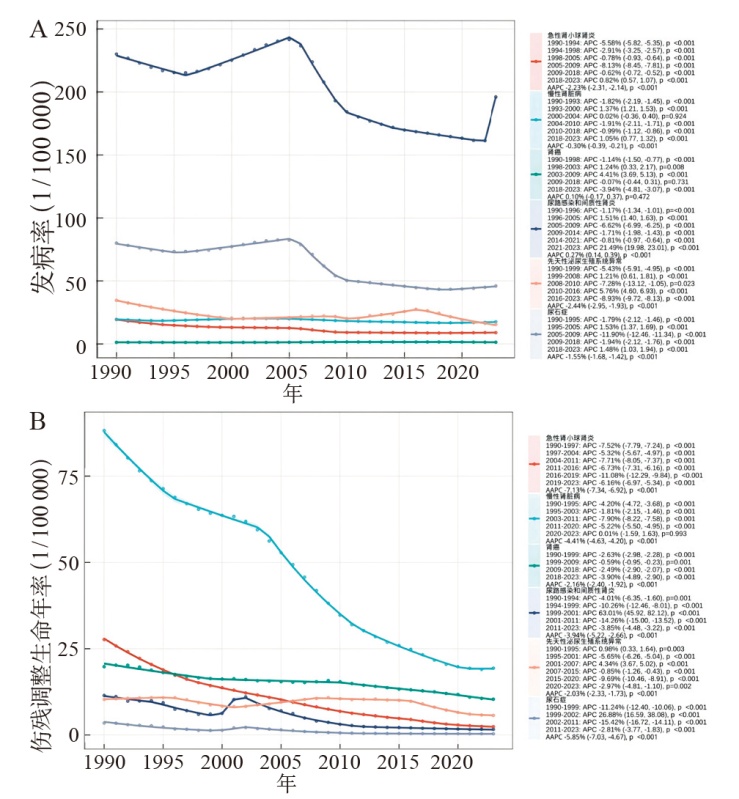
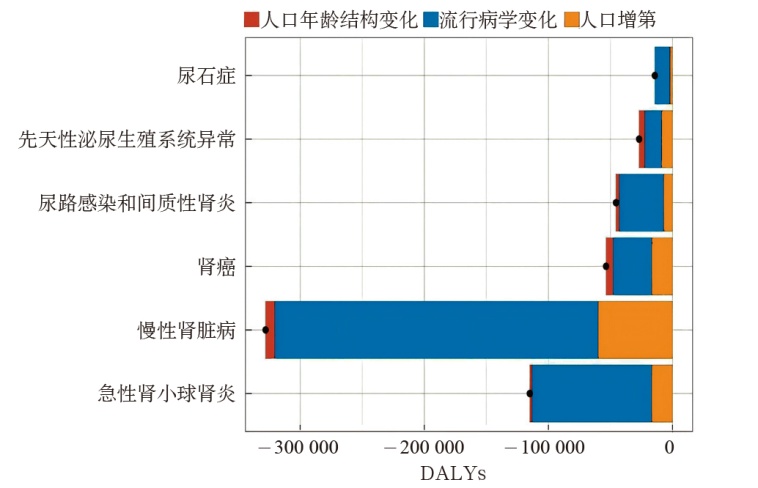
Figure 4
Decomposition analysis of DALYs for six urinary system diseases among children and adolescents under 20 years old in China"
| [1] |
Harambat J, Madden I. What is the true burden of chronic kidney disease in children worldwide?[J]. Pediatr Nephrol, 2023, 38(5): 1389-1393.
doi: 10.1007/s00467-022-05816-7 |
| [2] |
Raina R, Soundararajan A, Menassa N, et al. Patterns in the economic burden of acute kidney injury in hospitalized children, 2019-2021[J]. JAMA Netw Open, 2023, 6(6): e2317032.
doi: 10.1001/jamanetworkopen.2023.17032 |
| [3] |
Amanullah F, Malik AA, Zaidi Z. Chronic kidney disease causes and outcomes in children: perspective from a LMIC setting[J]. PLoS One, 2022, 17(6): e0269632.
doi: 10.1371/journal.pone.0269632 |
| [4] |
Shi L, Tang W, Zhang H, et al. The relationship between socioeconomic status, medical accessibility, hope and psychological resilience of caregivers of children with chronic kidney disease in China: structural equation model[J]. BMC Psychol, 2024, 12(1): 457.
doi: 10.1186/s40359-024-01901-8 pmid: 39198911 |
| [5] |
McCulloch M, Luyckx VA, Cullis B, et al. Challenges of access to kidney care for children in low-resource settings[J]. Nat Rev Nephrol, 2021, 17(1): 33-45.
doi: 10.1038/s41581-020-00338-7 |
| [6] |
Hao ZH, Jiang YP, Xu H, et al. Epidemiology and disease burden of pediatric congenital anomalies of the kidney and urinary tract: a national cross-sectional study of hospitalized children in China[J]. World J Pediatr, 2025, 21(3): 306-321.
doi: 10.1007/s12519-025-00891-w |
| [7] | 中华医学会儿科学分会肾脏病学组. 91所医院1990-2002年小儿慢性肾衰竭1268例调查报告[J]. 中华儿科杂志, 2004, 42(10): 724-730. |
| The Chinese Society of Pediatric Nephrology. Analysis of 1268 patients with chronic renal failure in childhood: a report from 91 hospitals in China from 1990 to 2002[J]. Zhonghua Erke Zazhi, 2004, 42(10): 724-730. | |
| [8] |
Wang Z, Fan Z, Xu D, et al. Factors contributing to the recurrence of urinary tract infections and revisit amongst children in the emergency department: a single-centre retrospective study[J]. Arch Esp Urol, 2024, 77(6): 666-673.
doi: 10.56434/j.arch.esp.urol.20247706.91 |
| [9] |
GBD 2023 Disease and Injury and Risk Factor Collabo-rators. Burden of 375 diseases and injuries, risk-attributable burden of 88 risk factors, and healthy life expectancy in 204 countries and territories, including 660 subnational locations, 1990-2023: a systematic analysis for the Global Burden of Disease Study 2023[J]. Lancet, 2025, 406(10513): 1873-1922.
doi: 10.1016/S0140-6736(25)01637-X pmid: 41092926 |
| [10] |
GBD 2023 Causes of Death Collaborators. Global burden of 292 causes of death in 204 countries and territories and 660 subnational locations, 1990-2023: a systematic analysis for the Global Burden of Disease Study 2023[J]. Lancet, 2025, 406(10513): 1811-1872.
doi: 10.1016/S0140-6736(25)01917-8 pmid: 41092928 |
| [11] |
Liu T, Mei H, Gu X, et al. Global burden, inequalities, frontier dynamics, and risk factors of sudden infant death syndrome, 1990-2021: a systematic analysis from the global burden of disease study 2021[J]. Transl Pediatr, 2025, 14(10): 2504-2519.
doi: 10.21037/tp |
| [12] |
Kang L, Liu J, Liu Y, et al. Global, regional, and national disease burden of autism spectrum disorder among children under 5 years from 1990 to 2019: an analysis for the global burden of disease 2019 study[J]. Asian J Psychiatr, 2023, 79: 103359.
doi: 10.1016/j.ajp.2022.103359 |
| [13] |
Clegg LX, Hankey BF, Tiwari R, et al. Estimating average annual per cent change in trend analysis[J]. Stat Med, 2009, 28(29): 3670-3682.
doi: 10.1002/sim.3733 pmid: 19856324 |
| [14] |
Zhang J, Pan L, Guo Q, et al. The impact of global, regional, and national population ageing on disability-adjusted life years and deaths associated with diabetes during 1990-2019: a global decomposition analysis[J]. Diabetes Metab Syndr, 2023, 17(6): 102791.
doi: 10.1016/j.dsx.2023.102791 |
| [15] |
Liu T, Chen Z, Ge J, et al. The evolving burden of childhood meningitis in low- and middle-income countries, 1990-2021: a decomposition and frontier analysis[J]. Eur J Pediatr, 2025, 184(11): 679.
doi: 10.1007/s00431-025-06516-8 |
| [16] |
Yip W, Fu H, Chen AT, et al. 10 years of health-care reform in China: progress and gaps in Universal Health Coverage[J]. Lancet, 2019, 394(10204): 1192-1204.
doi: S0140-6736(19)32136-1 pmid: 31571602 |
| [17] | Zhang Y, Chen L, van Velthoven MH, et al. mHealth Series: Measuring maternal newborn and child health coverage by text messaging - a county-level model for China[J]. J Glob Health, 2013, 3(2): 020402. |
| [18] | 叶章群, 周辉. 泌尿系统解释基础研究及临床新进展[J]. 中华泌尿外科杂志, 2017, 38(9): 644-649. |
| Ye ZQ, Zhou H. Advances in basic research and clinical management of urolithiasis[J]. Zhonghua Miniao Waike Zazhi, 2017, 38(9): 644-649. | |
| [19] |
Gong Y, Zhang Y, Shen Q, et al. Early detection of congenital anomalies of the kidney and urinary tract: cross-sectional results of a community-based screening and referral study in China[J]. BMJ Open, 2018, 8(5): e020634.
doi: 10.1136/bmjopen-2017-020634 |
| [20] | 卫生部, 国家中医药管理局, 总后卫生部. 抗菌药物临床应用指导原则(续七)[J]. 抗感染药学, 2007: 49-50. |
| Ministry of Health, State Administration of Traditional Chinese Medicine, Health Department of the General Logistics Department. Guiding Principles for Clinical Use of Antimicrobial Agents (Continued 7)[J]. Kangganran Yaoxue, 2007: 49-50. | |
| [21] |
Lazzerini M, Barbi E, Apicella A, et al. Delayed access or provision of care in Italy resulting from fear of COVID-19[J]. Lancet Child Adolesc Health, 2020, 4(5): e10-e11.
doi: 10.1016/S2352-4642(20)30108-5 pmid: 32278365 |
| [22] | 中国抗癌协会小儿肿瘤专业委员会. 儿童肾母细胞瘤诊断治疗建议(CCCG—WT-2016)[J]. 中华儿科杂志, 2017, 55(2): 90-94. |
| Chinese Children Cancer Group, Chinese Anti-Cancer Association. Recommendations for the diagnosis and treatment of pediatric Wilms' tumor (CCCG-WT-2016) [J]. Zhonghua Erke Zazhi, 2017, 55(2): 90-94. | |
| [23] |
Li L, Li Y, Chen Y, et al. Global, regional, and national lifetime probabilities of urinary tract infections and interstitial nephritis from 1990 to 2021[J]. J Health Popul Nutr, 2025, 44(1): 231.
doi: 10.1186/s41043-025-00950-y pmid: 40611189 |
| [24] |
Mattoo TK, Shaikh N, Nelson CP. Contemporary management of urinary tract infection in children[J]. Pediatrics, 2021, 150(4): e2022059259.
doi: 10.1542/peds.2022-059259 |
| [25] |
VanSickle JS, Warady BA. Chronic kidney disease in children[J]. Pediatr Clin North Am, 2022, 69(6): 1239-1254.
doi: 10.1016/j.pcl.2022.07.010 |
| [26] |
Nair N, Prashant Kadatane S, Yaacoub RM, et al. Challenges and unique considerations of adolescents with chronic kidney disease[J]. Acta Paediatr, 2023, 112(6): 1165-1176.
doi: 10.1111/apa.v112.6 |
| [27] |
Yang H, Wang Q, Luo J, et al. Ultrasound of urinary system and urinary screening in 14 256 asymptomatic children in China[J]. Nephrology (Carlton), 2010, 15(3): 362-367.
doi: 10.1111/(ISSN)1440-1797 |
| [28] | 中华医学会儿科学分会肾脏学组, 中华儿科杂志编辑委员会. 中国儿童慢性肾脏病早期筛查临床实践指南(2021版)[J]. 中华儿科杂志, 2022, 60(9): 858-868. |
| The Subspecialty Group of Nephrology, the Society of Pediatrics, Chinese Medical Association the Editorial Board. Clinical practice guideline for early screening of pediatric chronic kidney disease in China(version 2021)[J]. Zhonghua Erke Zazhi, 2022, 60(9): 858-868. | |
| [29] |
Qi J, Li M, Wang L, et al. National and subnational trends in cancer burden in China, 2005-2020: an analysis of national mortality surveillance data[J]. Lancet Public Health, 2023, 8(12): e943-e955.
doi: 10.1016/S2468-2667(23)00211-6 |
| [30] |
Aldrink JH, Heaton TE, Dasgupta R, et al. Update on Wilms tumor[J]. J Pediatr Surg, 2019, 54(3): 390-397.
doi: S0022-3468(18)30575-X pmid: 30270120 |
| [31] |
Tan X, Wang J, Tang J, et al. A nomogram for predicting cancer-specific survival in children with wilms tumor: a study based on seer database and external validation in China[J]. Front Public Health, 2022, 10: 829840.
doi: 10.3389/fpubh.2022.829840 |
| [32] |
Van Der Jeugt J, Jamaer C, Berquin C, et al. Robot-assisted radical nephrectomy for Wilms' tumor in children[J]. J Pediatr Urol, 2023, 19(4): 489-490.
doi: 10.1016/j.jpurol.2023.04.016 pmid: 37130763 |
| [33] | Castro SA, Dorfmueller HC. A brief review on Group A Streptococcus pathogenesis and vaccine development[J]. R Soc Open Sci, 2021, 8(3): 201991. |
| [34] |
He G, Liu Y, Bagga A, et al. Trends and socioeconomic inequality of the burden of congenital abnormalities of the kidney and urinary tract among children and adolescents[J]. Nephrol Dial Transplant, 2025, 40(3): 484-494.
doi: 10.1093/ndt/gfae115 |
| [35] | 黑明燕, 易著文. 环境与先天泌尿系统畸形的若干问题[J]. 中国当代儿科杂志, 2014, 16(4): 339-344. |
| Hei MY, Yi ZW. Environment and congenital urinary malformations[J]. Zhongguo Dangdai Erke Zazhi, 2014, 16(4): 339-344. | |
| [36] |
Groen In 't Woud S, Renkema KY, Schreuder MF, et al. Maternal risk factors involved in specific congenital anomalies of the kidney and urinary tract: A case-control study[J]. Birth Defects Res A Clin Mol Teratol, 2016, 106(7): 596-603.
doi: 10.1002/bdra.v106.7 |
| [37] |
Zhang ZG, Lin QC, Zhou QY, et al. Trend analysis of pediatric urolithiasis prevalence from 1990 to 2021 in the BRICS[J]. Front Pediatr, 2025, 13: 1551046.
doi: 10.3389/fped.2025.1551046 |
| [1] | LI Yun, GAO Hongbo, DI Yuqing, LI Longmin, LIU Haichun, ZHANG Xiaoyong, SHAO Yujun. Clinical characteristics and prognosis of metastatic pheochromocytoma and paraganglioma in children and adolescents [J]. Journal of Clinical Pediatrics, 2026, 44(2): 118-123. |
| [2] | CHANG Guoying, YANG Fan, YIN Lei, YUAN Jiajun, WANG Xiumin. From "Passive Continuation" to "Active Transition": Clinical practice and reflection on continuation therapy for pediatric and adolescent rare diseases [J]. Journal of Clinical Pediatrics, 2025, 43(10): 723-726. |
| [3] | LI Xingchuan,WANG Haidong,ZHANG Ni,WANG Yuping,ZHOU Yongning . Systematic review and meta-analysis of epidemiological investigation of Helicobacter pylori infection in children and adolescents in China [J]. , 2017, 35(10): 782-. |
|
||
