

Journal of Clinical Pediatrics ›› 2026, Vol. 44 ›› Issue (2): 118-123.doi: 10.12372/jcp.2026.25e0049
• Original Article • Previous Articles Next Articles
LI Yun, GAO Hongbo, DI Yuqing( ), LI Longmin, LIU Haichun, ZHANG Xiaoyong, SHAO Yujun
Received:2025-01-16
Accepted:2025-07-10
Published:2026-02-15
Online:2026-02-02
CLC Number:
LI Yun, GAO Hongbo, DI Yuqing, LI Longmin, LIU Haichun, ZHANG Xiaoyong, SHAO Yujun. Clinical characteristics and prognosis of metastatic pheochromocytoma and paraganglioma in children and adolescents[J].Journal of Clinical Pediatrics, 2026, 44(2): 118-123.

Table 1
General clinical features of recurrence and metastasis in children"
| 项目 | 结果 |
|---|---|
| 新发症状[n(%)] | 16(47.1) |
| 复发转移部位[n(%)] | |
| 肾上腺 腹膜后 骨骼 肝脏 肺 淋巴结 腹腔 盆腔 | 18(43.9) 24(58.5) 17(41.5) 8(19.5) 11(26.8) 28(68.3) 12(29.3) 5(12.2) |
| 转移部位数量≥2个[n(%)] | 33(80.5) |
| PFS[M(P25~P75)]/个月 | 48(17.5~101.0) |
| 3年PFS[n(%)] | 26(63.4) |
| 5年PFS[n(%)] | 16(39.0) |
| 10年PFS[n(%)] | 7(17.1) |
Table 2
Symptomatology, physical signs and catecholamine differences at initial diagnosis and recurrence or metastasis"
| 项目 | 初诊[n(%)] | 复发转移[n(%)] | P |
|---|---|---|---|
| 无症状 | 1(2.9) | 3(8.8) | 0.500 |
| 症状 | |||
| 头痛 多汗 心悸 三联症 恶心/呕吐 乏力 视物模糊 胸、腹、骨盆疼痛 | 24(70.6) 21(61.8) 15(44.1) 14(41.2) 17(50.0) 8(23.5) 4(11.8) 9(26.5) | 14(41.2) 14(41.2) 11(32.4) 5(14.7) 4(11.8) 2(5.9) 4(11.8) 8(23.5) | 0.013 0.092 0.344 0.004 0.001 0.031 1.000 1.000 |
| 血糖异常 | 0 | 1(2.9) | - |
| 高血压类型 | |||
| 阵发性 持续性 | 13(59.1) 9(40.9) | 5(22.7) 17(77.3) | 0.008 |
| 尿儿茶酚胺 | |||
| E≥6.42 μg NE≥40.65 μg DA≥300.59 μg | 16(57.1) 24(85.7) 13(46.4) | 15(53.6) 25(89.3) 13(46.4) | 1.000 1.000 1.000 |
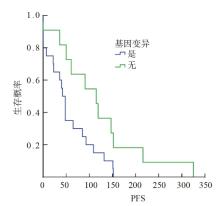
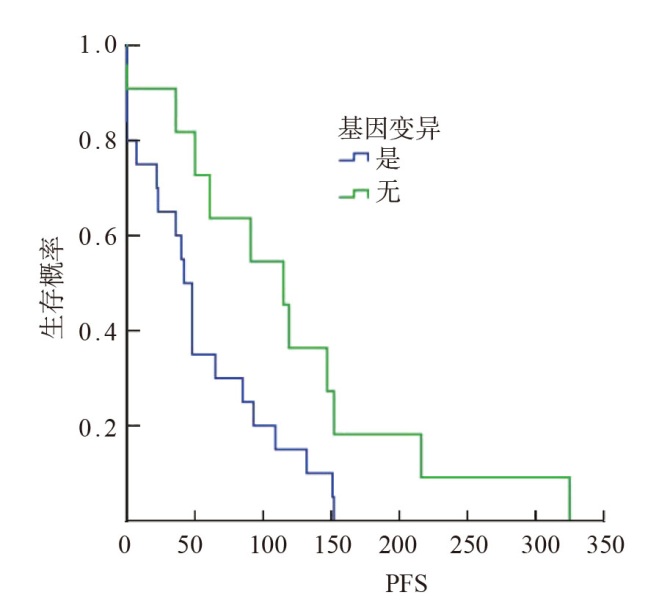
Figure 1
Progression-free survival curve of the group with or without gene mutation"
| [1] |
Mete O, Asa SL, Gill AJ, et al. Overview of the 2022 WHO classification of paragangliomas and pheochromocytomas[J]. Endocr Pathol, 2022, 33(1): 90-114.
doi: 10.1007/s12022-022-09704-6 pmid: 35285002 |
| [2] |
Berends AMA, Lenders JWM, Kerstens MN. Update on clinical characteristics in the evaluation of phaeochromocytoma and paraganglioma[J]. Best Pract Res Clin Endocrinol Metab, 2024, 38(6): 101953.
doi: 10.1016/j.beem.2024.101953 |
| [3] | Ardicli B, User IR, Ciftci AÖ, et al. Approach to pheochromocytoma and paraganglioma in children and adolescents: a retrospective clinical study from a tertiary care center[J]. JJ Pediatr Urol, 2021, 17(3): 400.e1-400.e7. |
| [4] |
Park H, Kim MS, Lee J, et al. Clinical presentation and treatment outcomes of children and adolescents with pheochromocytoma and paraganglioma in a single center in Korea[J]. Front Endocrinol (Lausanne), 2020, 11: 610746.
doi: 10.3389/fendo.2020.610746 |
| [5] |
Casey RT, Hendriks E, Deal C, et al. International consensus statement on the diagnosis and management of phaeochromocytoma and paraganglioma in children and adolescents[J]. Nat Rev Endocrinol, 2024, 20(12): 729-748.
doi: 10.1038/s41574-024-01024-5 pmid: 39147856 |
| [6] |
Kuo MJM, Nazari MA, Jha A, et al. Pediatric metastatic pheochromocytoma and paraganglioma: clinical presentation and diagnosis, genetics, and therapeutic approaches[J]. Front Endocrinol (Lausanne), 2022, 13: 936178.
doi: 10.3389/fendo.2022.936178 |
| [7] |
Shah MH, Goldner WS, Benson AB, et al. Neuroendocrine and adrenal tumors, version 2.2021, NCCN clinical practice guidelines in oncology[J]. J Natl Compr Canc Netw, 2021, 19(7): 839-868.
doi: 10.6004/jnccn.2021.0032 |
| [8] |
Peard L, Cost NG, Saltzman AF. Pediatric pheo-chromocytoma: current status of diagnostic imaging and treatment procedures[J]. Curr Opin Urol, 2019, 29(5): 493-499.
doi: 10.1097/MOU.0000000000000650 |
| [9] | Pamporaki C, Casey RT. Current views on paediatric phaeochromocytoma and paraganglioma with a focus on newest guidelines[J]. Best Pract Res Clin Endocrinol Metab, 2024: 101957. |
| [10] |
Stachowicz-Stencel T, Pasikowska N, Synakiewicz A. Pheochromocytoma and paraganglioma in children and adolescents[J]. Acta Biochim Pol, 2023, 70(3): 487-493.
doi: 10.18388/abp.2020_6955 pmid: 37717273 |
| [11] | 中华医学会内分泌学分会. 嗜铬细胞瘤和副神经节瘤诊断治疗专家共识(2020版)[J]. 中华内分泌代谢杂志, 2020, 36(9): 737-750. |
| Endocrinology CSO. Expert consensus on the diagnosis and treatment of pheochromocytoma and paraganglioma (2020)[J]. Zhonghua Neifenmidaixie Zazhi, 2020, 36(9): 737-750. | |
| [12] | 王伟. 2022儿童和青少年高血压专家共识[J]. 中国合理用药探索, 2022, 19(12): 10-22. |
| Wang W. Hypertension in children and adolescents[J]. Zhongguo Heliyongyao Tansuo, 2022, 19(12): 10-22. | |
| [13] |
Richards S, Aziz N, Bale S, et al. Standards and guidelines for the interpretation of sequence variants: a joint consensus recommendation of the American College of Medical Genetics and Genomics and the Association for molecular pathology[J]. Genet Med, 2015, 17(5): 405-424.
doi: 10.1038/gim.2015.30 pmid: 25741868 |
| [14] |
Nazari MA, Jha A, Kuo MJM, et al. Paediatric phaeochromocytoma and paraganglioma: a clinical update[J]. Clin Endocrinol (Oxf), 2024, 101(5): 446-454.
doi: 10.1111/cen.v101.5 |
| [15] | Choat H, Derrevere K, Knight L, et al. SDHB-associated paraganglioma in a pediatric patient and literature review on hereditary pheochromocytoma-paraganglioma syndromes[J]. Case Rep Endocrinol, 2014, 2014: 502734. |
| [16] |
Jochmanova I, Abcede AMT, Guerrero RJS, et al. Clinical characteristics and outcomes of SDHB-related pheochromocytoma and paraganglioma in children and adolescents[J]. J Cancer Res Clin Oncol, 2020, 146(4): 1051-1063.
doi: 10.1007/s00432-020-03138-5 pmid: 32062700 |
| [17] |
Virgone C, Andreetta M, Avanzini S, et al. Pheo-chromocytomas and paragangliomas in children: data from the Italian Cooperative Study (TREP)[J]. Pediatr Blood Cancer, 2020, 67(8): e28332.
doi: 10.1002/pbc.v67.8 |
| [18] |
Geroula A, Deutschbein T, Langton K, et al. Pheo-chromocytoma and paraganglioma: clinical feature-based disease probability in relation to catecholamine biochemistry and reason for disease suspicion[J]. Eur J Endocrinol, 2019, 181(4): 409-420.
doi: 10.1530/EJE-19-0159 |
| [19] |
Batsis M, Dagalakis U, Stratakis CA, et al. Attention deficit hyperactivity disorder in pediatric patients with pheochromocytoma and paraganglioma[J]. Horm Metab Res, 2016, 48(8): 509-513.
doi: 10.1055/s-0042-106725 pmid: 27171833 |
| [20] | Horton C, LaDuca H, Deckman A, et al. Universal germline panel testing for individuals with pheochromocytoma and paraganglioma produces high diagnostic yield[J]. J Clin Endocrinol Metab, 2022, 107(5): e1917-e1923. |
| [21] |
Seabrook A, Vasudevan A, Neville K, et al. Genotype-phenotype correlations in paediatric and adolescent phaeochromocytoma and paraganglioma: a cross-sectional study[J]. Arch Dis Child, 2024, 109(3): 201-208.
doi: 10.1136/archdischild-2023-325419 pmid: 38071512 |
| [22] |
Wong MY, Andrews KA, Challis BG, et al. Clinical practice guidance: surveillance for phaeochromocytoma and paraganglioma in paediatric succinate dehydrogenase gene mutation carriers[J]. Clin Endocrinol (Oxf), 2019, 90(4): 499-505.
doi: 10.1111/cen.2019.90.issue-4 |
| [23] |
Lenders JWM, Kerstens MN, Amar L, et al. Genetics, diagnosis, management and future directions of research of phaeochromocytoma and paraganglioma: a position statement and consensus of the Working Group on Endocrine Hypertension of the European Society of Hypertension[J]. J Hypertens, 2020, 38(8): 1443-1456.
doi: 10.1097/HJH.0000000000002438 pmid: 32412940 |
| [24] |
Giacché M, Tacchetti MC, Agabiti-Rosei C, et al. Pheochromocytoma-paraganglioma syndrome: a multiform disease with different genotype and phenotype features[J]. Biomedicines, 2024, 12(10):2385.
doi: 10.3390/biomedicines12102385 |
| [25] | Plouin PF, Amar L, Dekkers OM, et al. European society of endocrinology clinical practice guideline for long-term follow-up of patients operated on for a phaeochromocytoma or a paraganglioma[J]. Eur J Endocrinol, 2016, 174(5): G1-G10. |
| [26] |
Nölting S, Bechmann N, Taieb D, et al. Personalized management of pheochromocytoma and paraganglioma[J]. Endocr Rev, 2022, 43(2): 199-239.
doi: 10.1210/endrev/bnab019 |
| [27] |
Jha A, Taïeb D, Carrasquillo JA, et al. High-specific-activity--(131)I-MIBG versus (177)Lu-DOTATATE targeted radionuclide therapy for metastatic pheochromocytoma and paraganglioma[J]. Clin Cancer Res, 2021, 27(11): 2989-2995.
doi: 10.1158/1078-0432.CCR-20-3703 |
| [28] |
Carrasquillo JA, Chen CC, Jha A, et al. Systemic radiopharmaceutical therapy of pheochromocytoma and paraganglioma[J]. J Nucl Med, 2021, 62(9): 1192-1199.
doi: 10.2967/jnumed.120.259697 |
| [29] |
Urquhart C, Fleming B, Harper I, et al. The use of temozolomide in paediatric metastatic phaeo-chromocytoma/paraganglioma: a case report and literature review[J]. Front Endocrinol (Lausanne), 2022, 13: 1066208.
doi: 10.3389/fendo.2022.1066208 |
| [30] |
Li M, Prodanov T, Meuter L, et al. Recurrent Disease in Patients With Sporadic Pheochromocytoma and Paraganglioma[J]. J Clin Endocrinol Metab, 2023, 108(2): 397-404.
doi: 10.1210/clinem/dgac563 |
| [1] | HE Ying, LIU Zhiyong, YANG Hansong, CAI Yali, XU Jinglin, CHEN Dongmei. Clinical analysis of 153 neonatal enterovirus infections and antibiotic management improvement study [J]. Journal of Clinical Pediatrics, 2025, 43(2): 128-134. |
| [2] | CHANG Guoying, YANG Fan, YIN Lei, YUAN Jiajun, WANG Xiumin. From "Passive Continuation" to "Active Transition": Clinical practice and reflection on continuation therapy for pediatric and adolescent rare diseases [J]. Journal of Clinical Pediatrics, 2025, 43(10): 723-726. |
| [3] | JIANG Wenxuan, YE Fanghua, XIAO Yixin, YANG Liangchun. Analysis of clinical characteristics and prognostic factors of 45 children with hemophagocytic syndrome [J]. Journal of Clinical Pediatrics, 2025, 43(10): 762-767. |
| [4] | ZHAO Min, TANG Jihong, XIAO Xiao, YANG Letian, XU Huan, WU Yinyin, FENG Juan. Acute lymphoblastic leukemia with chemotherapy-related cerebral lesion: clinical and imaging features [J]. Journal of Clinical Pediatrics, 2025, 43(1): 14-20. |
| [5] | WANG Yuejia, XIA Lei, CHENG Huiqing, LYU Rongji, FAN Kun, XU Falin. Clinical characteristics of extremely premature infants conceived by assisted reproductive technology [J]. Journal of Clinical Pediatrics, 2024, 42(7): 600-605. |
| [6] | ZHONG Xiaomei, REN Hong, ZHANG Jian, LI Biru, QIAN Juan, NING Botao, GAO Yijin, WANG Ying. Comparison of clinical features between hemophagocytic lymphohistiocytosis and sepsis [J]. Journal of Clinical Pediatrics, 2024, 42(6): 547-552. |
| [7] | CHEN Shicai, DUAN Lifen, SUN Ying, SHAO Juwei, LI Qiong, LUO Mingying, REN Junjun, ZHANG Yunqian. Correlation between cognitive function and electroclinical characteristics of benign childhood epilepsy with centrotemporal spikes [J]. Journal of Clinical Pediatrics, 2024, 42(3): 211-217. |
| [8] | HUANG Shihao, YUAN Xiaojun. Analysis on clinical characteristics and treatment for Kasabach-Merritt phenomenon in 36 children with hemangioma [J]. Journal of Clinical Pediatrics, 2024, 42(11): 917-921. |
| [9] | HOU Ruolin, WU Jing, LI Ling. Pediatric autoimmune encephalitis with brain MRI showing meningeal thickening and enhancement [J]. Journal of Clinical Pediatrics, 2023, 41(9): 674-679. |
| [10] | WU Xiaoling, LYU Tiewei. Clinical analysis of idiopathic left ventricular tachycardia in children [J]. Journal of Clinical Pediatrics, 2023, 41(8): 599-603. |
| [11] | HUA Minmin, XIA Lei, HUO Wanying, ZHANG Yanhua, XU Falin. Analysis of clinical and prognostic factors of neonatal congenital chylothorax [J]. Journal of Clinical Pediatrics, 2023, 41(1): 25-29. |
| [12] | MIAO Min, WANG Caiying, PANG Lin. Analysis of clinical characteristics of measles in 757 children [J]. Journal of Clinical Pediatrics, 2022, 40(8): 591-596. |
| [13] | XU Min, ZHOU Wenjie, TANG Jihong, SHI Xiaoyan, ZHANG Bingbing, XIAO Xiao. Clinical analysis of 51 cases of acute lymphoblastic leukemia with seizures in children [J]. Journal of Clinical Pediatrics, 2022, 40(2): 118-122. |
| [14] | TAN Xiaohua, LI Caifeng, ZHAO Wenjia, KUANG Weiying, DENG Jianghong, ZHANG Junmei. Clinical characteristics and related factors of pulmonary involvements in patients with systemic juvenile idiopathic arthritis [J]. Journal of Clinical Pediatrics, 2022, 40(11): 864-868. |
| [15] | QIU Ling, CAO Jie. Analysis of clinical characteristics of childhood Miller-Fisher syndrome [J]. Journal of Clinical Pediatrics, 2021, 39(8): 565-. |
|
||
