

Journal of Clinical Pediatrics ›› 2026, Vol. 44 ›› Issue (4): 283-290.doi: 10.12372/jcp.2026.25e0910
• Original Article • Previous Articles Next Articles
HUANG Tao, CAO Ke, FU Xiaoying, CHEN Yunsheng, LUO Xiaojuan( )
)
Received:2025-07-28
Accepted:2026-02-12
Published:2026-04-15
Online:2026-03-31
CLC Number:
HUANG Tao, CAO Ke, FU Xiaoying, CHEN Yunsheng, LUO Xiaojuan. Clinical features and severe pneumonia risk factors in 708 pediatric pertussis inpatients[J].Journal of Clinical Pediatrics, 2026, 44(4): 283-290.
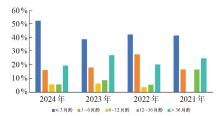
Figure 1
Age composition of hospitalized children with pertussis, 2021-2024"

Table 1
Detection of other pathogens in 3 groups"
| 混合感染病原 | 百日咳未合 并肺炎组 (n=306) | 百日咳合并 普通肺炎组 (n=316) | 百日咳合并 重症肺炎组 (n=86) |
|---|---|---|---|
| 病毒感染 | |||
| 鼻病毒 | 90 | 128 | 29 |
| 呼吸道合胞病毒 | 22 | 27 | 15 |
| 副流感病毒 | 21 | 22 | 7 |
| 腺病毒 | 21 | 21 | 5 |
| 偏肺病毒 | 9 | 21 | 1 |
| 甲型流感病毒 | 8 | 11 | 0 |
| 冠状病毒 | 12 | 9 | 2 |
| 乙流病毒 | 5 | 6 | 2 |
| 博卡病毒 | 2 | 3 | 1 |
| 肺炎衣原体 | 0 | 1 | 0 |
| 肺炎支原体 | 11 | 25 | 7 |
| 细菌感染 | |||
| 流感嗜血杆菌 | 7 | 10 | 7 |
| 肺炎链球菌 | 3 | 4 | 4 |
| 肺炎克雷伯菌 | 0 | 2 | 1 |
| 金黄色葡萄球菌 | 0 | 0 | 1 |
| 大肠埃希菌 | 1 | 0 | 2 |
| 鲍曼不动杆菌 | 0 | 0 | 1 |
| 铜绿假单胞菌 | 0 | 0 | 1 |
| 耶氏肺孢子菌 | 0 | 0 | 2 |
Table 2
Comparison of clinical characteristics and laboratory indicators among 3 groups"
| 变 量 | 百日咳未合并肺炎组 (n=306) | 百日咳合并普通肺炎组 (n=316) | 百日咳合并重症肺炎组 (n=86) | 统计量 | P |
|---|---|---|---|---|---|
| 男[n(%)] | 168(54.90) | 184(58.23) | 48(55.81) | 0.72 | 0.698 |
| 月龄[M(P25~P75)]/月 | 4.00(2.50~14.25)a | 4(2.70~14.00)a | 3(1.76~9.75)b | 9.65 | 0.008 |
| 月龄≤3月[n(%)] | 144(47.06)a,b | 133(42.09)b | 51(59.30)a | 8.17 | 0.017 |
| 入院前病程[M(P25~P75)]/天 | 14(10~20)a | 15(10~20)a | 13(8~20)b | 1.20 | 0.549 |
| 接触史[n(%)] | 158(51.63) | 165(52.21) | 52(60.47) | 2.55 | 0.280 |
| 多孩家庭[n(%)] | 161(52.61) | 149(47.15) | 44(51.16) | 5.42 | 0.066 |
| 早产[n(%)] | 16(5.23) | 21(6.65) | 9(11.63) | 4.66 | 0.097 |
| 未接种DTP[n(%)] | 147(48.04)a | 145(45.89)a | 57(66.28)b | 11.59 | 0.003 |
| 基础病史[n(%)] | 27(8.82)a | 32(10.12)a | 32(37.21)b | 52.08 | <0.001 |
| 发热[n(%)] | 94(30.71%)a | 117(37.03%)a | 64(74.42%)b | 54.76 | <0.001 |
| WBC[M(P25~P75)]/109·L-1 | 15.16(10.48~21.81)a | 15.04(10.55~22.66)a | 23.10(17.07~33.87)b | 25.83 | <0.001 |
| WBC>30×109/L[n(%)] | 22(7.19)a | 32(10.13)a | 28(32.56)b | 41.96 | <0.001 |
| LYM[M(P25~P75)]/% | 66.67(51.42~73.87)a | 65.71(50.30~72.97)a | 57.13(45.84~67.49)b | 10.39 | 0.006 |
| BP-Ct [M(P25~P75)] | 27.53(23.94~31.56)a | 26.94(24.00~1.00)a | 24.29(21.51~28.35)b | 14.11 | 0.001 |
Table 3
Multinomial logistic regression analysis of influencing factors for pertussis complicated by varying severities of pneumonia"
| 比较组别与变量 | B | SE | χ2值 | P | OR(95%CI) |
|---|---|---|---|---|---|
| 普通肺炎组与未合并肺炎组 | |||||
| LYM% | 0.291 | 0.289 | 1.012 | 0.314 | 1.338(0.759~2.359) |
| 月龄≤3月 | 0.023 | 0.243 | 0.009 | 0.924 | 1.023(0.636~1.648) |
| 发热 | 0.339 | 0.2 | 2.865 | 0.091 | 1.404(0.948~2.08) |
| 基础疾病 | 0.154 | 0.303 | 0.257 | 0.612 | 1.166(0.644~2.111) |
| WBC>30×109/L | 0.435 | 0.316 | 1.897 | 0.168 | 1.545(0.832~2.868) |
| 未接种DTP疫苗 | -0.154 | 0.244 | 0.396 | 0.529 | 0.858(0.531~1.384) |
| BP-Ct低 | -0.472 | 0.444 | 1.131 | 0.287 | 0.624(0.261~1.489) |
| 重症肺炎组与未合并肺炎组 | |||||
| LYM% | 0.327 | 0.363 | 0.812 | 0.367 | 1.386(0.681~2.822) |
| 月龄≤3月 | 0.431 | 0.425 | 1.027 | 0.311 | 1.538(0.669~3.539) |
| 发热 | 2.361 | 0.36 | 43.017 | <0.001 | 10.601(5.235~21.466) |
| 基础疾病 | 1.718 | 0.379 | 20.528 | <0.001 | 5.576(2.651~11.726) |
| WBC>30×109/L | 1.215 | 0.406 | 8.948 | 0.003 | 3.371(1.52~7.474) |
| 未接种DTP疫苗 | 0.458 | 0.451 | 1.035 | 0.309 | 1.582(0.654~3.826) |
| BP-Ct低 | 1.644 | 0.508 | 10.465 | 0.001 | 5.174(1.911~14.005) |
| [1] | 姚开虎, 汪丙松, 孟庆红. 疫苗时代百日咳的临床特征[J]. 中华医学杂志, 2022, 102(30): 2384-2388. |
| Yao KH, Wang BS, Meng QH. Clinical characteristics of pertussis in the vaccine era[J]. Zhonghua Yixue Zazhi, 2022, 102(30): 2384-2388. | |
| [2] | Brandal LT, Vestreim DF, Bruvik T, et al. Evolution of Bordetella pertussis in the acellular vaccine era in Norway, 1996 to 2019[J]. Eur J Clin Microbiol Infect Dis, 2022, 41(6): 913-924. |
| [3] | Noel G, Borand L, Leng C, et al. Circulation of Bordetella pertussis in vaccinated Cambodian children: a transversal serological study[J]. Int J Infect Dis, 2021, 106: 134-139. |
| [4] | Yu J, He H, Zhang Y, et al. Burden of whooping cough in China (pertussis China): study protocol of a prospective, population-based case-control study[J]. BMJ Open, 2022, 12(3): e053316. |
| [5] | 国家卫生健康委员会, 国家中医药管理局. 百日咳诊疗方案(2023版)[J]. 国际流行病学传染病学杂志, 2024, 51(1): 1-3. |
| National Health Commission of the People's Republic of China, National Administration of Traditional Chinese Medicine. Diagnosis and treatment plan for pertussis (2023 edition)[J]. Guoji Liuxingbingxue Chuanranbingxue Zazhi, 2024, 51(1): 1-3. | |
| [6] | 中华人民共和国国家卫生健康委员会, 国家中医药管理局. 儿童社区获得性肺炎诊疗规范(2019年版)[J]. 中华临床感染病杂志, 2019, 12(1): 6-13. |
| National Health Commission of the People's Republic of China, National Administration of Traditional Chinese Medicine. Guidelines for the diagnosis and treatment of community-acquired pneumonia in children (2019 edition) [J]. Zhonghua Linchuang Ganranbing Zazhi, 2019, 12(1): 6-13. | |
| [7] | 中华医学会儿科学分会呼吸学组, 中华儿科杂志编辑委员会, 中国医药教育协会儿科专业委员会. 儿童社区获得性肺炎管理指南(2024修订)[J]. 中华儿科杂志, 2024, 62(10): 920-930. |
| Respiratory Group of Pediatrics Branch of Chinese Medical Association, Editorial Board of Chinese Journal of Pediatrics, Pediatrics Professional Committee of China Medicine Education Association. Guidelines for the management of community-acquired pneumonia in children (2024 revision) [J]. Zhonghua Erke Zazhi, 2024, 62(10): 920-930. | |
| [8] | 石小松, 傅世杰, 何小花, 等. 福建省两地区百日咳鲍特菌抗原基因型特征及耐药性分析[J]. 临床儿科杂志, 2025, 43(8): 575-582. |
| Shi X, Fu SJ, He XH, et al. Antigenic genotypic characteristics and antibiotic resistance analysis of Bordetella pertussis in two regions of Fujian province[J]. Linchuang Erke Zazhi, 2025, 43(8): 575-582. | |
| [9] | 王彩英, 张慧敏, 张艳兰, 等. 184例百日咳婴幼儿临床特征[J]. 中华实验和临床感染病杂志(电子版), 2021, 15(2): 86-91. |
| Wang CY, Zhang HM, Zhang YL, et al. Clinical characteristics of 184 infants and young children with pertussis[J]. Zhonghua Shiyan He Linchuang Ganranbing Zazhi (Dianziban), 2021, 15(2): 86-91. | |
| [10] | 许美, 雷炎玲, 谭锟, 等. 住院患儿百日咳相关性肺炎309例临床分析[J]. 中华儿科杂志, 2018, 56(9): 686-690. |
| Xu M, Lei YL, Tan K, et al. Clinical analysis of 309 hospitalized children with pertussis-associated pneumonia[J]. Zhonghua Erke Zazhi, 2018, 56(9): 686-690. | |
| [11] | 康利民, 米荣, 崔小岱, 等. 3月龄以下百日咳住院患儿临床特征分析[J]. 中华医学杂志, 2024, 104(16): 1422-1425. |
| Kang LM, Mi R, Cui XD, et al. Clinical characteristics of hospitalized children with pertussis under 3 months of age[J]. Zhonghua Yixue Zazhi, 2024, 104(16): 1422-1425. | |
| [12] | Gentile A, Torres-Torreti JP, Lopez-Lopez P, et al. Epidemiologic changes and novelties on vaccination against Bordetella pertussis in Latin America[J]. Rev Chil Infectol, 2021, 38(2): 232-242. |
| [13] | 李雪倩, 叶枫, 洪婕, 等. 儿童重症百日咳临床特征及预后回顾性分析[J]. 中国实用儿科杂志, 2024, 39(9): 710-716. |
| Li XQ, Ye F, Hong J, et al. Retrospective analysis of clinical features and prognosis of severe pertussis in children[J]. Zhongguo Shiyong Erke Zazhi, 2024, 39(9): 710-716. | |
| [14] | Berger JT, Carcillo JA, Shanley TP, et al. Critical pertussis illness in children: a multicenter prospective cohort study[J]. Pediatr Crit Care Med, 2013, 14(4): 356-365. |
| [15] | Cherry JD. Pertussis in young infants throughout the world[J]. Clin Infect Dis, 2016, 63(suppl4): S119-S122. |
| [16] | 杨思园, 张慧敏, 顾红岩, 等. 百日咳鲍特菌合并呼吸道病毒感染患儿的实验室指标及临床特征[J]. 中华实验和临床感染病杂志(电子版), 2019, 13(2): 152-157. |
| Yang SY, Zhang HM, Gu HY, et al. Laboratory indicators and clinical features of children with Bordetella pertussis and respiratory virus co-infection[J]. Zhonghua Shiyan he Linchuang Ganranbing Zazhi (Dianziban), 2019, 13(2): 152-157. | |
| [17] | Tao Y, Tang M, Luo L, et al. Identification of etiologic agents and clinical characteristics for patients suspected of having pertussis in a large children's hospital in China[J]. Ann Transl Med, 2019, 7(18): 443. |
| [18] | Sun YP, Zheng XY, Zhang HX, et al. Epidemiology of respiratory pathogens among children hospitalized for pneumonia in Xiamen: a retrospective study[J]. Infect Dis Ther, 2021, 10(3): 1567-1578. |
| [19] | 黄超颖, 李雨希, 王红梅, 等. 住院百日咳儿童混合感染的临床特征[J]. 国际流行病学传染病学杂志, 2023, 50(5): 326-330. |
| Huang CY, Li YX, Wang HM, et al. Clinical characteristics of mixed infections in hospitalized children with pertussis[J]. Guoji Liuxingbingxue Chuanranbingxue Zazhi, 2023, 50(5): 326-330. | |
| [20] | Vittucci AC, Spuri Vennarucci V, Grandin A, et al. Pertussis in infants: an underestimated disease[J]. BMC Infect Dis, 2016, 16(1): 414. |
| [21] | Marshall H, Clarke M, Rasiah K, et al. Predictors of disease severity in children hospitalized for pertussis during an epidemic[J]. Pediatr Infect Dis J, 2015, 34(4): 339-345. |
| [22] | 韩馨怡, 蔡晓莹, 林广裕, 等. 100例百日咳婴幼儿合并病毒感染情况及临床特征分析[J]. 中国小儿急救医学, 2023, 30(5): 334-339. |
| Han XY, Cai XY, Lin GY, et al. Analysis of viral coinfection and clinical characteristics in 100 infants and young children with pertussis[J]. Zhongguo Xiaoer Jijiu Yixue, 2023, 30(5): 334-339. | |
| [23] | Feng Y, Chiu CH, Heininger U, et al. Emerging macrolide resistance in Bordetella pertussis in mainland China: findings and warning from the global pertussis initiative[J]. Lancet Reg Health West Pac, 2021, 8: 100098. |
| [24] | Wang C, Zhang H, Zhang Y, et al. Analysis of clinical characteristics of severe pertussis in infants and children: a retrospective study[J]. BMC Pediatr, 2021, 21(1): 65. |
| [25] | 邓永超, 董彩霞, 陈烁, 等. 婴幼儿百日咳鲍特菌核酸载量与临床特征及病情严重程度的相关性研究[J]. 中华预防医学杂志, 2024, 58(10): 1580-1586. |
| Deng YC, Dong CX, Chen S, et al. Correlation between Bordetella pertussis nucleic acid load and clinical features and disease severity in infants and young children[J]. Zhonghua Yufang Yixue Zazhi, 2024, 58(10): 1580-1586. | |
| [26] | Wu J, Jiang L, Mao L, et al. Prevalence of B. pertussis infection in children with clinically suspected pertussis[J]. J Microbiol Immunol Infect, 2020, 54(4): 693-700. |
| [27] | Mikelova LK, Halperin SA, Scheifele D, et al. Predictors of death in infants hospitalized with pertussis: a case-control study of 16 pertussis deaths in Canada[J]. J Pediatr, 2003, 143(5): 576-581. |
| [28] | 庞洁, 谌志筠, 何秋水. 百日咳实验室核酸检测方法的研究进展[J]. 临床检验杂志, 2020, 38(8): 620-624. |
| Pang J, Chen ZY, He QS. Research progress in laboratory nucleic acid detection methods for pertussis[J]. Linchuang Jianyan Zazhi, 2020, 38(8): 620-624. |
| [1] | HUANG Lisu, LI Yan, YANG Huazhen, LIU Hanmin. Interpretation of the Expert consensus on the clinical diagnosis and treatment of lymphadenopathy in children (2026) and rethinking of clinical practice [J]. Journal of Clinical Pediatrics, 2026, 44(4): 277-282. |
| [2] | SUI Mingze, SONG Dan, CHEN Zefu. Analysis of clinical characteristics and long-term prognosis of Chromobacterium violaceum infection in children [J]. Journal of Clinical Pediatrics, 2026, 44(4): 291-295. |
| [3] | LONG Xiaohui, LIAO Yinglan, JIA Jinrong. Clinical study of 65 cases of Chikungunya fever in children [J]. Journal of Clinical Pediatrics, 2026, 44(4): 296-301. |
| [4] | ZHAO Xiaopei, SONG Sirui, XIAO Tinging. Clinical characteristics, genetic variations and prognostic analysis of left ventricular noncompaction in children [J]. Journal of Clinical Pediatrics, 2026, 44(4): 302-307. |
| [5] | LI Heting, SUN Ruidi, JIANG Jun. Follow-up study on clinical manifestations and neurological recovery in children with Guillain-Barré syndrome accompanied by autonomic dysfunction [J]. Journal of Clinical Pediatrics, 2026, 44(4): 308-313. |
| [6] | CHEN Qiuxia, ZHU Chunhua, ZHAO Fei, WU Hongmei, ZHANG Aihua. Application and comparison of three modified percutaneous catheterization techniques in pediatric peritoneal dialysis: an 8-year retrospective single-center study [J]. Journal of Clinical Pediatrics, 2026, 44(4): 314-322. |
| [7] | LIU Hui, SUN Yingying, LIU Miao, ZHANG Jun, WANG Ying, ZHANG Wenqian, FENG Mingcai, LIU Xiaoke, WANG Yuan, MA Yanli. TRIT1-associated combined oxidative phosphorylation deficiency type 35: a report of 3 cases [J]. Journal of Clinical Pediatrics, 2026, 44(4): 331-336. |
| [8] | XIE Shiyu, ZHENG Minne, LIU Chunhua, WANG Yanli. A case of severe acute necrotizing pancreatitis in children treated by continuous regional arterial infusion [J]. Journal of Clinical Pediatrics, 2026, 44(4): 337-340. |
| [9] | LIU Shiyi, WANG Ying. Research advances on the intestinal microbiome in pediatric short bowel syndrome [J]. Journal of Clinical Pediatrics, 2026, 44(4): 348-354. |
| [10] | FAN Na, WANG Baoxi, LIN Yan, WANG Chunhui, ZHANG Anding, JIANG Xun. The hazards of functional constipation in children and the progress in its diagnosis and treatment [J]. Journal of Clinical Pediatrics, 2026, 44(4): 355-361. |
| [11] | GAO Yufei, QIAN Naisi, YANG Zhiyu, JIN Shan, LU Huiping, WU Cheng, SONG Hualing, YU Huiting. Child growth curves: historical development, construction methodologies, and applications [J]. Journal of Clinical Pediatrics, 2026, 44(4): 373-380. |
| [12] | HUANG Wenchen, FENG Yijie, WANG Xiaoyi, YAO Mei, MAO Shanshan. Clinical analysis of two cases of spinal muscular atrophy caused by structural variations in exon 1 and literature review [J]. Journal of Clinical Pediatrics, 2026, 44(3): 185-191. |
| [13] | LIN Yuan, LI Huarong, CHEN Chaoying. Clinicopathological features and prognosis of eight children with coexisting IgA nephropathy and membranous nephropathy: retrospective case series report [J]. Journal of Clinical Pediatrics, 2026, 44(3): 202-208. |
| [14] | ZHANG Shaoli, KANG Ping, TIAN Ming, YANG Jianwei, SUN Hongqi, YANG Junmei, ZHANG Liming. Clinical analysis of ANCA-associated vasculitis presenting with diffuse alveolar hemorrhage syndrome as the initial manifestation [J]. Journal of Clinical Pediatrics, 2026, 44(3): 229-235. |
| [15] | HU Jiaqi, XIAO Jianwen. TTMV::RARA positive acute promyelocytic leukemia in children: a case report and literature review [J]. Journal of Clinical Pediatrics, 2026, 44(3): 236-243. |
|
||
