

Journal of Clinical Pediatrics ›› 2026, Vol. 44 ›› Issue (7): 636-643.doi: 10.12372/jcp.2026.25e1170
• Clinical Research • Previous Articles Next Articles
GUO Xuemei, XUE Yao, WANG Yongren, RONG Liucheng, FANG Yongjun, LIN Rufeng( )
)
Received:2025-09-22
Revised:2025-12-23
Accepted:2026-03-17
Published:2026-07-15
Online:2026-07-12
Contact:
LIN Rufeng
E-mail:linrufeng0907@sina.com
CLC Number:
GUO Xuemei, XUE Yao, WANG Yongren, RONG Liucheng, FANG Yongjun, LIN Rufeng. Clinical features and prognosis of childhood acute myeloid leukemia with CBFA2T3::GLIS2 fusion[J].Journal of Clinical Pediatrics, 2026, 44(7): 636-643.
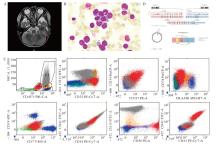
Figure 1
Clinical imaging, morphological, immunophenotypic, and molecular genetic features of Patient 4"
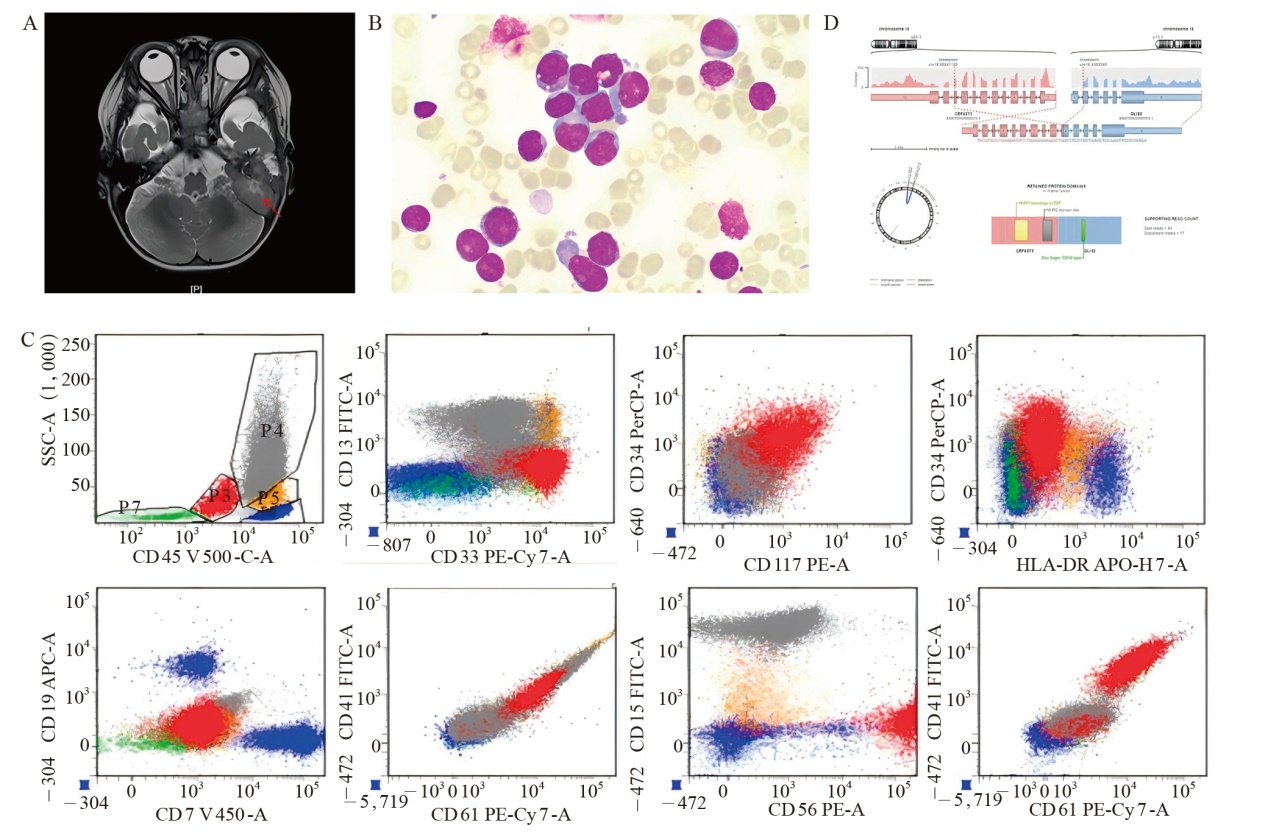

Table 1
Clinical characteristics, laboratory findings, and imaging results of six pediatric patients with CBFA2T3::GLIS2 fusion-positive acute myeloid leukemia"
| 患 儿 | 性 别 | 发病 年龄 /月龄 | FAB 分型 | 免疫分型 | 危险 分层 | 白细胞 计数/ ×109·L-1 | 染色体 | 合并 基因 | 乳酸 脱氢酶 /U·L-1 | 髓外 浸润 |
|---|---|---|---|---|---|---|---|---|---|---|
| 1 | 男 | 39 | M7 | CD33 68.3% CD61 42.1% CD41 30% CD34 33% CD56 99.9% CD38 68.7% HLA-DR 0% | 高危 | 6.26 | 46, Y,?(X; 12)(q28; q24), del(13)(q12q14), psu dic(17;?)(13;?), del(20)(q11.2)[9]/46, XY[11] | JAK2 变异 | 4 399 | 无 |
| 2 | 男 | 19 | M0 | CD33 89.4% CD34 98.5% CD117 99.8% CD56 99.2% HLA-DR 0% CD38 0% | 高危 | 5.07 | 46,XY | NOCTH 变异 | 580 | 椎管 占位 |
| 3 | 男 | 9 | M7 | CD33 98.1% CD61 10.6% CD41 11.3% CD117 99% CD56 99.8% CD38 6% HLA-DR 0% | 高危 | 48.54 | 46,XY | 无 | 2 836 | 无 |
| 4 | 男 | 16 | M7 | CD33 98.8% CD61 95.1% CD41 93.4% HLA-DR 0% CD117 36.7% CD56 96.2% | 高危 | 32.04 | 46,XY | 无 | 1 618 | 中枢 |
| 5 | 女 | 16 | M0 | CD33 97.5% CD117 99.2% CD34 97.3% CD56 98.5% | 高危 | 15.23 | 无法分析 | 无 | 699 | 无 |
| 6 | 男 | 8 | M7 | CD33 97.5% CD61 58.6% CD41 82% CD34 86.2% HLA-DR 0% CD117 30.8% CD56 100% | 高危 | 14.25 | 46,XY | ETV-6变异 | 301 | 软组 织及 骨骼 |
Table 2
Hematopoietic stem cell transplantation-related treatment characteristics and outcomes of six pediatric patients with CBFA2T3::GLIS2 fusion-positive acute myeloid leukemia"
| 患儿 | 2疗后疗效 | 移植前状态 | 移植供体 | 预处理方案 | 移植后维持 | 随访结局 | 总生存期/个月 |
|---|---|---|---|---|---|---|---|
| 1 | MRD+(0.5%) | MRD阴性,融合基因阴性 | 脐带血 | Flu+Ara-C+Bu+Cy+CCNU(MAC) | 阿扎胞苷 | CR | 35 |
| 2 | MRD+(10%) | MRD(22%)及融合基因阳性 | 母亲 | Dec+Bu+CCNU+Cy+Mel(MAC) | 地西他滨 | 移植后复发,死亡 | 6 |
| 3 | MRD+(0.25%) | MRD(0.31%)及融合基因阳性 | 脐带血 | Dec+CCNU+Mel+Cy+Bu(MAC) | 阿扎胞苷 | 移植后复发,死亡 | 11 |
| 4 | MRD- | MRD阴性,融合基因阴性 | 姐姐 | Ara-C+Flu+CCNU+Bu+TT+Cy(MAC) | 阿扎胞苷 | CR | 31 |
| 5 | - | - | - | - | - | 失访 | - |
| 6 | MRD+(3.75%) | MRD阴性,融合基因阴性 | 脐带血 | Dec+CCNU+Mel+Cy+Bu+TT(MAC) | 阿扎胞苷 | CR | 26 |
| [1] | Masetti R, Pigazzi M, Togni M, et al. CBFA2T3-GLIS2 fusion transcript is a novel common feature in pediatric, cytogenetically normal AML, not restricted to FAB M7 subtype[J/OL]. Blood, 2013, 121(17): 3469-3472. https://doi.org/10.1182/blood-2012-11-469825. |
| [2] | Hara Y, Shiba N, Ohki K, et al. Prognostic impact of specific molecular profiles in pediatric acute megakaryoblastic leukemia in non-Down syndrome[J/OL]. Genes Chromosomes Cancer, 2017, 56(5): 394-404. https://doi.org/10.1002/gcc.22444. |
| [3] | de Rooij JD, Branstetter C, Ma J, et al. Pediatric non-Down syndrome acute megakaryoblastic leukemia is characterized by distinct genomic subsets with varying outcomes[J/OL]. Nat Genet, 2017, 49(3): 451-456. https://doi.org/10.1038/ng.3772. |
| [4] | 张瑞东, 王林娅, 郑胡镛. 世界卫生组织2016急性白血病分型解读[J/OL]. 中华儿科杂志, 2017, 55(1): 15-18. https://doi.org/10.3760/cma.j.issn.0578-1310.2017.01.003. |
| Zhang RD, Wang LY, Zheng HY. Interpretation of the 2016 WHO classification of acute leukemia[J/OL]. Zhonghua Erke Zazhi, 2017, 55(1): 15-18. https://doi.org/10.3760/cma.j.issn.0578-1310.2017.01.003. | |
| [5] | 张之南, 沈悌. 血液病诊断及疗效标准[M]. 北京: 科学出版社, 2007. |
| Zhang ZN, Shen T. Diagnosis and therapeutic criteria for hematologic diseases[M]. Beijing: Kexue Chubanshe (Science Press), 2007. | |
| [6] | 中华医学会血液学分会实验诊断学组. 急性髓系白血病微小残留病检测与临床解读中国专家共识(2021年版)[J/OL]. 中华血液学杂志, 2021, 42(11): 889-897. https://doi.org/10.3760/cma.j.issn.0253-2727.2021.11.002. |
| Chinese Society of Hematology, Expert Group on Laboratory Diagnosis. Expert consensus on detection and clinical interpretation of minimal residual disease in acute myeloid leukemia (2021 edition) [J/OL]. Zhonghua Xueyexue Zazhi, 2021, 42( 11): 889-897. https://doi.org/10.3760/cma.j.issn.0253-2727.2021.11.002. | |
| [7] | 陶冶晴, 崔丁丁, 朱平, 等. 融合基因阳性儿童急性髓系白血病四例分析并文献复习[J/OL]. 中国小儿急救医学, 2025, 32(8). 619-622. https://doi.org/10.3760/cma.j.issn.1673-4912.2025.08.012. |
| Tao YQ, Cui DD, Zhu P, et al. Analysis of four cases of fusion gene positive acute myeloid leukemia in children and literature review[J/OL]. Zhongguo Xiaoer Jijiu Yixue, 2025, 32(8): 619-622. https://doi.org/10.3760/cma.j.issn.1673-4912.2025.08.012. | |
| [8] | Gruber TA, Larson Gedman A, Zhang J, et al. An Inv(16)(p13.3q24.3)-encoded CBFA2T3-GLIS2 fusion protein defines an aggressive subtype of pediatric acute megakaryoblastic leukemia[J/OL]. Cancer Cell, 2012, 22(5). 683-697. https://doi.org/10.1016/j.ccr.2012.10.007. |
| [9] | Smith JL, Ries RE, Hylkema T, et al. Comprehensive transcriptome profiling of cryptic CBFA2T3-GLIS2 fusion-positive AML defines novel therapeutic options:a COG and TARGET pediatric AML study[J/OL]. Clin Cancer Res, 2020, 26(3): 726-737. https://doi.org/10.1158/1078-0432.CCR-19-1800. |
| [10] | Gonzales F, Schneider C, Alexe G, et al.Identifying targeted therapies for CBFA2T3::GLIS2 acute myeloid leukemia[J/OL]. Leukemia, 2026, 40(2): 383-396. https://doi.org/10.1038/s41375-025-02845-7. |
| [11] | Gajendra S, Anupurba S, Gupta R, et al. Acute myeloid leukemia with RAM immunophenotype: a new underdiagnosed entity[J/OL]. Int J Lab Hematol, 2023, 45(4): 541-552. https://doi.org/10.1111/ijlh.14076. |
| [12] | Khanlari M, Wang L, Bolen CY, et al. CBFA2T3::GLIS2-positive acute leukemia with RAM and mixed T/megakaryocytic phenotype[J/OL]. EJHaem, 2023, 4(3): 765-769. https://doi.org/10.1002/jha2.741. |
| [13] | Zangrando A, Cavagnero F, Scarparo P, et al. CD56, HLA-DR, and CD45 recognize a subtype of childhood AML harboring CBFA2T3-GLIS2 fusion transcript[J/OL]. Cytometry A, 2021, 99(8): 844-850. https://doi.org/10.1002/cyto.a.24339. |
| [14] | Malik F, Eldomery MK, Wang W, et al.Myeloid sarcomas with CBFA2T3::GLIS2 fusion:clinicopathologic characterization of 4 cases mimicking small round cell tumors[J/OL]. Am J Clin Pathol, 2025, 163(3): 377-387. https://doi.org/10.1093/ajcp/aqae131. |
| [15] | Masetti R, Bertuccio SN, Pession A, et al. CBFA2T3-GLIS2-positive acute myeloid leukaemia. A peculiar paediatric entity[J/OL]. Br J Haematol, 2019, 184(3): 337-347. https://doi.org/10.1111/bjh.15725. |
| [16] | Lebedeva S, Mikhailova E, Bogacheva S, et al.Extramedullary relapse of CBFA2T3::GLIS2-positive megakaryoblastic leukemia mimicking secondary ewing sarcoma:an exemplary case for the diagnostic trap[J/OL]. Int J Mol Sci, 2025, 26(12): 5895. https://doi.org/10.3390/ijms26125895. |
| [17] | Hama A, Taga T, Tomizawa D, et al. Haematopoietic cell transplantation for children with acute megakaryoblastic leukaemia without Down syndrome[J/OL]. Br J Haematol, 2023, 201(4): 747-756. https://doi.org/10.1111/bjh.18691. |
| [18] | Huang BJ, Meyer LK, Alonzo TA, et al. Hematopoietic stem cell transplantation outcomes for high-risk AML:a report from the children's oncology group[J/OL]. J Clin Oncol, 2025, 43(17): 1961-1971. https://doi.org/10.1200/JCO-24-01841. |
| [19] | 尚倩雯, 张永湛, 陆爱东, 等. 改良CLAG方案治疗儿童复发/难治急性髓系白血病的疗效和安全性[J/OL]. 临床儿科杂志, 2024, 42(7): 589-594. https://doi.org/10.12372/jcp.2024.23e0555. |
| Shang QW, ZHANG YZ, LU AD, et al. The efficacy and safety of modified CLAG regimen for relapsed or refractory acute myeloid leukemia in children[J/OL]. Linchuang Erke Zazhi, 2024, 42(7): 589-594. https://doi.org/10.12372/jcp.2024.23e0555. | |
| [20] | Egan G, Tasian SK. Precision medicine for high-risk gene fusions in pediatric AML:a focus on KMT2A, NUP98, and GLIS2 rearrangements[J/OL]. Blood, 2025, 145(22): 2574-2586. https://doi.org/10.1182/blood.2024026598. |
| [21] | Masetti R, Bertuccio SN, Astolfi A, et al. Hh/Gli antagonist in acute myeloid leukemia with CBFA2T3-GLIS2 fusion gene[J/OL]. J Hematol Oncol, 2017, 10(1): 26. https://doi.org/10.1186/s13045-017-0396-0. |
| [22] | Gress V, Roussy M, Boulianne L, et al. CBFA2T3::GLIS2 pediatric acute megakaryoblastic leukemia is sensitive to BCL-XL inhibition by navitoclax and DT2216[J/OL]. Blood Adv, 2024, 8(1): 112-129. https://doi.org/10.1182/bloodadvances.2022008899. |
| [23] | Neault M, Lebert-Ghali CÉ, Fournier M, et al. CBFA2T3-GLIS2-dependent pediatric acute megakaryoblastic leukemia is driven by GLIS2 and sensitive to navitoclax[J/OL]. Cell Rep, 2023, 42(9): 113084. https://doi.org/10.1016/j.celrep.2023.113084. |
| [24] | Egan G, Tasian SK. Relapsed pediatric acute myeloid leukaemia:state-of-the-art in 2023[J/OL]. Haematologica, 2023, 108(9): 2275-2288. https://doi.org/10.3324/haematol.2022.281106. |
| [25] | Breviglieri C, Gouveia RV, Ginani VC, et al. Post-stem cell transplant maintenance for pediatric acute leukemias: insights from a Brazilian institution with a Latin American perspective[J/OL]. Front Oncol, 2025, 15: 1540158. https://doi.org/10.3389/fonc.2025.1540158. |
| [26] | Feng Y, Chen T, Zhang Y, et al. Azacitidine and lenalidomide combination:a novel relapse prophylaxis regimen after allogeneic hematopoietic stem-cell transplantation in patients with acute myeloid leukemia[J/OL]. Front Immunol, 2023, 14: 1182251. https://doi.org/10.3389/fimmu.2023.1182251. |
| [27] | Williams R L, Miller L, Massaro S, et al. Long-term survival after luveltamab tazevibulin, a novel folate receptor-α (FRα) targeting antibody-drug conjugate (ADC) in children with CBFA2T3::GLIS2 acute myeloid leukemia (AML)[J/OL]. J Clin Oncol, 2025, 43(16_suppl): e220. https://doi.org/10.1200/JCO.2025.43.16_suppl.e220. |
| [1] | Rachel Rosen, Osvaldo Borrelli, Christophe Faure, Katja Karrento, Usha Krishnan, Samuel Nurko, Nathalie Rommel, Alan Silverman, Michiel van Wijk, Marc Benninga (Author), Chinese Medical Association Parenteral and Enteral Nutrition Branch Pediatrics Group, The Subspecialty Group of Gastroenterology, The Society of Pediatric, Chinese Medical Association, Gastroenterology Group, Pediatrician Branch, Chinese Medical Doctor Association (Translator). Core interpretation and explanation of Rome Ⅴ diagnostic criteria: upper gastrointestinal disorders of gut-brain interaction in children and adolescents [J]. Journal of Clinical Pediatrics, 2026, 44(7): 595-608. |
| [2] | Carlo Di Lorenzo, Miguel Saps, Bruno P. Chumpitazi, Shaman Rajindrajith, Annamaria Staiano, Nikhil Thapar, Miranda van Tilburg, Carlos Velasco-Benítez, Arine Vlieger (Author), Chinese Medical Association Parenteral and Enteral Nutrition Branch Pediatrics Group, The Subspecialty Group of Gastroenterology, The Society of Pediatric, Chinese Medical Association, Gastroenterology Group, Pediatrician Branch, Chinese Medical Doctor Association (Translator). Core interpretation and explanation of Rome Ⅴ diagnostic criteria: lower and biliary disorders of gut-brain interaction in children and adolescents [J]. Journal of Clinical Pediatrics, 2026, 44(7): 609-621. |
| [3] | LI Xufeng, TANG Haoxun, LI Xingjun, ZHANG Lize, GAO Chenqing, ZHAO Shunying, LIU Jianhua. Clinical characteristics, chest CT imaging phenotypes, and their correlation with prognosis in 76 children with Chlamydia pneumoniae pneumonia [J]. Journal of Clinical Pediatrics, 2026, 44(7): 622-627. |
| [4] | WANG Zhen, SHAO Jingbo, ZHANG Na, XIA Min, ZHU Jiashi, DU Chengkan, LI Hong. Factors influencing long-term recurrence in pediatric acute lymphoblastic leukemia patients with low-risk disease at initial diagnosis: a five-year follow-up analysis of 254 cases from a single center [J]. Journal of Clinical Pediatrics, 2026, 44(7): 628-635. |
| [5] | YANG Lijun, FU Dongxia, CUI Yan, YANG Junmei, ZHANG Liming. Clinical manifestation and genetic analysis of CHARGE syndrome caused by CHD7 gene variation [J]. Journal of Clinical Pediatrics, 2026, 44(7): 644-650. |
| [6] | HU Yan, YANG Fan, LIANG Aimin, MAO Meng. Identification and management of faltering growth in children: insights from the 13th International Conference on Nutrition and Growth [J]. Journal of Clinical Pediatrics, 2026, 44(6): 485-488. |
| [7] | LIU Ziyao, WANG Congying, WANG Hongmao, ZHANG Mingming, XU Yingjie, LAI Jianming, NIU Wenquan, LI Xiaohui. Early differentiation of Kawasaki disease with joint symptoms and systemic juvenile idiopathic arthritis with Kawasaki disease-like symptoms: a single-center retrospective study [J]. Journal of Clinical Pediatrics, 2026, 44(6): 489-498. |
| [8] | LI Jian, LI Tao, HE Lulu, WU Lei, HU Tianjiao, HUANG Yixuan, LIN Xinrong, SHEN Qiyang, PAN Sirui, XIE Nan, ZHOU Jianfeng, ZHOU Chunlei, ZHOU Li. A retrospective analysis of 50 cases of malignant rhabdoid tumor in children: clinical features, treatment response and prognostic factors [J]. Journal of Clinical Pediatrics, 2026, 44(6): 499-507. |
| [9] | LI Yanhua, ZHANG Huanhuan, YANG Jingwei, LIAO Xuelian, SHAO Jingbo, JIAO Yangyang, ZHANG Ting, HUANG Can, JIANG Shayi. Analysis of survival prognosis and related risk factors of pediatric head and neck rhabdomyosarcoma [J]. Journal of Clinical Pediatrics, 2026, 44(6): 518-523. |
| [10] | SHI Yongyuan, YANG Lijuan, LEI Wenting, XIONG Yurong, PAN Shujing, LI Yuelin, ZHANG Jiali, TIAN Maoqiang. Clinical characteristics and prognosis analysis of autoimmune encephalitis with movement disorders in children: A single-center retrospective study [J]. Journal of Clinical Pediatrics, 2026, 44(6): 532-539. |
| [11] | GU Xinjia, ZHENG Zhihui, MEI Lingli, ZHENG Jinxin, LIU Taixiang, ZHU Jihua. Burden of urinary system diseases in children and adolescents in China, 1990-2023 [J]. Journal of Clinical Pediatrics, 2026, 44(6): 546-555. |
| [12] | CHEN Xumei, AIERKEN Aibibai, YUE Xueyan, RU Liang, ZHANG Li. A study on the latent profile analysis of psychological resilience and coping styles of parents of children with asthma and its influencing factors [J]. Journal of Clinical Pediatrics, 2026, 44(6): 556-563. |
| [13] | LUO Zihao, LI Shaojun, REN Peizhen, WANG Yanhong, GENG Gang. Analysis of clinical characteristics of children with pneumonia complicated with plastic bronchitis and establishment and validation of risk prediction model [J]. Journal of Clinical Pediatrics, 2026, 44(6): 564-572. |
| [14] | CHU Weihong, XU Liyan, PENG Shao, LAI Jianming. Lower extremity arterial thrombosis as first clinical manifestation in children's systemic lupus erythematosus complicated with antiphospholipid syndrome: a two-case report [J]. Journal of Clinical Pediatrics, 2026, 44(6): 579-583. |
| [15] | CHEN Liuwang, LIU Pan, XI Rongjuan, ZHANG Xianxia, ZHANG Yi, WEI Xingjiao, SU Min, YANG Yonghong, FU Yangxi. Methylmalonic acidemia with homocystinemia causing subacute combined degeneration of the spinal cord : a case report [J]. Journal of Clinical Pediatrics, 2026, 44(6): 584-588. |
|
||
