

Journal of Clinical Pediatrics ›› 2026, Vol. 44 ›› Issue (7): 644-650.doi: 10.12372/jcp.2026.25e1161
• Clinical Research • Previous Articles Next Articles
YANG Lijun, FU Dongxia, CUI Yan, YANG Junmei, ZHANG Liming( )
)
Received:2025-09-18
Revised:2025-11-04
Accepted:2025-12-05
Published:2026-07-15
Online:2026-07-12
Contact:
ZHANG Liming
E-mail:liming5127@163.com
CLC Number:
YANG Lijun, FU Dongxia, CUI Yan, YANG Junmei, ZHANG Liming. Clinical manifestation and genetic analysis of CHARGE syndrome caused by CHD7 gene variation[J].Journal of Clinical Pediatrics, 2026, 44(7): 644-650.

Table 1
The clinical characteristics of 13 patients with CS"
| 患儿 | 性别 | 就诊 年龄 | 眼部 缺陷 | 心脏 疾病 | 后鼻道 闭锁 | 发育 迟缓 | 性发育 异常 | 耳部 畸形 | 颅神经 功能障碍 | 特殊 面容 | 吞咽/ 喂养 困难 | 食管/ 气管 缺陷 | 大脑 结构 异常 | 喉软骨 发育 不良 | 其他 |
|---|---|---|---|---|---|---|---|---|---|---|---|---|---|---|---|
| 1 | 男 | 4.5岁 | + | + | + | + | + | + | - | + | + | + | - | - | 鼻窦炎、低促性腺激素性腺功能减退 |
| 2 | 男 | 6月龄 | + | + | - | + | + | + | - | + | + | - | + | - | 贫血、甲减、低血糖、垂体小、低促性腺激素性腺功能减退 |
| 3 | 男 | 1.3岁 | - | + | - | + | + | + | + | + | + | + | - | + | 低促性腺激素性腺功能减退 |
| 4 | 男 | 2日龄 | - | + | + | + | - | + | + | - | + | - | - | + | 声带麻痹 |
| 5 | 男 | 1日龄 | - | - | - | + | + | + | + | + | + | - | - | + | 脐疝、融合肾 |
| 6 | 女 | 1日龄 | + | + | + | + | - | + | + | - | + | + | + | + | 新生儿缺氧缺血性脑病/死亡 |
| 7 | 女 | 12日龄 | + | - | + | + | + | + | + | + | + | - | - | + | 死亡 |
| 8 | 女 | 10日龄 | + | + | + | + | - | - | + | + | + | + | + | + | 声带麻痹、肾盂分离 |
| 9 | 男 | 1日龄 | - | + | - | + | - | - | - | - | + | + | + | + | 贫血、腭裂/死亡 |
| 10 | 女 | 12岁 | + | - | - | + | + | + | + | + | - | - | - | - | 低促性腺激素性腺功能减退 |
| 11 | 男 | 3日龄 | + | + | + | + | + | + | + | + | + | + | - | + | 死亡 |
| 12 | 男 | 1日龄 | - | + | + | + | + | + | + | - | + | + | - | - | 死亡 |
| 13 | 男 | 10日龄 | - | + | + | + | + | + | + | - | + | - | - | - | 抽搐 |
Table 2
Genetic variation information of 13 children with CS"
| 患儿 | 变异基因 | 转录本/外显子 | 变异位点 | 氨基酸改变 | 变异类型 | 变异来源 | 致病性分析 | 是否报道 |
|---|---|---|---|---|---|---|---|---|
| 1 | CHD7 | NM_017780; exon10 | c.2630_2631dup | p.Asn878Leufs*11 | 移码变异 | 新发 | 致病 | 否 |
| 2 | CHD7 | NM_017780; exon10 | c.2824A>G | p.Thr942Ala | 错义变异 | 母亲 | 意义未明 | 否 |
| 3 | CHD7 | NM_017780; exon4 | c.2233_2235delinsAATA | p.Val745Asnfs*17 | 移码变异 | 新发 | 致病 | 否 |
| 4 | CHD7 | NM_017780; exon31 | c.6292C>T | p.Arg2098* | 无义变异 | 新发 | 致病 | 是 |
| 5 | CHD7 | NM_017780; exon10 | c.2754G>A | p.Trp918* | 无义变异 | 新发 | 致病 | 是 |
| 6 | CHD7 | NM_017780; exon2 | c.469C>T | p.Arg157* | 无义变异 | 新发 | 致病 | 是 |
| 7 | CHD7 | NM_017780; exon13 | c.3308T>A | p.Val1103Asp | 错义变异 | 新发 | 可能致病 | 是 |
| 8 | CHD7 | NM_017780; exon33 | c.7111delC | p.Gln2371Lysfs | 移码变异 | 新发 | 致病 | 是 |
| 9 | CHD7 | NM_017780; exon30 | c.6023delA | p.Asp2008Valfs | 移码变异 | 新发 | 致病 | 是 |
| 10 | CHD7 | NM_017780; exon15 | c.3565C>T | p.Arg1189Cys | 错义变异 | 新发 | 可能致病 | 是 |
| 11 | CHD7 | NM_017780; exon2 | c.478del | p.Tyr160Thrfs*51 | 移码变异 | 新发 | 致病 | 是 |
| 12 | CHD7 | NM_017780; exon26 | c.5428C>T | p.Arg1810* | 无义变异 | 新发 | 致病 | 是 |
| 13 | CHD7 | NM_017780; exon18 | c.4317delA | p.Gln1440Serfs*3 | 移码变异 | 新发 | 致病 | 是 |
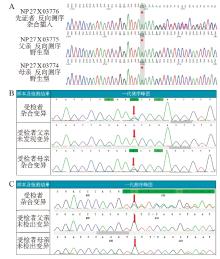
Figure 1
patient 1-3 and their parents' gene sequencing diagrams"
| [1] | Hall BD. Choanal atresia and associated multiple anomalies[J/OL]. J Pediatr, 1979, 95(3): 395-398. https://doi.org/10.1016/s0022-3476(79)80513-2. |
| [2] | Pagon RA, Graham JM, Zonana J, et al. Coloboma, congenital heart disease, and choanal atresia with multiple anomalies: CHARGE association[J/OL]. J Pediatr, 1981, 99(2): 223-227. https://doi.org/10.1016/s0022-3476(81)80454-4. |
| [3] | Hudson A, Trider CL, Blake K. CHARGE syndrome[J/OL]. Pediatr Rev, 2017, 38(1): 56-59. https://doi.org/10.1542/pir.2016-0050. |
| [4] | Hale CL, Niederriter AN, Green GE, et al. Atypical phenotypes associated with pathogenic CHD7 variants and a proposal for broadening CHARGE syndrome clinical diagnostic criteria[J/OL]. Am J Med Genet A, 2016, 170A(2): 344-354. https://doi.org/10.1002/ajmg.a.37435. |
| [5] | Kanwar K, Bashey S, Bohnsack BL, et al. Ocular manifestations of CHARGE syndrome in a pediatric cohort with genotype/phenotype analysis[J/OL]. Am J Med Genet A, 2024, 194(8): e63618. https://doi.org/10.1002/ajmg.a.63618. |
| [6] | 吴逊, 宋洁, 唐幂. 新发CHD7基因突变致CHARGE综合征的诊断分析[J/OL]. 临床小儿外科杂志, 2022, 21(9): 850854. https://doi.org/10.3760/cma.j.cn101785202205065010. |
| Wu X, Song J, Tang M. Application of targeted next-generation sequencing for syndromic congenital heart defects with novel mutations in CHARGE syndrome[J/OL]. Linchuang Xiaoer Waike Zazhi, 2022, 21(9): 850854. https://doi.org/10.3760/cma.j.cn101785202205065010. | |
| [7] | Jamadagni P, Breuer M, Schmeisser K, et al. Chromatin remodeller CHD7 is required for GABAergic neuron development by promoting PAQR3 expression[J/OL]. EMBO Rep, 2021, 22(6): e50958. https://doi.org/10.15252/embr.202050958. |
| [8] | Thomas AT, Waite J, Williams CA, et al. Phenotypic characteristics and variability in CHARGE syndrome: a PRISMA compliant systematic review and metaanalysis[J/OL]. J Neurodev Disord, 2022, 14(1): 49. https://doi.org/10.1186/s11689022094595. |
| [9] | Bedeschi MF, Crippa BL, Colombo L, et al. A case series of CHARGE syndrome: identification of key features for a neonatal diagnosis[J/OL]. Ital J Pediatr, 2020, 46(1): 53. https://doi.org/10.1186/s13052-020-0806-8. |
| [10] | Whittaker DE, Riegman KL, Kasah S, et al. The chromatin remodeling factor CHD7 controls cerebellar development by regulating reelin expression[J/OL]. J Clin Invest, 2017, 127 (3) : 874-887. https://doi.org/10.1172/JCI83408. |
| [11] | 孔佳怡, 李曼红, 王雨生, 等. 儿童CHARGE综合征的临床特征分析[J/OL]. 中华眼科杂志, 2025, 61(3): 182-188. https://doi.org/10.3760/cma.j.cn112142-20241130-00548. |
| Kong JY, Li MH, Wang YS, et al. Clinical features of CHARGE syndrome in children[J/OL]. Zhonghua Yanke Zazhi, 2025, 61(3): 182-188. https://doi.org/10.3760/cma.j.cn112142-20241130-00548. | |
| [12] | Layman WS, Hurd EA, Martin DM. Chromodomain proteins in development: lessons from CHARGE syndrome[J/OL]. Clin Genet, 2010, 78 (1): 11-20. https://doi.org/10.1111/j.1399-0004.2010.01446.x. |
| [13] | Dana J, Dorval G, Martin CS, et al. Investigating genotypetophenotype correlation in CHARGE syndrome by deep phenotyping and multiparametric clustering[J/OL]. Clin Genet, 2023, 104(4): 466471. https://doi.org/10.1111/cge.14363. |
| [14] | Qin Z, Su J, Li M, et al. Clinical and genetic analysis of CHD7 expands the genotype and phenotype of CHARGE syndrome[J/OL]. Front Genet, 2020, 11: 592. https://doi.org/10.3389/fgene.2020.00592. |
| [15] | 周洁, 高彬, 周英旎, 等. CHARGE综合征两例及基因突变研究[J/OL]. 中华内分泌代谢杂志, 2019, 35(5): 398-403. https://doi.org/10.3760/cma.j.issn.1000-6699.2019.02.009. |
| Zhou J, Gao B, Zhou YN, et al. Clinical data and mutation analysis of two cases of CHARGE syndrome[J/OL]. Zhonghua Neifenmi Daixie Zazhi, 2019, 35(5): 398-403. https://doi.org/10.3760/cma.j.issn.1000-6699.2019.02.009. | |
| [16] | Polito MV, Ferraioli M, Nocilla A, et al. CHARGE syndrome and congenital heart diseases: systematic review of literature[J/OL]. Monaldi Arch Chest Dis, 2023, 94(3). https://doi.org/10.4081/monaldi.2023.2661. |
| [17] | 葛丽丽, 孔京慧, 陈重芬, 等. CHARGE综合征7例患儿的临床表型及分子遗传学分析[J/OL]. 中华医学遗传学杂志, 2024, 41(9): 1053-1058. https://doi.org/10.3760/cma.j.cn511374-20230723-00012. |
| Ge LL, Kong JH, Chen CF, et al. Clinical phenotype and molecular genetic analysis of seven children with CHARGE syndrome[J/OL]. Zhonghua Yixue Yichuanxue Zazhi, 2024, 41(9): 1053-1058. https://doi.org/10.3760/cma.j.cn511374-20230723-00012. | |
| [18] | Wu X, Chen L, Lu W, et al. Discovery of novel variants on the CHD7 gene:a case series of CHARGE syndrome[J/OL]. Front Genet, 2022, 13: 852429. https://doi.org/10.3389/fgene.2022.852429. |
| [19] | 张超英, 孙云霞, 刘玉梅, 等. CHARGE综合征4例[J/OL]. 中国实用儿科杂志, 2024, 39(4): 316-320. https://doi.org/10.19538/j.ek2024040616. |
| Zhang CY, Sun YX, Liu YM, et al. Four cases of CHARGE syndrome[J/OL]. Zhongguo Shiyong Erke Zazhi, 2024, 39(4): 316-320. https://doi.org/10.19538/j.ek2024040616. | |
| [20] | van Ravenswaaij-Arts C, Martin DM. New insights and advances in CHARGE syndrome: diagnosis, etiologies, treatments, and research discoveries[J/OL]. Am J Med Genet C Semin Med Genet, 2017, 175(4): 397-406. https://doi.org/10.1002/ajmg.c.31592. |
| [21] | 中国耳聋基因筛查与诊断临床多中心研究协作组, 中华医学会医学遗传学分会. CHARGE综合征的听觉干预及语言康复专家共识[J/OL]. 临床耳鼻咽喉头颈外科杂志, 2025, 39(5): 396-406. https://doi.org/10.13201/j.issn.2096-7993.2025.05.002. |
| Chinese Multicentre Collaborative Group for Clinical Research on Genetic Screening and Diagnosis of Deafness Chinese Medical Association, Medical Genetics Branch. Expert consensus on auditory intervention and language rehabilitation of CHARGE syndrome[J/OL]. Linchuang Erbiyanhou Toujingwaike Zazhi, 2025, 39(5): 396-406. https://doi.org/10.13201/j.issn.2096-7993.2025.05.002. | |
| [22] | Biard JM, Payrat S, Clapuyt P, et al. Antenatal diagnosis of CHARGE syndrome: prenatal ultrasound findings and crucial role of fetal dysmorphic signs. About a series of 10 cases and review of literature[J/OL]. Eur J Med Genet, 2021, 64(4): 104189. https://doi.org/10.1016/j.ejmg.2021.104189. |
| [1] | Rachel Rosen, Osvaldo Borrelli, Christophe Faure, Katja Karrento, Usha Krishnan, Samuel Nurko, Nathalie Rommel, Alan Silverman, Michiel van Wijk, Marc Benninga (Author), Chinese Medical Association Parenteral and Enteral Nutrition Branch Pediatrics Group, The Subspecialty Group of Gastroenterology, The Society of Pediatric, Chinese Medical Association, Gastroenterology Group, Pediatrician Branch, Chinese Medical Doctor Association (Translator). Core interpretation and explanation of Rome Ⅴ diagnostic criteria: upper gastrointestinal disorders of gut-brain interaction in children and adolescents [J]. Journal of Clinical Pediatrics, 2026, 44(7): 595-608. |
| [2] | Carlo Di Lorenzo, Miguel Saps, Bruno P. Chumpitazi, Shaman Rajindrajith, Annamaria Staiano, Nikhil Thapar, Miranda van Tilburg, Carlos Velasco-Benítez, Arine Vlieger (Author), Chinese Medical Association Parenteral and Enteral Nutrition Branch Pediatrics Group, The Subspecialty Group of Gastroenterology, The Society of Pediatric, Chinese Medical Association, Gastroenterology Group, Pediatrician Branch, Chinese Medical Doctor Association (Translator). Core interpretation and explanation of Rome Ⅴ diagnostic criteria: lower and biliary disorders of gut-brain interaction in children and adolescents [J]. Journal of Clinical Pediatrics, 2026, 44(7): 609-621. |
| [3] | LI Xufeng, TANG Haoxun, LI Xingjun, ZHANG Lize, GAO Chenqing, ZHAO Shunying, LIU Jianhua. Clinical characteristics, chest CT imaging phenotypes, and their correlation with prognosis in 76 children with Chlamydia pneumoniae pneumonia [J]. Journal of Clinical Pediatrics, 2026, 44(7): 622-627. |
| [4] | WANG Zhen, SHAO Jingbo, ZHANG Na, XIA Min, ZHU Jiashi, DU Chengkan, LI Hong. Factors influencing long-term recurrence in pediatric acute lymphoblastic leukemia patients with low-risk disease at initial diagnosis: a five-year follow-up analysis of 254 cases from a single center [J]. Journal of Clinical Pediatrics, 2026, 44(7): 628-635. |
| [5] | GUO Xuemei, XUE Yao, WANG Yongren, RONG Liucheng, FANG Yongjun, LIN Rufeng. Clinical features and prognosis of childhood acute myeloid leukemia with CBFA2T3::GLIS2 fusion [J]. Journal of Clinical Pediatrics, 2026, 44(7): 636-643. |
| [6] | HU Yan, YANG Fan, LIANG Aimin, MAO Meng. Identification and management of faltering growth in children: insights from the 13th International Conference on Nutrition and Growth [J]. Journal of Clinical Pediatrics, 2026, 44(6): 485-488. |
| [7] | LIU Ziyao, WANG Congying, WANG Hongmao, ZHANG Mingming, XU Yingjie, LAI Jianming, NIU Wenquan, LI Xiaohui. Early differentiation of Kawasaki disease with joint symptoms and systemic juvenile idiopathic arthritis with Kawasaki disease-like symptoms: a single-center retrospective study [J]. Journal of Clinical Pediatrics, 2026, 44(6): 489-498. |
| [8] | LI Jian, LI Tao, HE Lulu, WU Lei, HU Tianjiao, HUANG Yixuan, LIN Xinrong, SHEN Qiyang, PAN Sirui, XIE Nan, ZHOU Jianfeng, ZHOU Chunlei, ZHOU Li. A retrospective analysis of 50 cases of malignant rhabdoid tumor in children: clinical features, treatment response and prognostic factors [J]. Journal of Clinical Pediatrics, 2026, 44(6): 499-507. |
| [9] | LI Yanhua, ZHANG Huanhuan, YANG Jingwei, LIAO Xuelian, SHAO Jingbo, JIAO Yangyang, ZHANG Ting, HUANG Can, JIANG Shayi. Analysis of survival prognosis and related risk factors of pediatric head and neck rhabdomyosarcoma [J]. Journal of Clinical Pediatrics, 2026, 44(6): 518-523. |
| [10] | SHI Yongyuan, YANG Lijuan, LEI Wenting, XIONG Yurong, PAN Shujing, LI Yuelin, ZHANG Jiali, TIAN Maoqiang. Clinical characteristics and prognosis analysis of autoimmune encephalitis with movement disorders in children: A single-center retrospective study [J]. Journal of Clinical Pediatrics, 2026, 44(6): 532-539. |
| [11] | GU Xinjia, ZHENG Zhihui, MEI Lingli, ZHENG Jinxin, LIU Taixiang, ZHU Jihua. Burden of urinary system diseases in children and adolescents in China, 1990-2023 [J]. Journal of Clinical Pediatrics, 2026, 44(6): 546-555. |
| [12] | CHEN Xumei, AIERKEN Aibibai, YUE Xueyan, RU Liang, ZHANG Li. A study on the latent profile analysis of psychological resilience and coping styles of parents of children with asthma and its influencing factors [J]. Journal of Clinical Pediatrics, 2026, 44(6): 556-563. |
| [13] | LUO Zihao, LI Shaojun, REN Peizhen, WANG Yanhong, GENG Gang. Analysis of clinical characteristics of children with pneumonia complicated with plastic bronchitis and establishment and validation of risk prediction model [J]. Journal of Clinical Pediatrics, 2026, 44(6): 564-572. |
| [14] | CHU Weihong, XU Liyan, PENG Shao, LAI Jianming. Lower extremity arterial thrombosis as first clinical manifestation in children's systemic lupus erythematosus complicated with antiphospholipid syndrome: a two-case report [J]. Journal of Clinical Pediatrics, 2026, 44(6): 579-583. |
| [15] | CHEN Liuwang, LIU Pan, XI Rongjuan, ZHANG Xianxia, ZHANG Yi, WEI Xingjiao, SU Min, YANG Yonghong, FU Yangxi. Methylmalonic acidemia with homocystinemia causing subacute combined degeneration of the spinal cord : a case report [J]. Journal of Clinical Pediatrics, 2026, 44(6): 584-588. |
|
||
