

Journal of Clinical Pediatrics ›› 2026, Vol. 44 ›› Issue (8): 721-726.doi: 10.12372/jcp.2026.25e1641
• Brief Report • Previous Articles Next Articles
HAN Yanan, GE Lanlan, CUI Jieyuan( )
)
Received:2025-12-22
Revised:2026-03-23
Accepted:2026-03-30
Published:2026-08-15
Online:2026-08-13
Contact:
CUI Jieyuan
E-mail:cuijieyuan_o@126.com
CLC Number:
HAN Yanan, GE Lanlan, CUI Jieyuan. A case report of branchio-oto-renal syndrome caused by EYA1 gene variant with a 6-year follow-up[J].Journal of Clinical Pediatrics, 2026, 44(8): 721-726.
Figure 1
Cervical MRI images of the patient"
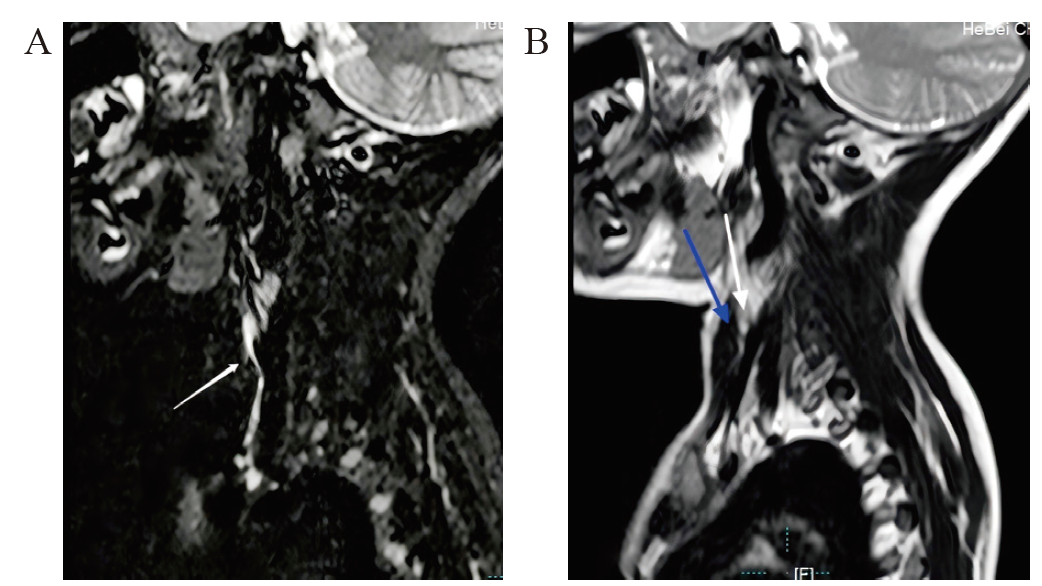

Table 1
Audiological examination results"
| 气导/dB | 骨导/dB | 声导抗 | 耳声发射 | |
|---|---|---|---|---|
| 右耳 | 55 | 40 | A | 未引出 |
| 左耳 | 70 | 50 | A | 未引出 |
Figure 2
Pedigree Sanger sequencing results for the proband and parents"
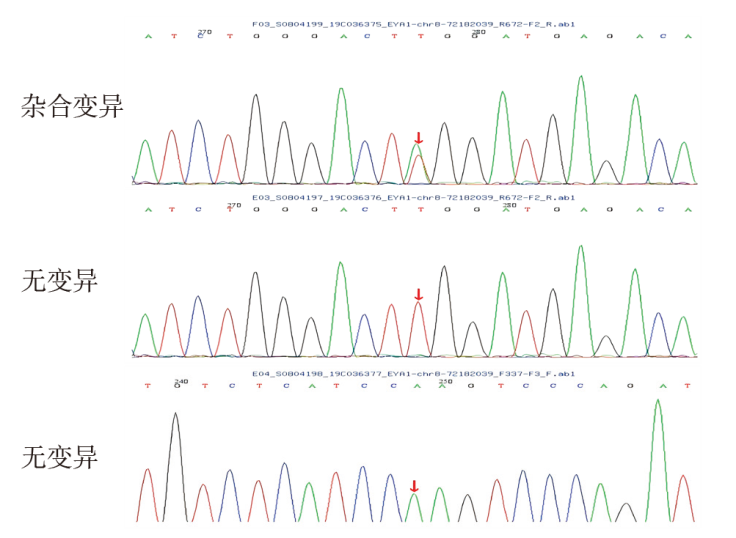
Table 2
Timeline of disease course and clinical management for the patient"
| 时间 | 临床表现、主要检查及治疗方案 |
|---|---|
| 2019年7月 | 间断发热、发现肾功能异常。查血常规:Hb70 g·L-1,肌酐:326 μmol·L-1,泌尿系超声:双肾小,基因结果:EYA1基因有1个杂合突变,c.986T>A。诊断CKD5、BORS,给予慢性肾脏病一体化治疗。 |
| 2021年12月 | 面色苍黄,全身皮肤干痒。查血常规:Hb55 g·L-1,肌酐:637 μmol·L-1。给予悬浮红细胞2U静点纠正贫血,病情好转出院,拒绝腹膜透析治疗。 |
| 2022年3月 | 患儿食欲差,间断恶心、呕吐。查血常规:Hb65 g·L-1,肌酐:900 μmol·L-1,电解质:钾4.03 mmol·L-1、钠124.7 mmol·L-1、离子钙0.99 mmol·L-1、碳酸氢盐8.9 mmol·L-1,血清蛋白:总蛋白64.6 g·L-1、前白蛋白295 mg·L-1、血白蛋白42.5 g·L-1,维生素D 13.2 ng·mL-1,甲状旁腺激素2 860 pg·mL-1,给予纠酸、纠正贫血、营养指导等治疗,病情稳定后行腹膜透析置管术,术后开始持续性非卧床腹膜透析及慢性肾脏病一体化治疗。 |
| 2023年3月 | 患儿为行腹膜平衡试验入院。查血常规:Hb77 g·L-1,肌酐:726 μmol·L-1,电解质:钙1.06 mmol·L-1、碳酸氢盐16.6 mmol·L-1,血清蛋白:总蛋白57 g·L-1、前白蛋白346 mg·L-1、血白蛋白34 g·L-1,腹透液常规及生化均正常。心脏超声结构及血流未见明显异常。每周腹膜透析KT/V1.636,TCcr=54.517 |
| 2024年10月 | 患儿发热伴腹透液浑浊1天。查血常规:WBC 12.36×10⁹·L-1、NEU 11.34×10⁹·L-1、Hb 87 g·L-1;肌酐:827 μmol·L-1;电解质大致正常,碳酸氢盐14.6 mmol·L-1;血清蛋白:总蛋白69.6 g·L-1、前白蛋白517 mg·L-1、血白蛋白40.2 g·L-1;腹透液常规:多个核细胞324×106·L-1,单个核4×10⁶·L-1。诊断为腹膜炎,给予腹腔内注入含头孢他啶及头孢唑林的腹膜透析液进行抗感染治疗。 |
| 2025年10月 | 患儿无不适,为评估病情,患儿无水肿及高血压,每日超滤量波动在300~400 mL。查血常规:Hb 96 g·L-1,血肌酐900 μmol·L-1;血清蛋白:总蛋白55 g·L-1、前白蛋白374 mg·L-1、血白蛋白35 g·L-1;电解质:钠136.3 mmol·L-1、钾4.42 mmol·L-1、离子钙1.18 mmol·L-1、碳酸氢盐24.5 mmol·L-1;维生素D 26.5 ng·mL-1,甲状旁腺激素266 pg·mL-1。STAMP筛查量表评分6分,中风险。心脏超声结构及血流未见明显异常。继续腹膜透析治疗。 |
| [1] | 邓丽莎, 胡炯炯, 马兆鑫. 鳃耳肾综合征临床特点与遗传学的研究进展[J/OL]. 中国眼耳鼻喉科杂志, 2018, 18(5): 359-362. https://doi.org/10.14166/j.issn.1671-2420.2018.05.022. |
| Deng LS, Hu JJ, Ma ZX. Research progress on clinical features and genetics of branchio-oto-renal syndrome[J/OL]. Zhongguo Yanerbihouke Zazhi, 2018, 18(5): 359-362. https://doi.org/10.14166/j.issn.1671-2420.2018.05.022. | |
| [2] | 唐毅, 张陶, 张霓霓, 等. 鳃耳综合征伴肾结石1例报告[J/OL]. 口腔医学研究, 2025, 41(3): 257-259. https://doi.org/10.13701/j.cnki.kqyxyj.2025.03.015. |
| Tang Y, Zhang T, Zhang NN, et al. A case report of branchio-otic syndrome with kidney stones[J/OL]. Kouqiang Yixue Yanjiu, 2025, 41(3): 257-259. https://doi.org/10.13701/j.cnki.kqyxyj.2025.03.015. | |
| [3] | Chang EH, Menezes M, Meyer NC, et al. Branchio-oto-renal syndrome:the mutation spectrum in EYA1 and its phenotypic consequences[J/OL]. Hum Mutat, 2004, 23(6): 582-589. https://doi.org/10.1002/humu.20048. |
| [4] | Richards S, Aziz N, Bale S, et al. Standards and guidelines for the interpretation of sequence variants: a joint consensus recommendation of the American College of Medical Genetics and Genomics and the Association for Molecular Pathology[J/OL]. Genet Med Open, 2015, 17(5): 405-424. https://doi.org/10.1038/gim.2015.30. |
| [5] | Graziani L, Carriero ML, Melchionda S, et al. Otofaciocervical syndrome and its overlap with branchioo-torenal spectrum:an integrated literature analysis of EYA1-related disorders, including a novel case with an 8q13.2q13.3 deletion[J/OL]. Genes, 2025, 16(11): 1267. https://doi.org/10.3390/genes16111267. |
| [6] | Krug P, Morinière V, Marlin S, et al. Mutation screening of the EYA1, SIX1, and SIX5 genes in a large cohort of patients harboring branchio-oto-renal syndrome calls into question the pathogenic role of SIX5 mutations[J/OL]. Hum Mutat, 2011, 32(2): 183-190. https://doi.org/10.1002/humu.21402. |
| [7] | Wang Y, Sun S, Qiu Y, et al. A novel mutation in EYA1 in a Chinese family with branchio-oto-renal syndrome[J/OL]. BMC Med Genet, 2018, 19(1): 139. https://doi.org/10.1186/s12881-018-0653-2. |
| [8] | Orten DJ, Fischer SM, Sorensen JL, et al. Branchio-oto-renal syndrome (BOR):novel mutations in the EYA1 gene, and a review of the mutational genetics of BOR[J/OL]. Hum Mutat, 2008, 29(4): 537-544. https://doi.org/10.1002/humu.20691. |
| [9] | Lee KY, Kim S, Kim UK, et al. Novel EYA1 mutation in a Korean branchio-oto-renal syndrome family[J/OL]. Int J Pediatr Otorhinolaryngol, 2007, 71(1): 169-174. https://doi.org/10.1016/j.ijporl.2006.08.023. |
| [10] | Spahiu L, Merovci B, Ismaili Jaha V, et al. Case report of a novel mutation of the EYA1 gene in a patient with branchio-oto-renal syndrome[J/OL]. Balkan J Med Genet, 2016, 19(2): 91-94. https://doi.org/10.1515/bjmg-2016-0042. |
| [11] | Yang M, Lu M, Feng H, et al. From renal biopsy to genetic diagnosis:EYA1 mutation in branchio-oto-renal syndrome with renal insufficiency[J/OL]. BMC Nephrol, 2025, 26(1): 707. https://doi.org/10.1186/s12882-025-04635-w. |
| [12] | Usami S, Abe S, Shinkawa H, et al. EYA1 nonsense mutation in a Japanese branchio-oto-renal syndrome family[J/OL]. J Hum Genet, 1999, 44(4): 261-265. https://doi.org/10.1007/s100380050156. |
| [13] | Cho SH, Jeong SH, Choi WH, et al. Genomic landscape of branchio-oto-renal syndrome through whole-genome sequencing: a single rare disease center experience in South Korea[J/OL]. IJMS, 2024, 25(15): 8149. https://doi.org/10.3390/ijms25158149. |
| [14] | Wang S, Wu C, Lu Y, et al. Mutation screening of the EYA1, SIX1, and SIX5 genes in an East Asian cohort with branchio-oto-renal syndrome[J/OL]. The Laryngoscope, 2012, 122(5): 1130-1136. https://doi.org/10.1002/lary.23217. |
| [15] | Stockley TL, Mendoza-Londono R, Propst EJ, et al. A recurrent EYA1 mutation causing alternative RNA splicing in branchio-oto-renal syndrome:implications for molecular diagnostics and disease mechanism[J/OL]. Am J Med Genetics Pt A, 2009, 149A(3): 322-327. https://doi.org/10.1002/ajmg.a.32679. |
| [16] | 胡清强, 庞润飞, 王静, 等. 1例鳃-耳-肾综合征散发患者遗传病因学研究[J/OL]. 大连医科大学学报, 2023, 45(2): 169-173. https://doi.org/10.11724/jdmu.2023.02.13. |
| Hu QQ, Pang RF, Wang J, et al. Genetic etiology study of a sporadic patient with branchio-oto-renal syndrome[J/OL]. Dalian Yike Daxue Xuebao, 2023, 45(2): 169-173. https://doi.org/10.11724/jdmu.2023.02.13. | |
| [17] | 孙留玉, 钟贞, 朱颖, 等. 鳃耳肾谱系疾病2例病例报告[J/OL]. 中国循证儿科杂志, 2021, 16(4): 306-309. https://doi.org/10.3969/j.issn.1673-5501.2021.04.011. |
| Sun LY, Zhong Z, Zhu Y, et al. Two case reports of branchio-oto-renal spectrum disorders[J/OL]. Zhongguo Xunzheng Erke Zazhi, 2021, 16(4): 306-309. https://doi.org/10.3969/j.issn.1673-5501.2021.04.011. | |
| [18] | 冯海锋, 许红恩, 陈蓓, 等. 5个鳃耳(肾)综合征家系的致病突变和诊疗分析[J/OL]. 中华耳鼻咽喉头颈外科杂志, 2022, 57(12): 1433-1441. http://doi.org/10.3760/cma.j.cn115330-20221119-00694. |
| Feng HF, Xu HE, Chen B, et al. Pathogenic mutations and diagnostic-therapeutic analysis of five families with branchio-oto(-renal) syndrome[J/OL]. Zhonghua Erbi Yanhou Toujing Waike Zazhi, 2022, 57(12): 1433-1441. https://doi.org/10.3760/cma.j.cn115330-20221119-00694. | |
| [19] | Klingbeil KD, Greenland CM, Arslan S, et al. Novel EYA1 Variants Causing Branchio-Oto-Renal Syndrome[J/OL]. Int J Pediatr Otorhinolaryngol, 2017, 98:59-63. https://doi.org/10.1016/j.ijporl.2017.04.037. |
| [20] | Yi J, Wei Y, Fu S, et al. Branchio-oto-renal syndrome in a young Han Chinese female: a case report and review of the literature[J/OL]. J Med Case Rep, 2025, 19: 430. https://doi.org/10.1186/s13256-025-05515-5. |
| [21] | Chen A, Ling J, Feng Y. Genetic research progress in branchio-oto syndrome/ branchio-oto-renal syndrome[J/OL]. Zhong Nan Da Xue Xue Bao Yi Xue Ban, 2022, 47(1): 129-138. https://doi.org/10.11817/j.issn.1672-7347.2022.210251. |
| [22] | Raveh E, Papsin BC, Forte V. Branchio-oculo-facial syndrome[J/OL]. Int J Pediatr Otorhinolaryngol, 2000, 53(2): 149-156. https://doi.org/10.1016/s0165-5876(00)00310-4. |
| [23] | Tingaud-Sequeira A, Trimouille A, Sagardoy T, et al. Oculo-auriculo-vertebral spectrum: new genes and literature review on a complex disease[J/OL]. J Med Genet, 2022, 59(5): 417-427. https://doi.org/10.1136/jmedgenet-2021-108219. |
| [24] | 陈植, 刘小荣. 儿童腹膜透析治疗的技术特点[J/OL]. 中国血液净化, 2019, 18(11): 763-765. https://doi.org/10.3969/j.issn.1671-4091.2019.11.008. |
| Chen Z, Liu XR. Technical characteristics of peritoneal dialysis therapy in children[J/OL]. Zhongguo Xueye Jinghua, 2019, 18(11): 763-765. https://doi.org/j.issn.1671-4091.2019.11.008. |
| [1] | LIN Jinfeng, CHEN Yi, DENG Yan, FENG Ai, HUANG Juan, CHEN Lizhu, XIE Jingqi, NIE Xiaojing. A comparative study on the detection of anti-Nephrin antibodies in children's nephrotic syndrome by chemiluminescence method and cell-based assay [J]. Journal of Clinical Pediatrics, 2026, 44(8): 682-689. |
| [2] | ZHENG Fangyuan, WANG Miao, DING Mingming, LU Aidong, JIA Yueping, ZENG Huimin, ZHANG Leping. Next-generation sequencing identified gene variants and their prognostic impact in pediatric Philadelphia chromosome positive acute lymphoblastic leukemia [J]. Journal of Clinical Pediatrics, 2026, 44(8): 690-697. |
| [3] | ZHANG Xiao, FANG Hongjun, KUANG Xiaojun, WANG Lijuan, WU Zhao, JIANG Sha, LI Pei, WU Liwen. Analysis of the clinical and electrophysiological characteristics of atonic seizures in children [J]. Journal of Clinical Pediatrics, 2026, 44(8): 698-704. |
| [4] | WANG Mengqian, YANG Hui. Case series analysis of 13 intestinal Behcet’s syndrome in children [J]. Journal of Clinical Pediatrics, 2026, 44(8): 705-711. |
| [5] | WU Xirong, GAO Qi, GUO Siyuan, YIN Qingqin, QIN Qiang, YIN Ju, JIAO Anxia, CHEN Chenghao, WU Di, WANG Bei, DUAN Xiaomin, PENG Yun, XU Baoping, GAO Liwei. Clinical characteristics and prognosis of pulmonary mucormycosis in children with diabetes mellitus [J]. Journal of Clinical Pediatrics, 2026, 44(8): 712-720. |
| [6] | SHI Jiayi, GAO Chunlin, JIA Lili, LU Yunyun, SUN Tao, ZHU Xiaodong, XIA Zhengkun, ZHANG Pei. Phenotypic characteristics and prognostic analysis of a pedigree with childhood isolated nephrotic syndrome caused by compound heterozygous mutations in the COQ2 gene [J]. Journal of Clinical Pediatrics, 2026, 44(8): 727-732. |
| [7] | Rachel Rosen, Osvaldo Borrelli, Christophe Faure, Katja Karrento, Usha Krishnan, Samuel Nurko, Nathalie Rommel, Alan Silverman, Michiel van Wijk, Marc Benninga (Author), Chinese Medical Association Parenteral and Enteral Nutrition Branch Pediatrics Group, The Subspecialty Group of Gastroenterology, The Society of Pediatric, Chinese Medical Association, Gastroenterology Group, Pediatrician Branch, Chinese Medical Doctor Association (Translator). Core interpretation and explanation of Rome Ⅴ diagnostic criteria: upper gastrointestinal disorders of gut-brain interaction in children and adolescents [J]. Journal of Clinical Pediatrics, 2026, 44(7): 595-608. |
| [8] | Carlo Di Lorenzo, Miguel Saps, Bruno P. Chumpitazi, Shaman Rajindrajith, Annamaria Staiano, Nikhil Thapar, Miranda van Tilburg, Carlos Velasco-Benítez, Arine Vlieger (Author), Chinese Medical Association Parenteral and Enteral Nutrition Branch Pediatrics Group, The Subspecialty Group of Gastroenterology, The Society of Pediatric, Chinese Medical Association, Gastroenterology Group, Pediatrician Branch, Chinese Medical Doctor Association (Translator). Core interpretation and explanation of Rome Ⅴ diagnostic criteria: lower and biliary disorders of gut-brain interaction in children and adolescents [J]. Journal of Clinical Pediatrics, 2026, 44(7): 609-621. |
| [9] | LI Xufeng, TANG Haoxun, LI Xingjun, ZHANG Lize, GAO Chenqing, ZHAO Shunying, LIU Jianhua. Clinical characteristics, chest CT imaging phenotypes, and their correlation with prognosis in 76 children with Chlamydia pneumoniae pneumonia [J]. Journal of Clinical Pediatrics, 2026, 44(7): 622-627. |
| [10] | WANG Zhen, SHAO Jingbo, ZHANG Na, XIA Min, ZHU Jiashi, DU Chengkan, LI Hong. Factors influencing long-term recurrence in pediatric acute lymphoblastic leukemia patients with low-risk disease at initial diagnosis: a five-year follow-up analysis of 254 cases from a single center [J]. Journal of Clinical Pediatrics, 2026, 44(7): 628-635. |
| [11] | GUO Xuemei, XUE Yao, WANG Yongren, RONG Liucheng, FANG Yongjun, LIN Rufeng. Clinical features and prognosis of childhood acute myeloid leukemia with CBFA2T3::GLIS2 fusion [J]. Journal of Clinical Pediatrics, 2026, 44(7): 636-643. |
| [12] | YANG Lijun, FU Dongxia, CUI Yan, YANG Junmei, ZHANG Liming. Clinical manifestation and genetic analysis of CHARGE syndrome caused by CHD7 gene variation [J]. Journal of Clinical Pediatrics, 2026, 44(7): 644-650. |
| [13] | HU Yan, YANG Fan, LIANG Aimin, MAO Meng. Identification and management of faltering growth in children: insights from the 13th International Conference on Nutrition and Growth [J]. Journal of Clinical Pediatrics, 2026, 44(6): 485-488. |
| [14] | LIU Ziyao, WANG Congying, WANG Hongmao, ZHANG Mingming, XU Yingjie, LAI Jianming, NIU Wenquan, LI Xiaohui. Early differentiation of Kawasaki disease with joint symptoms and systemic juvenile idiopathic arthritis with Kawasaki disease-like symptoms: a single-center retrospective study [J]. Journal of Clinical Pediatrics, 2026, 44(6): 489-498. |
| [15] | LI Jian, LI Tao, HE Lulu, WU Lei, HU Tianjiao, HUANG Yixuan, LIN Xinrong, SHEN Qiyang, PAN Sirui, XIE Nan, ZHOU Jianfeng, ZHOU Chunlei, ZHOU Li. A retrospective analysis of 50 cases of malignant rhabdoid tumor in children: clinical features, treatment response and prognostic factors [J]. Journal of Clinical Pediatrics, 2026, 44(6): 499-507. |
|
||
