

Journal of Clinical Pediatrics ›› 2026, Vol. 44 ›› Issue (8): 690-697.doi: 10.12372/jcp.2026.25e1694
• Clinical Research • Previous Articles Next Articles
ZHENG Fangyuan, WANG Miao, DING Mingming, LU Aidong, JIA Yueping, ZENG Huimin, ZHANG Leping( )
)
Received:2026-01-05
Revised:2026-03-10
Accepted:2026-06-22
Published:2026-08-15
Online:2026-08-13
Contact:
ZHANG Leping
E-mail:zhangleping@pkuph.edu.cn
CLC Number:
ZHENG Fangyuan, WANG Miao, DING Mingming, LU Aidong, JIA Yueping, ZENG Huimin, ZHANG Leping. Next-generation sequencing identified gene variants and their prognostic impact in pediatric Philadelphia chromosome positive acute lymphoblastic leukemia[J].Journal of Clinical Pediatrics, 2026, 44(8): 690-697.
Figure 1
Flowchart of patient enrollment"
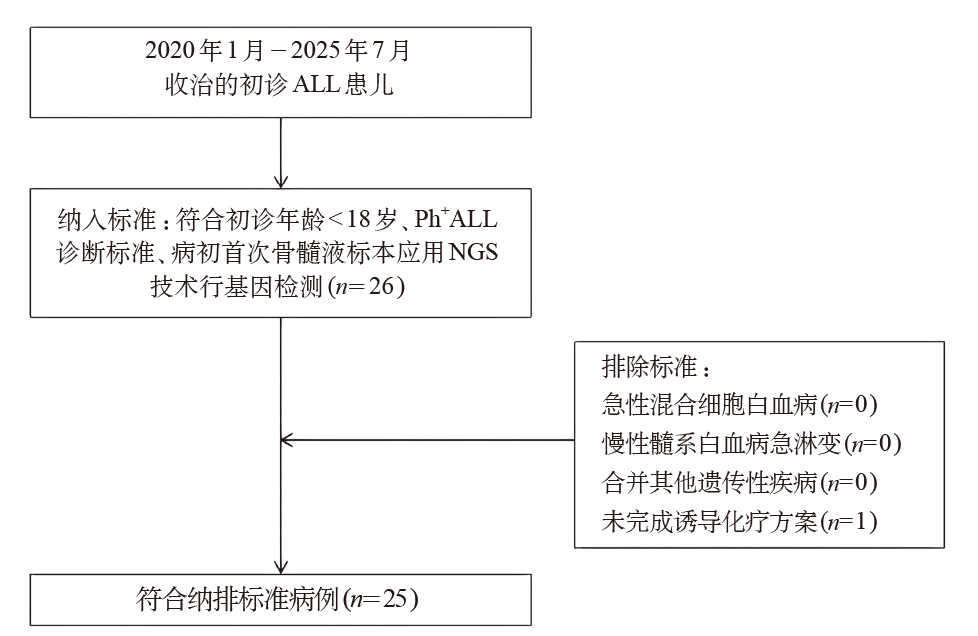

Table 1
General information of the patients"
| 项 目 | IKZF1plus组 (n=3) | 单纯IKZF1组 (n=15) | 无IKZF1组 (n=7) | 统计量 | P |
|---|---|---|---|---|---|
| 年龄[M(P25~P75)]/岁 | 13(11~15) | 8(4~16) | 10(8~14) | H=4.54 | 0.103 |
| 性别比(男∶女) | 2∶1 | 13∶2 | 3∶4 | χ2=2.50 | 0.286 |
| 白细胞计数($\bar{x}±s$)/×109·L-1 | 104.4±102.9 | 173.6±134.5 | 118.6±157.3 | F=2.59 | 0.273 |
| 血红蛋白含量($\bar{x}±s$)/g·L-1 | 110.0±14.7 | 108.8±27.4 | 101.0±25.3 | F=2.23 | 0.327 |
| 血小板计数($\bar{x}±s$)/×109·L-1 | 147.0±22.5 | 119.2±115.1 | 353.5±380.1 | F=4.65 | 0.097 |
| 肝大比例($\bar{x}±s$)/% | 33 | 47 | 51 | χ2=2.25 | 0.324 |
| 脾大比例($\bar{x}±s$)/% | 33 | 40 | 57 | χ2=1.01 | 0.602 |
| 骨髓形态学原幼淋巴细胞比例($\bar{x}±s$)/% | 85.1±17.2 | 81.1±12.5 | 62.2±26.1 | F=4.37 | 0.112 |
| 骨髓免疫分型普通B细胞类型者所致比例/% | 100 | 100 | 71.4 | χ2=2.70 | 0.259 |
| 合并额外染色体者所占比例/% | 33 | 67 | 43 | χ2=3.12 | 0.210 |
| P190蛋白表达者所致比例/% | 100 | 86 | 86 | χ2=0.87 | 0.499 |
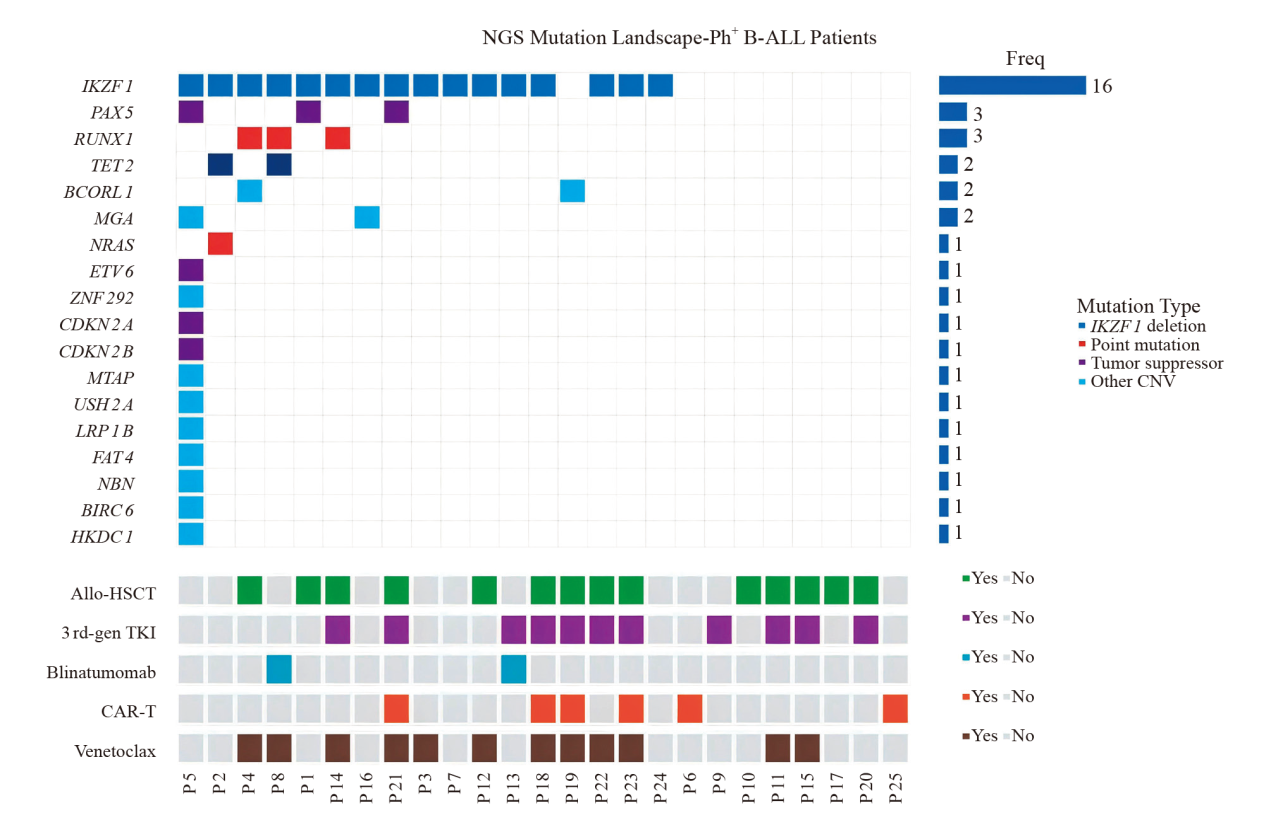
Figure 2
Concurrent genetic variations other than BCR::ABL1 fusion gene and post-induction medication in 25 pediatric patients"
| [1] | Balduzzi A, Valsecchi MG, Tran TH, et al. Philadelphia chromosome‐positive acute lymphoblastic leukaemia in children and adolescents: A changing treatment landscape and a methodological challenge[J/OL]. Br J Haematol, 2025, 208(3): 1127-1132. https://doi.org/10.1111/bjh.70288. |
| [2] | Hunger SP, Tran TH, Saha V, et al. Dasatinib with intensive chemotherapy in de novo paediatric Philadelphia chromosome-positive acute lymphoblastic leukaemia (CA180-372/COG AALL1122): a single-arm, multicentre, phase 2 trial[J/OL]. Lancet Haematol, 2023, 10(7): e510-e520. https://doi.org/10.1016/S2352-3026(23)00088-1. |
| [3] | 中华医学会儿科学分会血液学组. 儿童急性淋巴细胞白血病诊疗建议(第四次修订)[J/OL]. 中华儿科杂志, 2014, 52(9): 641-644. https://doi.org/10.3760/cma.j.issn.0578-1310.2014.09.001. |
| Subspecialty Group of Hematology, Society of Pediatrics, Chinese Medical Association. Recommendations for the diagnosis and treatment of childhood acute lymphoblastic leukemia (4th revision) [J/OL]. Zhoughua Erke Zazhi, 2014, 52( 9): 641-644. https://doi.org/10.3760/cma.j.issn.0578-1310.2014.09.001. | |
| [4] | 黄俊涛, 郑胡镛. 儿童ph阳性急性淋巴细胞白血病的靶向治疗研究进展[J/OL]. 中国小儿血液与肿瘤杂志, 2024, 29(3): 218-223. https://doi.org/10.3969/j.issn.1673-5323.2024. |
| Huang JT, Zheng HY. Research progress on targeted therapy of pediatric Philadelphia chromosome-positive acute lymphoblastic leukemia[J/OL]. Zhongguo Xiaoer Xueye Yu Zhongliu Zazhi, 2024, 29(3): 218-223. https://doi.org/10.3969/j.issn.1673-5323.2024.03.006. | |
| [5] | Shen S, Chen X, Cai J, et al. Effect of dasatinib vs imatinib in the treatment of pediatric philadelphia chro-osome-positive acute lymphoblasa clinical trial[J/OL]. JAMA Oncol, 2019, 6(3): 358-366. https://doi.org/10.1001/jamaoncol.2019.5868. |
| [6] | 王真, 朱嘉莳, 付盼, 等. 复发急性淋巴细胞白血病患儿的预后及影响因素单中心分析[J/OL]. 临床儿科杂志, 2025, 43(04): 271-277. https://doi.org/10.12372/jcp.2025.24e0563. |
| Wang Z, Zhu JS, Fu P, et al. Single-center analysis of prognosis and influencing factors in children with relapsed acute lymphoblastic leukemia[J/OL]. Linchuang Erke Zazhi, 2025, 43(4): 271-277. https://doi.org/10.12372/jcp.2025.24e0563. | |
| [7] | 中华医学会血液学分会干细胞应用学组. 中国异基因造血干细胞移植治疗血液系统疾病专家共识(II)- -移植后白血病复发(2016年版)[J/OL]. 中华血液学杂志, 2016, 37(10): 846-851. https://doi.org/10.3760/cma.j.issn.0253-2727.2016.10.004. |
| Subspecialty Group of Stem Cell Therapy, Chinese Society of Hematology, Chinese Medical Association. Chinese expert consensus on allogeneic hematopoietic stem cell transplantation for hematological diseases (II): post-transplant leukemia relapse (2016 version)[J/OL]. zhonghua xueyexue zazhi, 2016, 37(10): 846-851. https://doi.org/10.3760/cma.j.issn.0253-2727.2016.10.004. | |
| [8] | Blunck CB, Poubel CP, Lopes BA, et al. Characterisation of cells markers associated with IKZF1plus in BCP-ALL[J/OL]. Transl Oncol, 2024, 50: 102127. https://doi.org/10.1016/j.tranon.2024.102127. |
| [9] | Ito Y, Ozawa H, Eto T, et al. IKZF1plus alterations are not associated with outcomes in Philadelphia‐positive acute lymphoblastic leukemia patients enrolled in the FBMTG ALL/MRD2008 trial[J/OL]. European J of Haematology, 2023, 111(1): 103-112. https://doi.org/10.1111/ejh.13972. |
| [10] | Lana T, de Lorenzo P, Bresolin S, et al. Refinement of IKZF1 status in pediatric Philadelphia-positive acute lymphoblastic leukemia[J/OL]. Leukemia, 2015, 29(10): 2107-2110. https://doi.org/10.1038/leu.2015.78. |
| [11] | van der Veer A, Zaliova M, Mottadelli F, et al. IKZF1 status as a prognostic feature in BCR-ABL1-positive childhood ALL[J/OL]. Blood, 2014, 123(11): 1691-1698. https://doi.org/10.1182/blood-2013-06-509794. |
| [12] | van Outersterp I, Boer JM, van de Ven C, et al. Tyrosine kinase inhibitor resistance in de novo BCR::ABL1-positive BCP-ALL beyond kinase domain mutations[J/OL]. Blood Advances, 2024, 8(8): 1835-1845. https://doi.org/10.1182/bloodadvances.2023012162. |
| [13] | Garcia-Solorio J, Núñez-Enriquez JC, Jiménez-Olivares M, et al. IKZF1plus is a frequent biomarker of adverse prognosis in Mexican pediatric patients with B-acute lymphoblastic leukemia[J/OL]. Front. Oncol, 2024, 14. https://doi.org/10.3389/fonc.2024.1337954. |
| [14] | Emerenciano M. IKZF1:born to be the repressor[J/OL]. Blood, 2025, 145(4): 354-356. https://doi.org/10.1182/blood.2024026967. |
| [15] | Deng S, Ou J, Chen J, et al. Refining risk stratification for B-cell precursor adult acute lymphoblastic leukemia treated with a pediatric-inspired regimen by combining IKZF1 deletion and minimal residual disease[J/OL]. Transplant Cell Ther, 2025, 31(4): 242-252. https://doi.org/10.1016/j.jtct.2025.01.003. |
| [16] | Wang’ondu RW, Ashcraft E, Chang T, et al. Heterogeneity of IKZF1 genomic alterations and risk of relapse in childhood B-cell precursor acute lymphoblastic leukemia[J/OL]. Leukemia, 2025, 39(7): 1595-1606. https://doi.org/10.1038/s41375-025-02633-3. |
| [17] | Association of CDKN2A/2B deletion with relapse after hematopoietic stem cell transplantation for acute lymphoblastic leukemia[J/OL]. BCT, 2023, 6(3). https://doi.org/10.31547/bct-2023-004. |
| [18] | Lin S, Liao N, Li X, et al. Prognosis of pediatric BCP‐ALL with IKZF1 deletions and impact of intensive chemotherapy:Results of SCCLG‐2016 study[J/OL]. European J of Haematology, 2024, 113(3): 357-370. https://doi.org/10.1111/ejh.14245. |
| [19] | Fedullo AL, Messina M, Elia L, et al. Prognostic implications of additional genomic lesions in adult Philadelphia chromosome-positive acute lymphoblastic leukemia[J/OL]. Haematologica, 2018, 104(2): 312-318. https://doi.org/10.3324/haematol.2018.196055. |
| [20] | Mitchell RJ, Kirkwood AA, Barretta E, et al. IKZF1 alterations are not associated with outcome in 498 adults with B-precursor ALL enrolled in the UKALL14 trial[J/OL]. Blood Advances, 2021, 5(17): 3322-3332. https://doi.org/10.1182/bloodadvances.2021004430. |
| [21] | Foà R, Bassan R, Vitale A, et al. Dasatinib-Blinatumomab for Ph-positive acute lymphoblastic leukemia in adults[J/OL]. N Engl J Med, 2020, 383(17):1613-1623. https://doi.org/10.1056/NEJMoa2016272. |
| [22] | Sasaki Y, Kantarjian HM, Short NJ, et al. Genetic correlates in patients with Philadelphia chromosome-positive acute lymphoblastic leukemia treated with Hyper-CVAD plus dasatinib or ponatinib[J/OL]. Leukemia, 2022, 36(5): 1253-1260. https://doi.org/10.1038/s41375-021-01496-8. |
| [23] | Kim R, Chalandon Y, Rousselot P, et al. Significance of measurable residual disease in adult philadelphia chromosome-Positive ALL:A GRAAPH-2014 Study[J/OL]. JCO, 2024, 42(26): 3140-3150. https://doi.org/10.1200/JCO.24.00108. |
| [24] | Li J, Lu A, Gao Y, et al. Minimal residual disease monitoring in childhood Philadelphia-positive acute lymphoblastic leukemia: prognostic significance and correlation between multiparameter flow cytometry and real-time quantitative polymerase chain reaction[J/OL]. Touch Rev Oncol Haematol, 2024. https://doi.org/10.3324/haematol.2024.285119. |
| [25] | Pan L, Chen Y, Weng K, et al. Prognostic significance and treatment strategies for IKZF1 deletion in pediatric B-cell precursor acute lymphoblastic leukemia[J/OL]. BMC Cancer, 2024, 24(1). https://doi.org/10.1186/s12885-024-12828-z. |
| [26] | 王毓, 薛玉娟, 左英熹, 等. CD19 CAR-T细胞治疗难治/复发急性B淋巴细胞白血病儿童及青少年患者的疗效及安全性[J]. 临床儿科杂志, 2024, 42(7): 583-588. https://doi.org/10.12372/jcp.2024.24e0207. |
| Wang Y, Xue YJ, Zuo YX, et al. Efficacy and safety of CD19 targeted CAR-T cells in the treatment of refractory/relapsed B-cell acute lymphoblastic leukemia in children and adolescents[J/OL]. Linchuang Erke Zazhi, 2024, 42(7): 583-588. https://doi.org/10.12372/jcp.2024.24e0207. | |
| [27] | Soverini S, Martelli M, Bavaro L, et al. BCR-ABL1 compound mutants:prevalence, spectrum and correlation with tyrosine kinase inhibitor resistance in a consecutive series of Philadelphia chromosome-positive leukemia patients analyzed by NGS[J/OL]. Leukemia, 2020, 35(7): 2102-2107. https://doi.org/10.1038/s41375-020-01098-w. |
| [1] | LIN Jinfeng, CHEN Yi, DENG Yan, FENG Ai, HUANG Juan, CHEN Lizhu, XIE Jingqi, NIE Xiaojing. A comparative study on the detection of anti-Nephrin antibodies in children's nephrotic syndrome by chemiluminescence method and cell-based assay [J]. Journal of Clinical Pediatrics, 2026, 44(8): 682-689. |
| [2] | ZHANG Xiao, FANG Hongjun, KUANG Xiaojun, WANG Lijuan, WU Zhao, JIANG Sha, LI Pei, WU Liwen. Analysis of the clinical and electrophysiological characteristics of atonic seizures in children [J]. Journal of Clinical Pediatrics, 2026, 44(8): 698-704. |
| [3] | WANG Mengqian, YANG Hui. Case series analysis of 13 intestinal Behcet’s syndrome in children [J]. Journal of Clinical Pediatrics, 2026, 44(8): 705-711. |
| [4] | WU Xirong, GAO Qi, GUO Siyuan, YIN Qingqin, QIN Qiang, YIN Ju, JIAO Anxia, CHEN Chenghao, WU Di, WANG Bei, DUAN Xiaomin, PENG Yun, XU Baoping, GAO Liwei. Clinical characteristics and prognosis of pulmonary mucormycosis in children with diabetes mellitus [J]. Journal of Clinical Pediatrics, 2026, 44(8): 712-720. |
| [5] | HAN Yanan, GE Lanlan, CUI Jieyuan. A case report of branchio-oto-renal syndrome caused by EYA1 gene variant with a 6-year follow-up [J]. Journal of Clinical Pediatrics, 2026, 44(8): 721-726. |
| [6] | SHI Jiayi, GAO Chunlin, JIA Lili, LU Yunyun, SUN Tao, ZHU Xiaodong, XIA Zhengkun, ZHANG Pei. Phenotypic characteristics and prognostic analysis of a pedigree with childhood isolated nephrotic syndrome caused by compound heterozygous mutations in the COQ2 gene [J]. Journal of Clinical Pediatrics, 2026, 44(8): 727-732. |
| [7] | Rachel Rosen, Osvaldo Borrelli, Christophe Faure, Katja Karrento, Usha Krishnan, Samuel Nurko, Nathalie Rommel, Alan Silverman, Michiel van Wijk, Marc Benninga (Author), Chinese Medical Association Parenteral and Enteral Nutrition Branch Pediatrics Group, The Subspecialty Group of Gastroenterology, The Society of Pediatric, Chinese Medical Association, Gastroenterology Group, Pediatrician Branch, Chinese Medical Doctor Association (Translator). Core interpretation and explanation of Rome Ⅴ diagnostic criteria: upper gastrointestinal disorders of gut-brain interaction in children and adolescents [J]. Journal of Clinical Pediatrics, 2026, 44(7): 595-608. |
| [8] | Carlo Di Lorenzo, Miguel Saps, Bruno P. Chumpitazi, Shaman Rajindrajith, Annamaria Staiano, Nikhil Thapar, Miranda van Tilburg, Carlos Velasco-Benítez, Arine Vlieger (Author), Chinese Medical Association Parenteral and Enteral Nutrition Branch Pediatrics Group, The Subspecialty Group of Gastroenterology, The Society of Pediatric, Chinese Medical Association, Gastroenterology Group, Pediatrician Branch, Chinese Medical Doctor Association (Translator). Core interpretation and explanation of Rome Ⅴ diagnostic criteria: lower and biliary disorders of gut-brain interaction in children and adolescents [J]. Journal of Clinical Pediatrics, 2026, 44(7): 609-621. |
| [9] | LI Xufeng, TANG Haoxun, LI Xingjun, ZHANG Lize, GAO Chenqing, ZHAO Shunying, LIU Jianhua. Clinical characteristics, chest CT imaging phenotypes, and their correlation with prognosis in 76 children with Chlamydia pneumoniae pneumonia [J]. Journal of Clinical Pediatrics, 2026, 44(7): 622-627. |
| [10] | WANG Zhen, SHAO Jingbo, ZHANG Na, XIA Min, ZHU Jiashi, DU Chengkan, LI Hong. Factors influencing long-term recurrence in pediatric acute lymphoblastic leukemia patients with low-risk disease at initial diagnosis: a five-year follow-up analysis of 254 cases from a single center [J]. Journal of Clinical Pediatrics, 2026, 44(7): 628-635. |
| [11] | GUO Xuemei, XUE Yao, WANG Yongren, RONG Liucheng, FANG Yongjun, LIN Rufeng. Clinical features and prognosis of childhood acute myeloid leukemia with CBFA2T3::GLIS2 fusion [J]. Journal of Clinical Pediatrics, 2026, 44(7): 636-643. |
| [12] | YANG Lijun, FU Dongxia, CUI Yan, YANG Junmei, ZHANG Liming. Clinical manifestation and genetic analysis of CHARGE syndrome caused by CHD7 gene variation [J]. Journal of Clinical Pediatrics, 2026, 44(7): 644-650. |
| [13] | HU Yan, YANG Fan, LIANG Aimin, MAO Meng. Identification and management of faltering growth in children: insights from the 13th International Conference on Nutrition and Growth [J]. Journal of Clinical Pediatrics, 2026, 44(6): 485-488. |
| [14] | LIU Ziyao, WANG Congying, WANG Hongmao, ZHANG Mingming, XU Yingjie, LAI Jianming, NIU Wenquan, LI Xiaohui. Early differentiation of Kawasaki disease with joint symptoms and systemic juvenile idiopathic arthritis with Kawasaki disease-like symptoms: a single-center retrospective study [J]. Journal of Clinical Pediatrics, 2026, 44(6): 489-498. |
| [15] | LI Jian, LI Tao, HE Lulu, WU Lei, HU Tianjiao, HUANG Yixuan, LIN Xinrong, SHEN Qiyang, PAN Sirui, XIE Nan, ZHOU Jianfeng, ZHOU Chunlei, ZHOU Li. A retrospective analysis of 50 cases of malignant rhabdoid tumor in children: clinical features, treatment response and prognostic factors [J]. Journal of Clinical Pediatrics, 2026, 44(6): 499-507. |
|
||
