

Journal of Clinical Pediatrics ›› 2026, Vol. 44 ›› Issue (6): 532-539.doi: 10.12372/jcp.2026.25e0962
• Original Article • Previous Articles Next Articles
SHI Yongyuan1,2, YANG Lijuan1,2, LEI Wenting1, XIONG Yurong1, PAN Shujing1, LI Yuelin1, ZHANG Jiali1, TIAN Maoqiang1( )
)
Received:2025-08-07
Revised:2025-11-17
Accepted:2025-12-04
Published:2026-06-15
Online:2026-06-04
Contact:
TIAN Maoqiang
E-mail:drmaoqiang@126.com
CLC Number:
SHI Yongyuan, YANG Lijuan, LEI Wenting, XIONG Yurong, PAN Shujing, LI Yuelin, ZHANG Jiali, TIAN Maoqiang. Clinical characteristics and prognosis analysis of autoimmune encephalitis with movement disorders in children: A single-center retrospective study[J].Journal of Clinical Pediatrics, 2026, 44(6): 532-539.
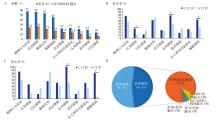
Figure 1
Clinical data of 82 children with AE"
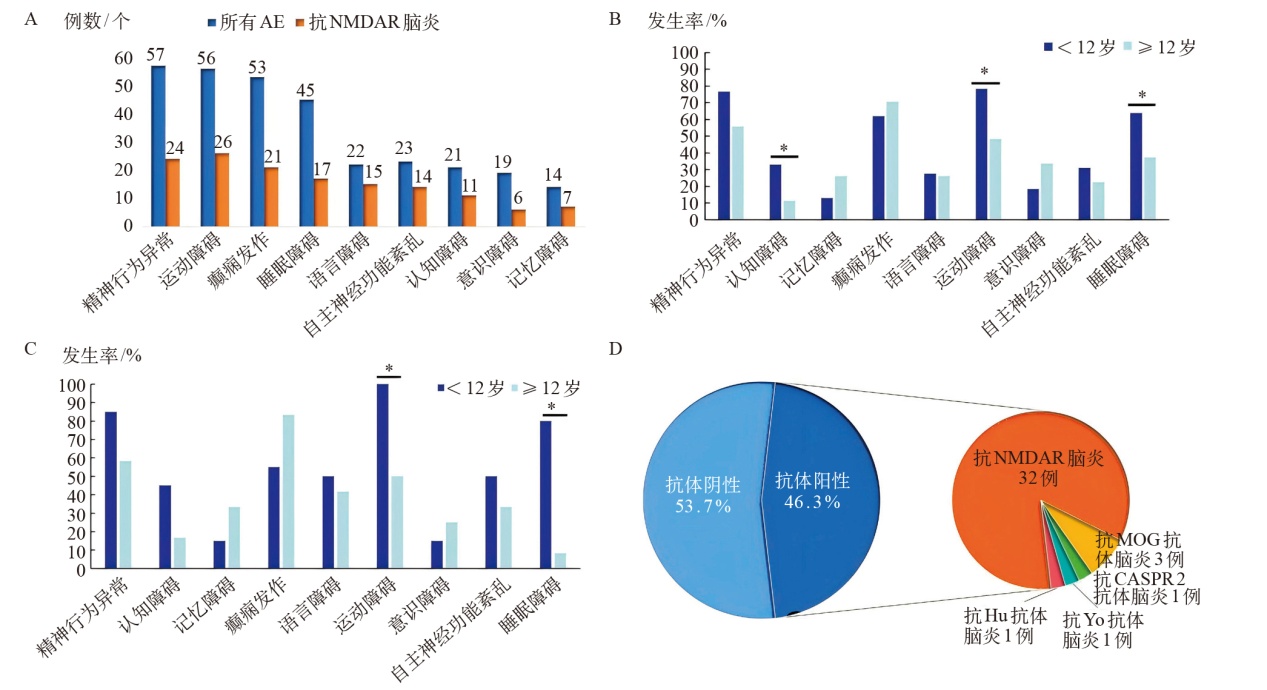
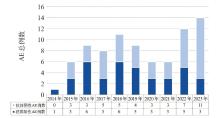
Figure 2
Distribution of antibody-positive and antibody-negative AE patients"
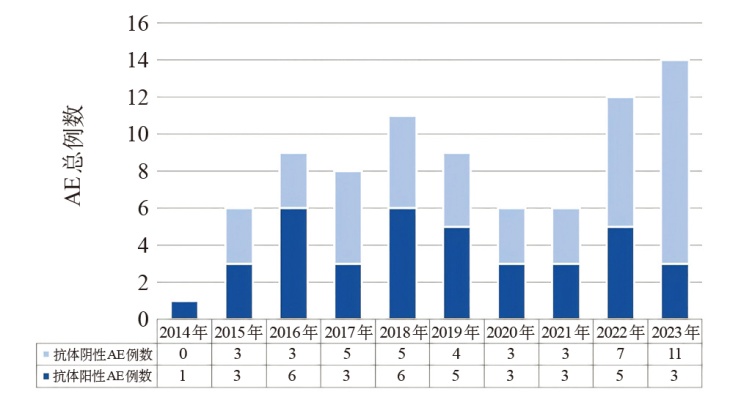

Table 1
Analysis of general information and clinical manifestations in 82 children with AE"
| 项目 | 运动障碍组(n=56) | 无运动障碍组(n=26) | 统计量 | P |
|---|---|---|---|---|
| 年龄[M(P25~P75)]/岁 | 8(4~11) | 12.5(4~14.5) | Z=1.78 | 0.075 |
| 男性[n(%)] | 25(44.6) | 14(53.8) | χ2=0.60 | 0.437 |
| 住院时长[M(P25~P75)]/d | 20.00(14.00~26.5) | 17.5(12.75~22.25) | Z=1.42 | 0.155 |
| 急性或亚急性起病[n(%)] | 53(94.6) | 25(96.2) | χ2=0.00 | 1.000 |
| 呕吐[n(%)] | 2(3.6) | 0(0.0) | - | 1.0001) |
| 头晕/头痛[n(%)] | 4(7.1) | 6(23.1) | χ2=2.85 | 0.091 |
| 精神行为异常[n(%)] | 41(73.2) | 16(61.5) | χ2=1.14 | 0.285 |
| 认知障碍[n(%)] | 17(30.4) | 4(15.4) | χ2=2.09 | 0.148 |
| 记忆障碍[n(%)] | 8(14.3) | 6(23.1) | χ2=0.45 | 0.503 |
| 癫痫发作[n(%)] | 35(62.5) | 18(69.2) | χ2=0.35 | 0.553 |
| 癫痫持续状态[n(%)] | 9(16.1) | 3(11.5) | χ2=0.04 | 0.838 |
| 语言障碍[n(%)] | 18(32.1) | 4(15.4) | χ2=2.54 | 0.111 |
| 意识障碍[n(%)] | 15(26.8) | 4(15.4) | χ2=1.30 | 0.255 |
| 自主神经功能障碍[n(%)] | 20(35.7) | 3(11.5) | χ2=5.14 | 0.023 |
| 睡眠障碍[n(%)] | 35(62.5) | 10(38.5) | χ2=4.14 | 0.042 |
| 阳性体征[n(%)] | 12(21.4) | 3(11.5) | χ2=0.60 | 0.441 |
| 并发症[M(P25~P75)]/个 | 1(0~3) | 1(0~2) | Z=0.32 | 0.749 |
| 治疗前mRS评分[M(P25~P75)] | 4(3~4.75) | 3(3~4.25) | Z=2.25 | 0.025 |
Table 2
Analysis of auxiliary examinations in 82 cases of AE in children"
| 项目 | 运动障碍组(n=56) | 无运动障碍组(n=26) | 统计量 | P |
|---|---|---|---|---|
| 外周血白细胞[M(P25~P75)]/×109·L-1 | 8.47(6.20~11.33) | 6.85(5.69~10.69) | Z=1.11 | 0.267 |
| 外周血血红蛋白( x±s)/g·L-1 | 122.70±15.34 | 122.38±13.18 | t=0.09 | 0.929 |
| 外周血血小板( x±s)/×109·L-1 | 322.88±118.59 | 326.27±109.24 | t=0.12 | 0.902 |
| 外周血中性粒细胞[M(P25~P75)]/×109·L-1 | 5.24(3.92~7.97) | 4.74(3.10~7.20) | Z=1.04 | 0.298 |
| 外周血淋巴细胞[M(P25~P75)]/×109·L-1 | 1.93(1.45~2.91) | 1.94(0.96~2.44) | Z=1.12 | 0.262 |
| 血钾( x±s)/mmol·L-1 | 4.14±0.46 | 4.14±0.52 | t=0.05 | 0.961 |
| 血钠( x±s)/mmol·L-1 | 137.49±2.64 | 136.94±3.10 | t=0.84 | 0.404 |
| 丙氨酸氨基转移酶[M(P25~P75)]/U·L-1 | 16.50(12.00~30.25) | 19.00(9.75~28.50) | Z=0.39 | 0.694 |
| 肌酸激酶同工酶[M(P25~P75)]/U·L-1 | 19.0(14.00~24.00) | 19.0(15.00~22.00) | Z=0.37 | 0.712 |
| 脑脊液压力≥200 mmH2O[n(%)] | 13(23.2) | 8(30.8) | χ2=0.53 | 0.466 |
| 脑脊液白细胞[M(P25~P75)]/×106·L-1 | 11.00(1.25~32.75) | 8.00(2.00~14.75) | Z=0.74 | 0.457 |
| 脑脊液蛋白质[M(P25~P75)]/mg·L-1 | 295.50(198.00~365.75) | 295.50(244.00~397.50) | Z=0.52 | 0.517 |
| 脑脊液葡萄糖( x±s)/mmol·L-1 | 3.62±0.54 | 3.96±0.62 | t=2.55 | 0.013 |
| 脑脊液氯化物( x±s)/mmol·L-1 | 125.85±4.03 | 125.82±2.91 | t=0.03 | 0.977 |
| 抗NMDAR抗体阳性[n(%)] | 26(46.4) | 6(23.1) | χ2=4.07 | 0.044 |
| 头颅MRI异常[n(%)] | 27(48.2) | 11(42.3) | χ2=0.25 | 0.618 |
| 脑电图异常[n(%)] | 45(80.4) | 22(84.6) | χ2=0.03 | 0.875 |
Table 3
Analysis of treatment and prognosis in 82 children with AE"
| 项目 | 运动障碍组(n=56) | 无运动障碍组(n=26) | 统计量 | P |
|---|---|---|---|---|
| 免疫延迟治疗[n(%)] | 10(17.9) | 4(15.4) | χ2=0.00 | 1.000 |
| 二线治疗[n(%)] | 9(16.1) | 3(11.5) | χ2=0.04 | 0.838 |
| 气管插管[n(%)] | 7(12.5) | 8(30.8) | χ2=2.84 | 0.092 |
| 出院时mRS评分[M(P25~P75)] | 2.00(1.00~3.75) | 1.00(1.00~2.00) | Z=2.21 | 0.027 |
| 随访时mRS评分[M(P25~P75)] | 0.00(0.00~2.00) | 0.00(0.00~2.00) | Z=0.31 | 0.757 |
| 预后不良[n(%)] | 16(28.6) | 8(30.8) | χ2=0.04 | 0.839 |
| 复发[n(%)] | 7(12.5) | 2(7.7) | χ2=0.07 | 0.788 |
| [1] |
Ren H, Fan S, Zhao Y, et al. The changing spectrum of antibody-mediated encephalitis in China[J]. J Neuroimmunol, 2021, 361: 577753.
doi: 10.1016/j.jneuroim.2021.577753 |
| [2] |
Dalmau J, Graus F. Antibody-mediated encephalitis[J]. N Engl J Med, 2018, 378(9): 840-851.
doi: 10.1056/NEJMra1708712 |
| [3] | 中华医学会神经病学分会神经感染性疾病与脑脊液细胞学学组. 中国自身免疫性脑炎诊治专家共识(2022年版)[J]. 中华神经科杂志, 2022, 55(9): 931-949. |
| Chinese Society of Neuroinfectious Diseases and Cerebrospinal Fluid Cytology. Chinese expert consensus on the diagnosis and management of autoimmune encephalitis (2022 edition)[J]. Zhonghua Shenjingke Zazhi, 2022, 55(9): 931-949. | |
| [4] |
Li X, Hou C, Wu WL, et al. Pediatric anti-N-methyl-D-aspartate receptor encephalitis in southern China: analysis of 111 cases[J]. J Neuroimmunol, 2021, 352: 577479.
doi: 10.1016/j.jneuroim.2021.577479 |
| [5] | 李红梅, 孟强. 抗N-甲基-D-天冬氨酸受体脑炎运动障碍的研究进展[J]. 中华神经医学杂志, 2023, 22(8): 844-848. |
| Li HM, Meng Q. Recent advance in movement disorder of anti-N-methyl-D-aspartate receptor encephalitis[J]. Zhonghua Shenjingyixue Zazhi, 2023, 22(8): 844-848. | |
| [6] |
Termsarasab P, Frucht SJ. Dystonic storm: a practical clinical and video review[J]. J Clin Mov Disord, 2017, 4: 10.
doi: 10.1186/s40734-017-0057-z pmid: 28461905 |
| [7] | 侯池, 李小晶, 田杨, 等. 儿童抗N-甲基-D-天冬氨酸受体脑炎合并横纹肌溶解症4例分析[J]. 临床儿科杂志, 2021, 39(12): 938-940. |
| Hou C, Li XJ, Tian Y, et al. Anti-N-methyl-D-aspartate-receptor encephalitis with rhabdomyolysis in children[J]. Linchuang Erke Zazhi, 2021, 39(12): 938-940. | |
| [8] | 马碧泓, 黄玲英, 施晓容. 儿童抗N-甲基-D-天冬氨酸受体脑炎评估量表的应用研究进展[J]. 中外医疗, 2025, 44(3): 148-152. |
| Ma BH, Huang LY, Shi XR. Research progress on the application of assessment scales for pediatric anti-N-methyl-D-aspartate receptor encephalitis[J]. Zhongwai Yiliao, 2025, 44(3): 148-152. | |
| [9] |
Goldberg EM, Titulaer M, de Blank P M, et al. Anti-N-methyl-D-aspartate receptor-mediated encephalitis in infants and toddlers: case report and review of the literature[J]. Pediatr Neurol, 2014, 50(2): 181-184.
doi: 10.1016/j.pediatrneurol.2013.10.002 pmid: 24315538 |
| [10] |
Cantalupo G, Fasano A. Pediatric freezing of gait caused by anti-NMDAR encephalitis[J]. Mov Disord, 2019, 34(5): 756-757.
doi: 10.1002/mds.v34.5 |
| [11] |
Varley JA, Webb AJS, Balint B, et al. The Movement disorder associated with NMDAR antibody-encephalitis is complex and characteristic: an expert video-rating study[J]. J Neurol Neurosurg Psychiatry, 2019, 90(6): 724-726.
doi: 10.1136/jnnp-2018-318584 pmid: 30032119 |
| [12] |
Sanger TD, Chen D, Fehlings D L, et al. Definition and classification of hyperkinetic movements in childhood[J]. Mov Disord, 2010, 25(11): 1538-1549.
doi: 10.1002/mds.v25:11 |
| [13] |
Graus F, Titulaer MJ, Balu R, et al. A clinical approach to diagnosis of autoimmune encephalitis[J]. Lancet Neurol, 2016, 15(4): 391-404.
doi: 10.1016/S1474-4422(15)00401-9 pmid: 26906964 |
| [14] |
Tania Cellucci, Heather Van Mater, Francesc Graus, et al. Clinical approach to the diagnosis of autoimmune encephalitis in the pediatric patient[J]. Neurol Neuroimmunol Neuroinflamm, 2020, 7(4): e730.
doi: 10.1212/NXI.0000000000000730 |
| [15] |
Dale RC, Mohammad SS. Movement disorders associated with pediatric encephalitis[J]. Handb Clin Neurol, 2024, 200: 229-238.
doi: 10.1016/B978-0-12-823912-4.00018-9 pmid: 38494280 |
| [16] |
Seery N, Butzkueven H, O'Brien T J, et al. Contemporary advances in anti-NMDAR antibody (Ab)-mediated encephalitis[J]. Autoimmun Rev, 2022, 21(4): 103057.
doi: 10.1016/j.autrev.2022.103057 |
| [17] |
Yoshida J, Oñate M, Khatami L, et al. Cerebellar contributions to the basal ganglia influence motor coordination, reward processing, and movement vigor[J]. J Neurosci, 2022, 42(45): 8406-8415.
doi: 10.1523/JNEUROSCI.1535-22.2022 pmid: 36351826 |
| [18] |
Garone G, Graziola F, Grasso M, et al. Acute Movement disorders in childhood[J]. J Clin Med, 2021, 10(12): 2671.
doi: 10.3390/jcm10122671 |
| [19] |
Qin M, Chen J, Guo X, et al. Movement disorders in autoimmune encephalitis: an update[J]. J Neurol, 2023, 270(11): 5288-5302.
doi: 10.1007/s00415-023-11881-1 |
| [20] |
Siriratnam P, McArthur L, Chen Z, et al. Movement disorders in cell surface antibody mediated autoimmune encephalitis: a meta-analysis[J]. Front Neurol, 2023, 14: 1225523.
doi: 10.3389/fneur.2023.1225523 |
| [21] | Haq AU, Nabi D, Alam M, et al. The spectrum of movement disorders in anti-N-methyl-D-aspartate receptor (NMDAR) encephalitis both in children and adults: an experience from a single tertiary care center[J]. Cureus, 2021, 13(12): e20376. |
| [22] |
Balint B, Vincent A, Meinck HM, et al. Movement disorders with neuronal antibodies: syndromic approach, genetic parallels and pathophysiology[J]. Brain, 2018, 141(1): 13-36.
doi: 10.1093/brain/awx189 pmid: 29053777 |
| [23] |
Granata T, Matricardi S, Ragona F, et al. Pediatric NMDAR encephalitis: a single center observation study with a closer look at movement disorders[J]. Eur J Paediatr Neurol, 2018, 22(2): 301-307.
doi: 10.1016/j.ejpn.2018.01.012 |
| [24] |
Hang H, Lin L, Li D, et al. Association between clinical factors and orofacial dyskinesias in anti-N-methyl-D-aspartate receptor encephalitis[J]. Brain Behav, 2022, 12(7): e2638.
doi: 10.1002/brb3.2638 pmid: 35620876 |
| [25] | Feng J, Li J, Xie Y, et al. Clinical features of 28 cases of anti-leucine-rich glioma-inactivated protein 1 encephalitis and anti-contactin-associated protein-like 2 encephalitis[J]. Zhong Nan Da Xue Xue Bao Yi Xue Ban, 2023, 48(3): 386-396. |
| [26] |
Ghimire P, Khanal UP, Gajurel BP, et al. Anti-LGI1, anti-GABABR, and Anti-CASPR2 encephalitides in Asia: a systematic review[J]. Brain Behav, 2020, 10(10): e01793.
doi: 10.1002/brb3.v10.10 |
| [27] |
石红琴, 孟环宇, 梁华峰, 等. 免疫相关运动障碍临床研究进展[J]. 中国现代神经疾病杂志, 2020, 20(9): 766-772.
doi: 10.3969/j.issn.1672-6731.2020.09.003 |
| Shi HQ, Meng HY, Liang HF, et al. Clinical progress of immune-related movement disorder[J]. Zhongguo Xiandai Shenjingjibing Zazhi, 2020, 20(9): 766-772. | |
| [28] | 杭海伦, 林柳余, 陆杰, 等. 抗N-甲基-D天冬氨酸受体脑炎运动障碍临床分析[J]. 中国神经精神疾病杂志, 2022, 48(3): 129-133. |
| Hang HL, Lin LY, Lu J, et al. The analysis of characteristics of movement disorders in anti-N-methyl-D-aspartate receptor encephalitis[J]. Zhongguo Shenjing Jingshen Jibing Zazhi, 2022, 48(3): 129-133. | |
| [29] |
Yeshokumar AK, Sun LR, Klein JL, et al. Gait disturbance as the presenting symptom in young children with anti-NMDA receptor encephalitis[J]. Pediatrics, 2016, 138(3): e20160901.
doi: 10.1542/peds.2016-0901 |
| [30] |
Yan L, Zhang S, Huang X, et al. Clinical study of autonomic dysfunction in patients with anti-NMDA receptor encephalitis[J]. Front Neurol, 2021, 12: 609750.
doi: 10.3389/fneur.2021.609750 |
| [31] |
Li H, Chen J, Zhou P, et al. Analysis of characteristics of movement disorders in patients with anti-N-methyl-D-aspartate receptor encephalitis[J]. Front Neurol, 2024, 15: 1357697.
doi: 10.3389/fneur.2024.1357697 |
| [32] |
李学斌, 杨灿, 李秋波. 抗N-甲基-D-天门冬氨酸受体脑炎病理机制的研究进展[J]. 中风与神经疾病杂志, 2023, 40(4): 382-384.
doi: 10.19845/j.cnki.zfysjjbzz.2023.0091 |
| Li XB, Yang C, Li QB. Research progress on the pathological mechanism of anti-N-methyl-D-sspartate receptor encephalitis[J]. Zhongfeng Yu Shenjingjibing Zazhi, 2023, 40(4): 382-384. | |
| [33] |
Stamelou M, Plazzi G, Lugaresi E, et al. The distinct movement disorder in anti-NMDA receptor encephalitis may be related to status dissociatus: a hypothesis[J]. Mov Disord, 2012, 27(11): 1360-1363.
doi: 10.1002/mds.v27.11 |
| [1] | Rachel Rosen, Osvaldo Borrelli, Christophe Faure, Katja Karrento, Usha Krishnan, Samuel Nurko, Nathalie Rommel, Alan Silverman, Michiel van Wijk, Marc Benninga (Author), Chinese Medical Association Parenteral and Enteral Nutrition Branch Pediatrics Group, The Subspecialty Group of Gastroenterology, The Society of Pediatric, Chinese Medical Association, Gastroenterology Group, Pediatrician Branch, Chinese Medical Doctor Association (Translator). Core interpretation and explanation of Rome Ⅴ diagnostic criteria: upper gastrointestinal disorders of gut-brain interaction in children and adolescents [J]. Journal of Clinical Pediatrics, 2026, 44(7): 595-608. |
| [2] | Carlo Di Lorenzo, Miguel Saps, Bruno P. Chumpitazi, Shaman Rajindrajith, Annamaria Staiano, Nikhil Thapar, Miranda van Tilburg, Carlos Velasco-Benítez, Arine Vlieger (Author), Chinese Medical Association Parenteral and Enteral Nutrition Branch Pediatrics Group, The Subspecialty Group of Gastroenterology, The Society of Pediatric, Chinese Medical Association, Gastroenterology Group, Pediatrician Branch, Chinese Medical Doctor Association (Translator). Core interpretation and explanation of Rome Ⅴ diagnostic criteria: lower and biliary disorders of gut-brain interaction in children and adolescents [J]. Journal of Clinical Pediatrics, 2026, 44(7): 609-621. |
| [3] | LI Xufeng, TANG Haoxun, LI Xingjun, ZHANG Lize, GAO Chenqing, ZHAO Shunying, LIU Jianhua. Clinical characteristics, chest CT imaging phenotypes, and their correlation with prognosis in 76 children with Chlamydia pneumoniae pneumonia [J]. Journal of Clinical Pediatrics, 2026, 44(7): 622-627. |
| [4] | WANG Zhen, SHAO Jingbo, ZHANG Na, XIA Min, ZHU Jiashi, DU Chengkan, LI Hong. Factors influencing long-term recurrence in pediatric acute lymphoblastic leukemia patients with low-risk disease at initial diagnosis: a five-year follow-up analysis of 254 cases from a single center [J]. Journal of Clinical Pediatrics, 2026, 44(7): 628-635. |
| [5] | GUO Xuemei, XUE Yao, WANG Yongren, RONG Liucheng, FANG Yongjun, LIN Rufeng. Clinical features and prognosis of childhood acute myeloid leukemia with CBFA2T3::GLIS2 fusion [J]. Journal of Clinical Pediatrics, 2026, 44(7): 636-643. |
| [6] | YANG Lijun, FU Dongxia, CUI Yan, YANG Junmei, ZHANG Liming. Clinical manifestation and genetic analysis of CHARGE syndrome caused by CHD7 gene variation [J]. Journal of Clinical Pediatrics, 2026, 44(7): 644-650. |
| [7] | HU Yan, YANG Fan, LIANG Aimin, MAO Meng. Identification and management of faltering growth in children: insights from the 13th International Conference on Nutrition and Growth [J]. Journal of Clinical Pediatrics, 2026, 44(6): 485-488. |
| [8] | LIU Ziyao, WANG Congying, WANG Hongmao, ZHANG Mingming, XU Yingjie, LAI Jianming, NIU Wenquan, LI Xiaohui. Early differentiation of Kawasaki disease with joint symptoms and systemic juvenile idiopathic arthritis with Kawasaki disease-like symptoms: a single-center retrospective study [J]. Journal of Clinical Pediatrics, 2026, 44(6): 489-498. |
| [9] | LI Jian, LI Tao, HE Lulu, WU Lei, HU Tianjiao, HUANG Yixuan, LIN Xinrong, SHEN Qiyang, PAN Sirui, XIE Nan, ZHOU Jianfeng, ZHOU Chunlei, ZHOU Li. A retrospective analysis of 50 cases of malignant rhabdoid tumor in children: clinical features, treatment response and prognostic factors [J]. Journal of Clinical Pediatrics, 2026, 44(6): 499-507. |
| [10] | LI Yanhua, ZHANG Huanhuan, YANG Jingwei, LIAO Xuelian, SHAO Jingbo, JIAO Yangyang, ZHANG Ting, HUANG Can, JIANG Shayi. Analysis of survival prognosis and related risk factors of pediatric head and neck rhabdomyosarcoma [J]. Journal of Clinical Pediatrics, 2026, 44(6): 518-523. |
| [11] | GU Xinjia, ZHENG Zhihui, MEI Lingli, ZHENG Jinxin, LIU Taixiang, ZHU Jihua. Burden of urinary system diseases in children and adolescents in China, 1990-2023 [J]. Journal of Clinical Pediatrics, 2026, 44(6): 546-555. |
| [12] | CHEN Xumei, AIERKEN Aibibai, YUE Xueyan, RU Liang, ZHANG Li. A study on the latent profile analysis of psychological resilience and coping styles of parents of children with asthma and its influencing factors [J]. Journal of Clinical Pediatrics, 2026, 44(6): 556-563. |
| [13] | LUO Zihao, LI Shaojun, REN Peizhen, WANG Yanhong, GENG Gang. Analysis of clinical characteristics of children with pneumonia complicated with plastic bronchitis and establishment and validation of risk prediction model [J]. Journal of Clinical Pediatrics, 2026, 44(6): 564-572. |
| [14] | CHU Weihong, XU Liyan, PENG Shao, LAI Jianming. Lower extremity arterial thrombosis as first clinical manifestation in children's systemic lupus erythematosus complicated with antiphospholipid syndrome: a two-case report [J]. Journal of Clinical Pediatrics, 2026, 44(6): 579-583. |
| [15] | CHEN Liuwang, LIU Pan, XI Rongjuan, ZHANG Xianxia, ZHANG Yi, WEI Xingjiao, SU Min, YANG Yonghong, FU Yangxi. Methylmalonic acidemia with homocystinemia causing subacute combined degeneration of the spinal cord : a case report [J]. Journal of Clinical Pediatrics, 2026, 44(6): 584-588. |
|
||
