

Journal of Clinical Pediatrics ›› 2026, Vol. 44 ›› Issue (6): 556-563.doi: 10.12372/jcp.2026.25e1127
• Original Article • Previous Articles Next Articles
CHEN Xumei, AIERKEN Aibibai, YUE Xueyan, RU Liang( ), ZHANG Li()
Received:2025-09-12
Revised:2025-12-15
Accepted:2026-01-19
Published:2026-06-15
Online:2026-06-04
Contact:
RU Liang, ZHANG Li
E-mail:18997953070@163.com;meilirenshengicu@163.com
CLC Number:
CHEN Xumei, AIERKEN Aibibai, YUE Xueyan, RU Liang, ZHANG Li. A study on the latent profile analysis of psychological resilience and coping styles of parents of children with asthma and its influencing factors[J].Journal of Clinical Pediatrics, 2026, 44(6): 556-563.

Table 1
Basic information of children with asthma and their caregivers"
| 项目 | 分类 | n | % |
|---|---|---|---|
| 患儿性别 | 男 | 132 | 55.90 |
| 女 | 104 | 44.10 | |
| 患儿年龄/岁 | ≤6 | 107 | 45.30 |
| 7~14 | 129 | 54.70 | |
| 哮喘病程 | <1年 | 65 | 27.50 |
| 1~3年 | 97 | 41.10 | |
| >3年 | 74 | 31.40 | |
| 发作频率 | 每月≥4次 | 58 | 24.60 |
| 每月2~3次 | 86 | 36.40 | |
| 每月<2次 | 92 | 39.00 | |
| 哮喘严重程度 | 轻度 | 96 | 40.70 |
| 中度 | 102 | 43.20 | |
| 重度 | 38 | 16.10 | |
| 家长身份 | 父亲 | 92 | 39.00 |
| 母亲 | 144 | 61.00 | |
| 家长年龄/岁 | 25~35 | 124 | 52.50 |
| 36~45 | 98 | 41.50 | |
| >45 | 14 | 5.90 | |
| 家长文化程度 | 小学及以下 | 20 | 8.50 |
| 初中 | 56 | 23.70 | |
| 高中/中专 | 74 | 31.40 | |
| 大专及以上 | 86 | 36.40 | |
| 家庭月收入/元 | <5000 | 68 | 28.80 |
| 5000~10000 | 93 | 39.40 | |
| >10000 | 75 | 31.80 | |
| 是否主要照护者 | 否 | 41 | 17.40 |
| 是 | 195 | 82.60 |
Table 2
Model fit results of the latent profile analysis of psychological resilience and coping styles in parents of children with asthma"
| 类别 | AIC | BIC | aBIC | 熵值 | LMRT | BLRT | 类别概率 |
|---|---|---|---|---|---|---|---|
| 模型1 | 2543.553 | 2578.191 | 2546.495 | 1 | |||
| 模型2 | 1950.795 | 2006.217 | 1955.503 | 0.897 | <0.001 | <0.001 | 0.602/0.398 |
| 模型3 | 1725.686 | 1801.891 | 1732.159 | 0.900 | <0.001 | <0.001 | 0.226/0.413/0.361 |
| 模型4 | 1667.763 | 1764.751 | 1676.001 | 0.883 | 0.148 | <0.001 | 0.318/0.161/0.174/0.347 |
| 模型5 | 1568.029 | 1685.799 | 1578.032 | 0.904 | 0.286 | <0.001 | 0.110/0.284/0.242/0.119/0.246 |
Table 3
Proportions of each category and basis for naming"
| 类别 | 名称 | n(%) | 命名依据 |
|---|---|---|---|
| 类别1 | 低弹性-消极应对型 | 52(22.0) | 此亚型家长的心理弹性得分较低,在面对患儿哮喘时,容易产生焦虑、抑郁、无助等负面情绪。应对方式以消极应对为主,如对患儿的治疗缺乏信心、不积极配合医护人员的指导、在患儿发作时手足无措等。该亚型家长中文化程度较低、家庭经济状况较差的比例相对较高,患儿哮喘病情往往较为严重,发作频率较高。 |
| 类别2 | 中弹性-混合应对型 | 98(41.5) | 这类家长的心理弹性处于中等水平。在应对方式上,既有积极应对的一面,如会关注患儿的症状变化,按时带患儿复诊;也存在一定的消极应对倾向,如在患儿病情反复时会出现焦虑情绪,偶尔会采取回避问题的方式。该亚型家长的年龄跨度较大,人口学特征和患儿病情情况较为多样。 |
| 类别3 | 高弹性-积极应对型 | 86(36.4) | 此亚型家长在心理弹性量表上的得分较高,表现出较强的坚韧、力量和乐观精神。在应对方式上,更多地采用积极应对方式,如主动寻求医疗信息、与医护人员沟通、积极调整家庭生活方式以配合患儿治疗等。该亚型家长的文化程度相对较高,家庭经济状况较好,患儿哮喘发作频率较低、病情相对稳定。 |
Figure 1
Schematic diagram of potential profile classification"
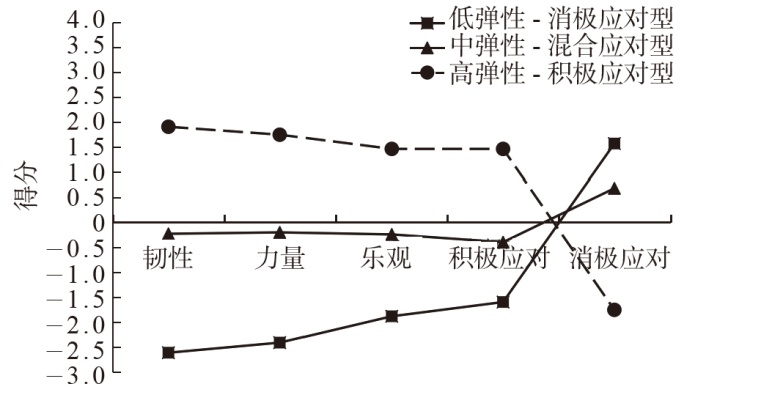
Table 4
Variable assignment status"
| 变 量 | 变量赋值 |
|---|---|
| 患儿性别 | 1=男;2=女 |
| 患儿年龄 | 1=≤6岁;2=7~14岁 |
| 哮喘病程 | 1=<1年;2=1~3年;3=>3年 |
| 发作频率 | 1=每月≥4次;2=每月2~3次;3=每月<2次 |
| 哮喘严重程度 | 1=轻度;2=中度;3=重度 |
| 家长身份 | 1=父亲;2=母亲 |
| 家长年龄 | 1=25~35岁;2=36~45岁;3=>45岁 |
| 家长文化程度 | 1=小学及以下;2=初中;3=高中/中专;4=大专及以上 |
| 家庭月收入 | 1=<5000元;2=5 000~10000元;3=>10000元 |
| 是否为主要照护者 | 0=否;1=是 |
Table 5
Multinomial logistic regression analysis results of parental psychological resilience and coping strategies in parents of children with asthma"
| 类型 | 变量 | β | SE | Z值 | P | OR | 95%CI |
|---|---|---|---|---|---|---|---|
| 中弹性-混合应对型 | |||||||
| 患儿性别 | -0.106 | 0.497 | 0.213 | 0.832 | 0.900 | 0.340~2.384 | |
| 患儿年龄 | 0.846 | 0.581 | 1.457 | 0.145 | 2.331 | 0.747~7.277 | |
| 哮喘病程 | -0.381 | 0.351 | 1.085 | 0.278 | 0.683 | 0.343~1.360 | |
| 发作频率 | -1.060 | 0.401 | 2.641 | 0.008 | 0.346 | 0.158~0.761 | |
| 哮喘严重程度 | -0.109 | 0.377 | 0.288 | 0.773 | 0.897 | 0.429~1.877 | |
| 家长身份(母亲对父亲) | -0.146 | 0.502 | 0.290 | 0.772 | 0.864 | 0.323~2.313 | |
| 家长年龄 | -0.088 | 0.451 | 0.196 | 0.845 | 0.915 | 0.378~2.217 | |
| 家长文化程度 | 0.583 | 0.261 | 2.235 | 0.025 | 1.791 | 1.074~2.986 | |
| 家庭月收入 | 0.884 | 0.335 | 2.641 | 0.008 | 2.420 | 1.256~4.663 | |
| 是否主要照护者 | 0.733 | 0.361 | 2.305 | 0.011 | 2.001 | 1.074~3.586 | |
| 高弹性-积极应对型 | |||||||
| 患儿性别 | -0.274 | 0.509 | 0.538 | 0.590 | 0.760 | 0.280~2.062 | |
| 患儿年龄 | 1.408 | 0.577 | 2.442 | 0.015 | 4.088 | 1.320~12.662 | |
| 哮喘病程 | -1.105 | 0.362 | 3.054 | 0.002 | 0.331 | 0.163~0.673 | |
| 发作频率 | -1.463 | 0.406 | 3.607 | <0.001 | 0.232 | 0.105~0.513 | |
| 哮喘严重程度 | -0.141 | 0.376 | 0.374 | 0.708 | 0.869 | 0.416~1.815 | |
| 家长身份(母亲对父亲) | -0.028 | 0.515 | 0.055 | 0.956 | 0.972 | 0.354~2.668 | |
| 家长年龄 | 0.304 | 0.427 | 0.712 | 0.476 | 1.356 | 0.587~3.134 | |
| 家长文化程度 | 0.538 | 0.249 | 2.158 | 0.031 | 1.712 | 1.051~2.789 | |
| 家庭月收入 | 0.984 | 0.336 | 2.929 | 0.003 | 3.025 | 1.156~9.236 | |
| 是否主要照护者 | 1.794 | 0.542 | 3.310 | 0.001 | 3.304 | 1.049~10.372 | |
| [1] | Chisholm K, Daines L, Turner S. Challenges in diagnosing asthma in children[J]. BMJ, 2024, 384: e075924. |
| [2] | 中国医药教育协会儿科专业委员会, 中华医学会儿科学分会呼吸学组哮喘协作组, 中国医师协会呼吸医师分会儿科呼吸工作委员会, 等. 中国儿童支气管哮喘诊治现状及发展策略(2022)[J]. 中华实用儿科临床杂志, 2023, 38(9) : 647-680. |
| China Medicine Education Association Committee on Pediatrics, Cooperative Group of Asthma, the Subspecialty Group of Respiratory, the Society of Pediatrics, Chinese Medical Association, Chinese Medical Doctor Association Committee on Respirology Pediatrics, et al. Current situation and development strategies of diagnosis and treatment of bronchial asthma in children in China (2022)[J]. Zhonghua Shiyong Erke Linchuang Zazhi, 2023, 38(9): 647-680. | |
| [3] | Wang X, Chien WT, Chong YY. Effectiveness of psychosocial interventions for improving asthma symptoms and parental stress in families of school-age children with asthma: a systematic review and meta-analysis[J]. Int J Nurs Stud, 2024, 12(1): 104905. |
| [4] | Khalsi F, Mansouri H, Kbaier S, et al. Knowledge and perception of asthma among parents of children with asthma[J]. Tunis Med, 2024, 102(10): 647-652. |
| [5] | Parvane M, Rezaei F. Parental psychological model for children with asthma and its mediating role for child anxiety[J]. East Asian Arch Psychiatry, 2023, 3(4): 107-113. |
| [6] |
Fawcett R, Porritt K, Stern C, et al. Experiences of parents and carers in managing asthma in children: a qualitative systematic review[J]. JBI Database System Rev Implement Rep, 2019, 17(5): 793-984.
doi: 10.11124/JBISRIR-2017-004019 pmid: 31090652 |
| [7] |
尹奎, 彭坚, 张君. 潜在剖面分析在组织行为领域中的应用[J]. 心理科学进展, 2020, 28(7): 1056-1070.
doi: 10.3724/SP.J.1042.2020.01056 |
| Yin K, Peng J, Zhang J. The application of latent profile analysis in organizational behavior research[J]. Xinli Kexue Jinzhan, 2020, 28(7): 1056-1070. | |
| [8] | 中华医学会儿科学分会呼吸学组. 儿童支气管哮喘诊断与防治指南(2016年版)[C]. 第二十次全国儿科中西医结合学术会议论文集, 2016: 47-61. |
| [9] | 曹玲, 陈星, 符州, 等. 儿童慢性气道炎症相关性疾病缓解期治疗与康复管理专家共识[J]. 临床儿科杂志, 2022, 40(10): 770-781. |
| Cao L, Chen X, Fu Z, et al. Expert consensus on the treatment and rehabilitation management of chronic airway inflammation-related diseases in children[J]. Linchuang Erke Zazhi, 2022, 40(10): 770-781. | |
| [10] | 孙振球. 医学统计学[M]. 3版. 北京: 人民卫生出版社, 2010: 1. |
| Sun ZQ. Medical statistics[M]. 3rd edition. Beijing: People's Medical Publishing House, 2010: 1. | |
| [11] | 刘东玮, 任兴华, 周郁秋, 等. 中文版心理弹性量表在精神分裂症患者中的信效度测量[J]. 中国实用护理杂志, 2020, 36(18): 1366-1371. |
| Liu DW, Ren XH, Zhou YQ, et al. The validity and reliability of the Chinese version of Connor Davidson Resilience Scale in schizophrenia[J]. Zhongguo Shiyong Huli Zazhi, 2020, 36(18): 1366-1371. | |
| [12] | 解亚宁. 简易应对方式量表信度和效度的初步研究[J]. 中国临床心理学杂志, 1998, 6(2): 114-115. |
| Xie YN. Preliminary study on the reliability and validity of the simple coping style questionnaire[J]. Zhongguo Lichuang Xinlixue Zazhi, 1998, 6(2): 114-115. | |
| [13] | 贾改敬, 王瑞, 李茜梅. 学龄前期哮喘儿童主要照顾者居家照护能力的影响因素调查研究[J]. 海南医学, 2025, 36(11): 1633-1638. |
| Jia GJ, Wang R, Li QM. Investigation on the influencing factors of home care ability of primary caregivers for preschool children with asthma[J]. Hainan Yixue, 2025, 36(11):1633-1638. | |
| [14] |
Frydenberg A, Oborne N, Polley C, et al. Paediatric asthma education: implementation of video-based education for families[J]. J Paediatr Child Health, 2022, 58(5): 868-872.
doi: 10.1111/jpc.v58.5 |
| [15] |
Silva CM, Barros L, Simões F. Health-related quality of life in paediatric asthma: children's and parents' perspectives[J]. Psychol Health Med, 2015, 20(8): 940-954.
doi: 10.1080/13548506.2014.969745 pmid: 25311376 |
| [16] |
Zanobetti A, Ryan PH, Coull B, et al. Children’s respiratory and environmental workgroup (CREW) consortium. childhood asthma incidence, early and persistent wheeze, and neighborhood socioeconomic factors in the ECHO/CREW consortium[J]. JAMA Pediatr, 2022, 176(8): 759-767.
doi: 10.1001/jamapediatrics.2022.1446 pmid: 35604671 |
| [17] | Gomes ALA, Lima KF, Mendes ERDR, et al. Association of self-efficacy of parents/caregivers with childhood asthma control parameters[J]. Rev Esc Enferm USP, 2017, 51(1): e03282. |
| [18] |
Dan L, Kintner EK, Petrini M, et al. Information needs and resources and self-management challenges of parents caring for a child with asthma in China[J]. Clin Nurs Res, 2021, 30(6): 901-910.
doi: 10.1177/1054773821996097 pmid: 33615838 |
| [19] |
Bandura A. Social cognitive theory: an agentic perspective[J]. Annu Rev Psychol, 2001, 52(1): 1-26.
doi: 10.1146/psych.2001.52.issue-1 |
| [20] |
Strömberg Celind F, Wennergren G, Vasileiadou S, et al. Higher parental education was associated with better asthma control[J]. Acta Paediatr, 2019, 108(5): 920-926.
doi: 10.1111/apa.14610 |
| [21] |
Hunleth J, Spray J, Ruiz S, et al. Situating household management of children's asthma in the context of social, economic, and environmental injustice[J]. J Asthma, 2022, 59(1): 70-78.
doi: 10.1080/02770903.2020.1837159 |
| [22] |
Chen E, Shalowitz MU, Story RE, et al. Parents' childhood socioeconomic circumstances are associated with their children's asthma outcomes[J]. J Allergy Clin Immunol, 2017, 140(3): 828-835.
doi: S0091-6749(17)30031-3 pmid: 28089871 |
| [23] | 沈志莹, 石双姣, 张秋香, 等. 儿童照顾者居家用药安全评估量表的编制及信度效度检验[J]. 中国护理管理, 2023, 23(10): 1486-1493. |
| Shen ZY, Shi SJ, Zhang QX, et al. Development and psychometric properties testing of Home Medication Safety Assessment Scale of children's caregivers[J]. Zhongguo Huli Guanli, 2023, 23(10): 1486-1493. | |
| [24] | 凌倩, 江思锋, 余旺灵, 等. 哮喘患儿父母自我调节疲劳现状及影响因素分析[J]. 临床护理杂志, 2024, 23(4): 6-10. |
| Ling Q, Jiang Sf, Yu WL, et al. Analysis of self-regulatory fatigue status and influencing factors in parents of children with asthma[J]. Linchuang Huli Zazhi, 2024, 23(4): 6-10. | |
| [25] |
Dut R, Soyer O, Sahiner UM, et al. Psychological burden of asthma in adolescents and their parents[J]. J Asthma, 2022, 59(6): 1116-1121.
doi: 10.1080/02770903.2021.1903916 |
| [26] |
Cheng J, Wang H, Zhang X, et al. The factors of family management affecting asthma control status in school-age children with asthma in China[J]. J Asthma, 2022, 59(5): 1041-1050.
doi: 10.1080/02770903.2021.1895209 |
| [27] |
Tona JT, Ash J, Brown E, et al. Caregiver burden, stress, and relationship cohesion among self-identified caregivers of children with pediatric acute-onset neuropsychiatric syndrome[J]. J Child Adolesc Psychopharmacol, 2023, 33(9): 378-386.
doi: 10.1089/cap.2023.0030 |
| [28] | Yang F, Zhou J, Xiao H, et al. Caregiver burden among parents of school-age children with asthma: a cross-sectional study[J]. Front Public Health, 2024, 5(12): 1368519. |
| [29] |
Meltzer LJ, Pugliese CE. Sleep in young children with asthma and their parents[J]. J Child Health Care, 2017, 21(3): 301-311.
doi: 10.1177/1367493517712064 pmid: 29119809 |
| [30] |
Costa DD, Pitrez PM, Barroso NF, et al. Asthma control in the quality of life levels of asthmatic patients' caregivers: a systematic review with meta-analysis and meta-regression[J]. J Pediatr (Rio J), 2019, 95(4): 401-409.
doi: 10.1016/j.jped.2018.10.010 |
| [31] |
Kato T. Coping with stress, executive functions, and depressive symptoms: focusing on flexible responses to stress[J]. J Clin Med, 2021, 10(14): 3122.
doi: 10.3390/jcm10143122 |
| [1] | Rachel Rosen, Osvaldo Borrelli, Christophe Faure, Katja Karrento, Usha Krishnan, Samuel Nurko, Nathalie Rommel, Alan Silverman, Michiel van Wijk, Marc Benninga (Author), Chinese Medical Association Parenteral and Enteral Nutrition Branch Pediatrics Group, The Subspecialty Group of Gastroenterology, The Society of Pediatric, Chinese Medical Association, Gastroenterology Group, Pediatrician Branch, Chinese Medical Doctor Association (Translator). Core interpretation and explanation of Rome Ⅴ diagnostic criteria: upper gastrointestinal disorders of gut-brain interaction in children and adolescents [J]. Journal of Clinical Pediatrics, 2026, 44(7): 595-608. |
| [2] | Carlo Di Lorenzo, Miguel Saps, Bruno P. Chumpitazi, Shaman Rajindrajith, Annamaria Staiano, Nikhil Thapar, Miranda van Tilburg, Carlos Velasco-Benítez, Arine Vlieger (Author), Chinese Medical Association Parenteral and Enteral Nutrition Branch Pediatrics Group, The Subspecialty Group of Gastroenterology, The Society of Pediatric, Chinese Medical Association, Gastroenterology Group, Pediatrician Branch, Chinese Medical Doctor Association (Translator). Core interpretation and explanation of Rome Ⅴ diagnostic criteria: lower and biliary disorders of gut-brain interaction in children and adolescents [J]. Journal of Clinical Pediatrics, 2026, 44(7): 609-621. |
| [3] | LI Xufeng, TANG Haoxun, LI Xingjun, ZHANG Lize, GAO Chenqing, ZHAO Shunying, LIU Jianhua. Clinical characteristics, chest CT imaging phenotypes, and their correlation with prognosis in 76 children with Chlamydia pneumoniae pneumonia [J]. Journal of Clinical Pediatrics, 2026, 44(7): 622-627. |
| [4] | WANG Zhen, SHAO Jingbo, ZHANG Na, XIA Min, ZHU Jiashi, DU Chengkan, LI Hong. Factors influencing long-term recurrence in pediatric acute lymphoblastic leukemia patients with low-risk disease at initial diagnosis: a five-year follow-up analysis of 254 cases from a single center [J]. Journal of Clinical Pediatrics, 2026, 44(7): 628-635. |
| [5] | GUO Xuemei, XUE Yao, WANG Yongren, RONG Liucheng, FANG Yongjun, LIN Rufeng. Clinical features and prognosis of childhood acute myeloid leukemia with CBFA2T3::GLIS2 fusion [J]. Journal of Clinical Pediatrics, 2026, 44(7): 636-643. |
| [6] | YANG Lijun, FU Dongxia, CUI Yan, YANG Junmei, ZHANG Liming. Clinical manifestation and genetic analysis of CHARGE syndrome caused by CHD7 gene variation [J]. Journal of Clinical Pediatrics, 2026, 44(7): 644-650. |
| [7] | HU Yan, YANG Fan, LIANG Aimin, MAO Meng. Identification and management of faltering growth in children: insights from the 13th International Conference on Nutrition and Growth [J]. Journal of Clinical Pediatrics, 2026, 44(6): 485-488. |
| [8] | LIU Ziyao, WANG Congying, WANG Hongmao, ZHANG Mingming, XU Yingjie, LAI Jianming, NIU Wenquan, LI Xiaohui. Early differentiation of Kawasaki disease with joint symptoms and systemic juvenile idiopathic arthritis with Kawasaki disease-like symptoms: a single-center retrospective study [J]. Journal of Clinical Pediatrics, 2026, 44(6): 489-498. |
| [9] | LI Jian, LI Tao, HE Lulu, WU Lei, HU Tianjiao, HUANG Yixuan, LIN Xinrong, SHEN Qiyang, PAN Sirui, XIE Nan, ZHOU Jianfeng, ZHOU Chunlei, ZHOU Li. A retrospective analysis of 50 cases of malignant rhabdoid tumor in children: clinical features, treatment response and prognostic factors [J]. Journal of Clinical Pediatrics, 2026, 44(6): 499-507. |
| [10] | LI Yanhua, ZHANG Huanhuan, YANG Jingwei, LIAO Xuelian, SHAO Jingbo, JIAO Yangyang, ZHANG Ting, HUANG Can, JIANG Shayi. Analysis of survival prognosis and related risk factors of pediatric head and neck rhabdomyosarcoma [J]. Journal of Clinical Pediatrics, 2026, 44(6): 518-523. |
| [11] | SHI Yongyuan, YANG Lijuan, LEI Wenting, XIONG Yurong, PAN Shujing, LI Yuelin, ZHANG Jiali, TIAN Maoqiang. Clinical characteristics and prognosis analysis of autoimmune encephalitis with movement disorders in children: A single-center retrospective study [J]. Journal of Clinical Pediatrics, 2026, 44(6): 532-539. |
| [12] | GU Xinjia, ZHENG Zhihui, MEI Lingli, ZHENG Jinxin, LIU Taixiang, ZHU Jihua. Burden of urinary system diseases in children and adolescents in China, 1990-2023 [J]. Journal of Clinical Pediatrics, 2026, 44(6): 546-555. |
| [13] | LUO Zihao, LI Shaojun, REN Peizhen, WANG Yanhong, GENG Gang. Analysis of clinical characteristics of children with pneumonia complicated with plastic bronchitis and establishment and validation of risk prediction model [J]. Journal of Clinical Pediatrics, 2026, 44(6): 564-572. |
| [14] | CHU Weihong, XU Liyan, PENG Shao, LAI Jianming. Lower extremity arterial thrombosis as first clinical manifestation in children's systemic lupus erythematosus complicated with antiphospholipid syndrome: a two-case report [J]. Journal of Clinical Pediatrics, 2026, 44(6): 579-583. |
| [15] | CHEN Liuwang, LIU Pan, XI Rongjuan, ZHANG Xianxia, ZHANG Yi, WEI Xingjiao, SU Min, YANG Yonghong, FU Yangxi. Methylmalonic acidemia with homocystinemia causing subacute combined degeneration of the spinal cord : a case report [J]. Journal of Clinical Pediatrics, 2026, 44(6): 584-588. |
|
||
