

Journal of Clinical Pediatrics ›› 2026, Vol. 44 ›› Issue (6): 564-572.doi: 10.12372/jcp.2026.25e0439
• Original Article • Previous Articles Next Articles
LUO Zihao1, LI Shaojun2, REN Peizhen1, WANG Yanhong1, GENG Gang1( )
)
Received:2025-04-22
Revised:2025-11-04
Accepted:2026-04-23
Published:2026-06-15
Online:2026-06-04
Contact:
GENG Gang
E-mail:genggang550928@126.com
CLC Number:
LUO Zihao, LI Shaojun, REN Peizhen, WANG Yanhong, GENG Gang. Analysis of clinical characteristics of children with pneumonia complicated with plastic bronchitis and establishment and validation of risk prediction model[J].Journal of Clinical Pediatrics, 2026, 44(6): 564-572.
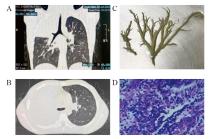
Figure 1
Chest imaging, bronchoscopic removal of casts and pathological examination of pneumonia complicated with PB"
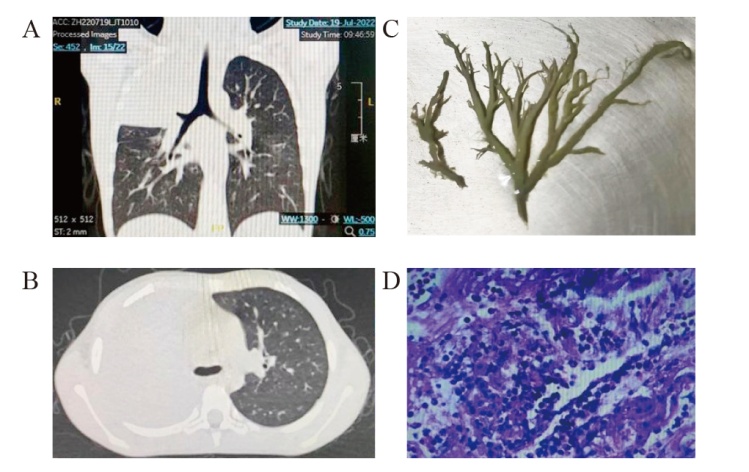

Table 1
Clinical characteristics of the modeling group"
| 项目 | 总人数(n=1 887) | 非PB组(n=1 754) | PB组(n=133) | P |
|---|---|---|---|---|
| 发热时间[M(P25~P75)]/d | 5.00(3.00~7.00) | 5.00(3.00~7.00) | 10.00(7.00~11.00) | <0.001 |
| WBC[M(P25~P75]/×109·L-1 | 7.48(5.82~9.88) | 7.59(5.89~10.07) | 7.29(5.43~10.52) | 0.694 |
| NLR[M(P25~P75)] | 1.52(0.85~3.00) | 1.44(0.79~2.57) | 3.45(2.20~5.60) | <0.001 |
| PLT[M(P25~P75]/×109·L-1 | 346.50(264.00~444.00) | 354.50(270.00~454.00) | 262.00(205.00~341.00) | <0.001 |
| CRP[M(P25~P75]/mg·L-1 | 13.43(5.18~27.58) | 12.93(5.16~26.36) | 22.55(9.00~47.83) | <0.001 |
| PCT[M(P25~P75]/ng·mL-1 | 0.10(0.06~0.20) | 0.09(0.06~0.19) | 0.26(0.09~0.74) | 0.023 |
| 纤维蛋白原[M(P25~P75]/g·L-1 | 3.39(2.36~4.43) | 3.29(2.31~4.32) | 4.11(3.24~4.96) | <0.001 |
| D-二聚体[M(P25~P75]/mg·L-1 | 0.55(0.29~1.52) | 0.53(0.28~1.28) | 2.32(0.84~3.97) | <0.001 |
| LDH[M(P25~P75]/U·L-1 | 280.00(233.00~360.00) | 276.00(232.00~352.00) | 396.00(280.00~566.00) | <0.001 |
| 哮喘病史[n(%)] | <0.001 | |||
| 0 | 1 820(96.45) | 1 708(97.38) | 112(84.21) | |
| 1 | 67(3.55) | 46(2.62) | 21(15.79) | |
| 气促[n(%)] | <0.001 | |||
| 0 | 1 383(73.29) | 1 334(76.05) | 49(36.84) | |
| 1 | 504(26.71) | 420(23.95) | 84(63.16) | |
| 胸腔积液[n(%)] | <0.001 | |||
| 0 | 1 475(78.17) | 1 419(80.90) | 56(42.11) | |
| 1 | 412(21.83) | 335(19.10) | 77(57.89) | |
| 气道重建显示不通畅[n(%)] | <0.001 | |||
| 0 | 750(39.75) | 734(41.85) | 16(12.03) | |
| 1 | 1 137(60.25) | 1 020(58.15) | 117(87.97) |
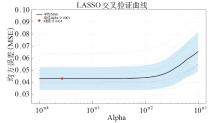
Figure 2
Cross-validation curve graph"
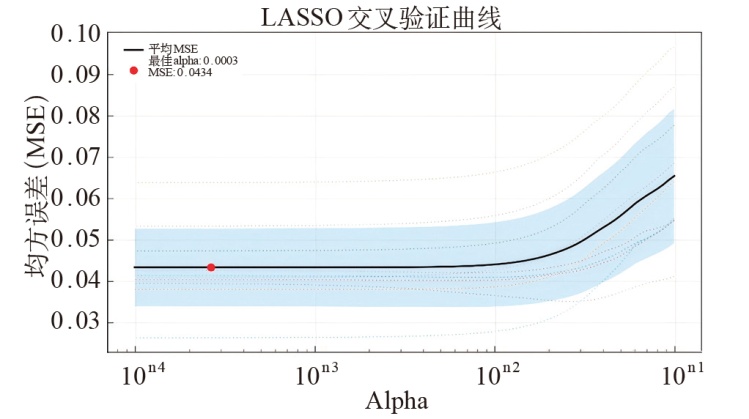
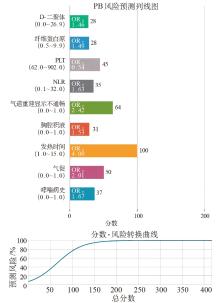
Figure 3
Nomogram model for predicting PB in children"
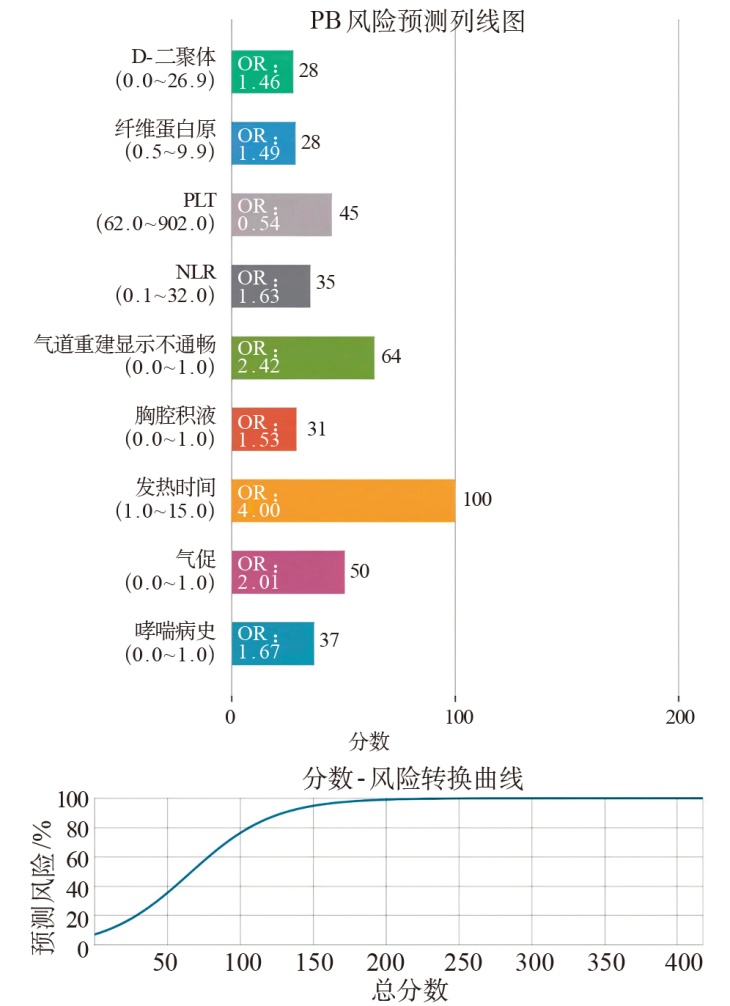
Table 2
The table of Lasso regression coefficients"
| 变 量 | Lasso系数 | logistic回归系数 | OR(95% CI) | P |
|---|---|---|---|---|
| 发热时间 | 0.076 | 1.564 | 4.78(3.49~6.54) | <0.001 |
| 胸腔积液 | 0.0460 | 0.660 | 1.94(1.53~2.45) | <0.001 |
| 哮喘病史 | 0.034 | 0.425 | 1.53(1.29~1.82) | <0.001 |
| 气道重建显示不通畅 | 0.026 | 0.835 | 2.31(1.62~3.28) | <0.001 |
| 气促 | 0.037 | 0.563 | 1.76(1.38~2.23) | <0.001 |
| PLT | -0.031 | -0.792 | 0.45(0.32~0.63) | <0.001 |
| NLR | 0.046 | 0.409 | 1.51(1.23~1.84) | <0.001 |
| D-二聚体 | 0.029 | 0.404 | 1.50(1.23~1.83) | <0.001 |
| 纤维蛋白原 | 0.018 | 0.426 | 1.53(1.170~2.01) | 0.002 |
| CRP | 0.014 | 0.1745 | 1.19(0.93~1.53) | 0.167 |
| LDH | 0.018 | 0.147 | 1.16(0.93~1.44) | 0.189 |
| PCT | 0.003 | 0.033 | 1.03(0.81~1.32) | 0.789 |
| WBC | -0.002 | -0.030 | 0.97(0.75~1.25) | 0.813 |
Table 3
Weighted logistic regression analysis"
| 变 量 | 加权回归系数 | 加权OR(95% CI) | P |
|---|---|---|---|
| 哮喘病史 | 0.510 | 1.67(1.24~2.15) | <0.001 |
| 气促 | 0.699 | 2.01(1.54~2.64) | <0.001 |
| 发热时间 | 1.385 | 4.00(3.24~5.83) | <0.001 |
| 胸腔积液 | 0.425 | 1.53(1.19~1.94) | <0.001 |
| 气道重建显示不通畅 | 0.884 | 2.42(1.77~3.87) | <0.001 |
| NLR | 0.487 | 1.63(1.28~2.25) | <0.001 |
| PLT | -0.620 | 0.54(0.33~0.72) | <0.001 |
| 纤维蛋白原 | 0.394 | 1.48(1.12~2.08) | 0.004 |
| D-二聚体 | 0.381 | 1.46(1.20~1.80) | 0.006 |
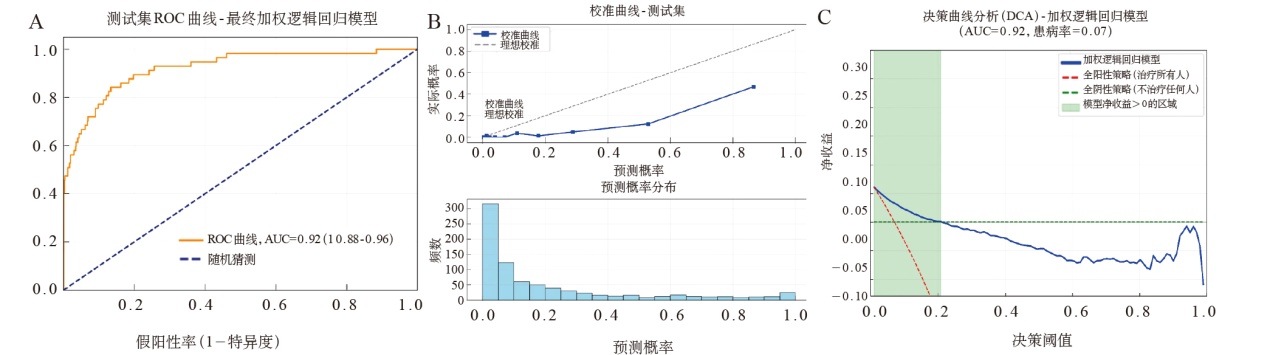
Figure 4
Model validation"
| [1] |
Yang L, Zhang Y, Shen C, et al. Clinical features and risk factors of plastic bronchitis caused by Mycoplasma pneumoniae pneumonia in children[J]. BMC Pulm Med, 2023, 23(1): 468.
doi: 10.1186/s12890-023-02766-0 pmid: 37996853 |
| [2] | 曾其毅, 刘大波, 罗仁忠, 等. 儿童塑型性支气管炎的诊断与治疗[J]. 中国实用儿科杂志, 2004, 19 (2): 81-83. |
| Zeng QY, Liu DB, Luo RZ, et al. Diagnosis and treatment of plastic bronchitis in children[J]. Zhongguo Shiyong Erke Zazhi, 2004, 19(2): 81-83. | |
| [3] | 胡晓光, 张海邻. 儿童塑型性支气管炎的常见病因及致病机制[J]. 中华实用儿科临床杂志, 2021, 36(4): 244-247. |
| Hu XG, Zhang HL. Common causes and pathogenic mechanisms of plastic bronchitis in children[J]. Zhonghua Shiyong Erke Linchuang Zazhi, 2021, 36(4): 244-247. | |
| [4] | 田杰, 金玉, 刘素琴. 儿童塑型性支气管炎研究进展[J]. 国际医药卫生导报, 2022, 28(6): 805-808. |
| Tian J, Jin Y, Liu SQ. Research progress on plastic bronchitis in children[J]. Guoji Yiyao Weisheng Daodao, 2022, 28(6): 805-808. | |
| [5] | 中华医学会儿科学分会呼吸学组, 中华儿科杂志编辑委员会, 中国医药教育协会儿科专业委员会, 儿童社区获得性肺炎管理指南(2024修订)[J]. 中华儿科杂志, 2024, 62(10): 920-930. |
| The Subspecialty Group of Respiratory, the Society of Pediatrics, Chinese Medical Association; the Editorial Board, Chinese Journal of Pediatrics; China Medicine Education Association Committee on Pediatrics. Guidelines for the management of community-acquired pneumonia in children (2024 revision)[J]. Zhonghua Erke Zazhi, 2024, 62(10): 920-930. | |
| [6] |
Madsen P, Shah SA, Rubin BK. Plastic bronchitis: new insights and a classification scheme[J]. Paediatr Respir Rev, 2005, 6(4): 292-300.
pmid: 16298313 |
| [7] |
Seear M, Hui H, Magee F, et al. Bronchial casts in children: a proposed classification based on nine cases and a review of the literature[J]. Am J Respir Crit Care Med, 1997, 155(1):364-370.
doi: 10.1164/ajrccm.155.1.9001337 |
| [8] |
Liu M, Wei D, Zhang T, et al. Distinct clinical characteristics of bocavirus and Mycoplasma pneumoniae infection in children plastic bronchitis[J]. Immun Inflamm Dis, 2024, 12(8): e1373.
doi: 10.1002/iid3.v12.8 |
| [9] |
Vickers AJ, Elkin EB. Decision curve analysis: a novel method for evaluating prediction models[J]. Med Decis Making, 2006, 26(6):565-574.
doi: 10.1177/0272989X06295361 pmid: 17099194 |
| [10] |
Soyer T, Yalcin Ş, Emiralioğlu N, et al. Use of serial rigid bronchoscopy in the treatment of plastic bronchitis in children[J]. Pediatr Surg, 2016, 51(10):1640-1643.
doi: 10.1016/j.jpedsurg.2016.03.017 |
| [11] |
Zhao L, Zhang T, Cui X, et al. Development and validation of a nomogram to predict plastic bronchitis in children with refractory Mycoplasma pneumoniae pneumonia[J]. BMC Pulm Med, 2022, 22(1): 253.
doi: 10.1186/s12890-022-02047-2 |
| [12] | 刘佳惠, 马丽, 李芳. 列线图模型在肺炎支原体感染患儿中塑型性支气管炎发生的预测价值[J]. 温州医科大学学报, 2023, 53(3): 209-214. |
| Liu JH, Ma L, Li F. The predictive value of the nomogram model for the occurrence of plastic bronchitis in children with mycoplasma pneumoniae infection[J]. Wenzhou Yike Daxue Xuebao, 2023, 53(3): 209-214. | |
| [13] |
Cai X, Lin M, Zhou L, et al. Characteristics of plastic bronchitis in children with infectious pneumonia[J]. Ital J Pediatr, 2025, 51(1): 24.
doi: 10.1186/s13052-025-01873-4 pmid: 39901284 |
| [14] | 田曼, 张晓军. 儿童塑型性支气管炎的影像学特征[J]. 中华实用儿科临床杂志, 2021, 36(4): 250-252. |
| Tian M, Zhang XJ. Imaging features of plastic bronchitis in children[J]. Zhonghua Shiyong Erke Linchuang Zazhi, 2021, 36(4): 250-252. | |
| [15] |
Huang F, Gu W, Diwu J, et al. Etiology and clinical features of infection-associated plastic bronchitis in children[J]. BMC Infect Dis, 2023, 23(1): 588.
doi: 10.1186/s12879-023-08529-w pmid: 37679703 |
| [16] | 李晓楠, 卢志威, 陈杰华, 等. 单中心儿童塑型性支气管炎病原学特点及变迁[J]. 中国小儿急救医学, 2022, 29(12): 973-976. |
| Li XN, Lu ZW, Chen JH, et al. Etiological characteristics and changes of plastic bronchitis in children in a single center[J]. Zhongguo Xiaoer Jijiu Yixue, 2022, 29(12): 973-976. | |
| [17] |
Wang L, Wang W, Sun JM, et al. Efficacy of fiberoptic bronchoscopy and bronchoalveolar lavage in childhood-onset, complicated plastic bronchitis[J]. Pediatr Pulmonol, 2020, 55(11): 3088-3095.
doi: 10.1002/ppul.v55.11 |
| [18] |
Chen X, Wu S, Huang Z, et al. Plastic bronchitis in children: a review of 55 cases over a 10-year period[J]. Int J Pediatr, 2024, 2024: 9271324.
doi: 10.1155/ijpe.v2024.1 |
| [19] |
Rüegger CM, Bär W, Iseli P. Simultaneous atelectasis in human bocavirus infected monozygotic twins: was it plastic bronchitis?[J]. BMC Pediatr, 2013, 13: 209.
doi: 10.1186/1471-2431-13-209 pmid: 24344641 |
| [20] |
Brogan TV, Finn LS, Pyskaty DJ Jr, et al. Plastic bronchitis in children: a case series and review of the medical literature[J]. Pediatr Pulmonol, 2002, 34(6): 482-487.
doi: 10.1002/ppul.v34:6 |
| [21] | 黄晶晶, 袁林, 卓志强, 等. 儿童腺病毒肺炎并塑型性支气管炎 9 例临床分析[J]. 中华实用儿科临床杂志, 2020, 35(16): 1260-1263. |
| Huang JJ, Yuan L, Zhuo ZQ, et al. Clinical analysis of 9 cases of adenovirus pneumonia complicated with plastic bronchitis in children[J]. Zhonghua Shiyong Erke Linchuang Zazhi, 2020, 35(16): 1260-1263. | |
| [22] | 高微微, 翟嘉, 郭永盛, 等. 11例儿童腺病毒肺炎合并塑型性支气管炎特征分析[J]. 临床儿科杂志, 2024, 42(6): 509-514. |
| Gao WW, Zhai J, Guo YS, et al. Characteristic analysis of 11 cases of adenovirus pneumonia complicated with plastic bronchitis in children[J]. Linchuang Erke Zazhi, 2024, 42(6): 509-514. | |
| [23] |
Nayır Büyükşahin H, Emiralioglu N, Sekerel BE, et al. Plastic bronchitis during childhood: Diversity of presentation, etiology, treatment, and outcomes[J]. Pediatr Pulmonol, 2023, 58(9): 2559-2567.
doi: 10.1002/ppul.v58.9 |
| [24] |
Kallam EF, Kasi AS, Patki R, et al. Bronchoscopic interventions for plastic bronchitis in children without structural heart disease[J]. Eur J Pediatr, 2021, 180(12): 3547-3554.
doi: 10.1007/s00431-021-04161-5 |
| [25] | 赵红杰, 郭倩, 田代印. 儿童塑型性支气管炎的临床预警因素分析[J]. 重庆医学, 2022, 51(17): 2942-2944. |
| Zhao HJ, Guo Q, Tian DY. Analysis of clinical early warning factors for plastic bronchitis in children[J]. Chongqing Yixue, 2022, 51(17): 2942-2944. | |
| [26] |
Krenke K, Krenke R, Krauze A, et al. Plastic bronchitis: an unusual cause of atelectasis[J]. Respiration, 2010, 80(2): 146-147.
doi: 10.1159/000243711 pmid: 19797884 |
| [27] |
Zhong H, Yin R, Zhao R, et al. Analysis of clinical characteristics and risk factors of plastic bronchitis in children with Mycoplasma pneumoniae pneumonia[J]. Front Pediatr, 2021, 9:735093.
doi: 10.3389/fped.2021.735093 |
| [28] |
Lin X, Xu E, Zhang T, et al. Risk factors for pleural effusion in children with plastic bronchitis caused by pneumonia[J]. Front Pediatr, 2024, 12: 1412729.
doi: 10.3389/fped.2024.1412729 |
| [29] | 李欢欢, 王军. RMPP患儿血常规、免疫球蛋白、D-D表达及预测塑型性支气管炎发生风险的效能研究[J]. 河北医科大学学报, 2021, 42(8): 914-919. |
| Li HH, Wang J. Study on the efficacy of blood routine, immunoglobulin, D-D expression in children with RMPP in predicting the risk of plastic bronchitis[J]. Hebei Yike Daxue Xuebao, 2021, 42(8): 914-919. | |
| [30] | 石小松, 何小花, 陈捷. 儿童大环内酯类药物无反应性肺炎支原体肺炎合并塑型性支气管炎的危险因素分析及列线图构建[J]. 中国当代儿科杂志, 2025, 27(1): 62-67. |
| Shi XX, He XH, Chen J. Analysis of risk factors and construction of nomogram for Mycoplasma pneumoniae pneumonia complicated with plastic bronchitis that is unresponsive to macrolide drugs in children[J]. Zhongguo Dangdai Erke Zazhi, 2025, 27(1): 62-67. | |
| [31] | 牛艳华, 董晓艳. 儿童大环内酯类耐药肺炎支原体肺炎发生塑型性支气管炎的临床特征及危险因素分析[J]. 临床儿科杂志, 2026, 44(2): 111-117. |
| Niu YH, Dong XY. Clinical characteristics and risk factors for plastic bronchitis in children with macrolide-resistant Mycoplasma pneumoniae pneumonia[J]. Linchuang Erke Zazhi, 2026, 44(2): 111-117. | |
| [32] | 韩利, 张筠, 张铁栓. 重症肺炎患者D-二聚体、纤维蛋白原、IL-6水平变化及其临床意义[J]. 中国呼吸与危重监护杂志, 2017, 16(1): 71-73. |
| Han L, Zhang J, Zhang TS. Changes in D-dimer, fibrinogen and IL-6 levels in patients with severe pneumonia and their clinical significance[J]. Zhongguo Huxi Yu Weizhong Jianhu Zazhi, 2017, 16(1): 71-73. | |
| [33] | Xu Q, Zhang L, Hao C, et al. Prediction of bronchial mucus plugs formation in patients with refractory Mycoplasma pneumoniae pneumonia[J]. J Trop Pediatr, 2017, 63(2): 148-154. |
| [34] |
Salamone I, Mondello B, Lucanto MC, et al. Bronchial tree-shaped mucous plug in cystic fibrosis: imaging-guided management[J]. Respirol Case Rep, 2017, 5(2): e00214.
doi: 10.1002/rcr2.v5.2 |
| [35] |
Ma R, Bai T, Yuan B, et al. Risk factor analysis of plastic bronchitis among 126 children with macrolide-resistant Mycoplasma pneumoniae pneumonia with mutations at the A2063G site after bronchoscopy examination: a nomogram prediction model[J]. Front Pediatr, 2025, 13:1521954.
doi: 10.3389/fped.2025.1521954 |
| [36] | 郭永盛, 邹映雪, 翟嘉, 等. 73例儿童Ⅰ型塑型性支气管炎临床特征分析[J]. 天津医科大学学报, 2017, 23(5): 422-425. |
| Guo YY, Zou YX, Zhai J, er al. Analysis of clinical characteristics of 73 cases of type I plastic bronchitis in children[J]. Tianjin Yike Daxue Xuebao, 2017, 23(5): 422-425. |
| [1] | Rachel Rosen, Osvaldo Borrelli, Christophe Faure, Katja Karrento, Usha Krishnan, Samuel Nurko, Nathalie Rommel, Alan Silverman, Michiel van Wijk, Marc Benninga (Author), Chinese Medical Association Parenteral and Enteral Nutrition Branch Pediatrics Group, The Subspecialty Group of Gastroenterology, The Society of Pediatric, Chinese Medical Association, Gastroenterology Group, Pediatrician Branch, Chinese Medical Doctor Association (Translator). Core interpretation and explanation of Rome Ⅴ diagnostic criteria: upper gastrointestinal disorders of gut-brain interaction in children and adolescents [J]. Journal of Clinical Pediatrics, 2026, 44(7): 595-608. |
| [2] | Carlo Di Lorenzo, Miguel Saps, Bruno P. Chumpitazi, Shaman Rajindrajith, Annamaria Staiano, Nikhil Thapar, Miranda van Tilburg, Carlos Velasco-Benítez, Arine Vlieger (Author), Chinese Medical Association Parenteral and Enteral Nutrition Branch Pediatrics Group, The Subspecialty Group of Gastroenterology, The Society of Pediatric, Chinese Medical Association, Gastroenterology Group, Pediatrician Branch, Chinese Medical Doctor Association (Translator). Core interpretation and explanation of Rome Ⅴ diagnostic criteria: lower and biliary disorders of gut-brain interaction in children and adolescents [J]. Journal of Clinical Pediatrics, 2026, 44(7): 609-621. |
| [3] | LI Xufeng, TANG Haoxun, LI Xingjun, ZHANG Lize, GAO Chenqing, ZHAO Shunying, LIU Jianhua. Clinical characteristics, chest CT imaging phenotypes, and their correlation with prognosis in 76 children with Chlamydia pneumoniae pneumonia [J]. Journal of Clinical Pediatrics, 2026, 44(7): 622-627. |
| [4] | WANG Zhen, SHAO Jingbo, ZHANG Na, XIA Min, ZHU Jiashi, DU Chengkan, LI Hong. Factors influencing long-term recurrence in pediatric acute lymphoblastic leukemia patients with low-risk disease at initial diagnosis: a five-year follow-up analysis of 254 cases from a single center [J]. Journal of Clinical Pediatrics, 2026, 44(7): 628-635. |
| [5] | GUO Xuemei, XUE Yao, WANG Yongren, RONG Liucheng, FANG Yongjun, LIN Rufeng. Clinical features and prognosis of childhood acute myeloid leukemia with CBFA2T3::GLIS2 fusion [J]. Journal of Clinical Pediatrics, 2026, 44(7): 636-643. |
| [6] | YANG Lijun, FU Dongxia, CUI Yan, YANG Junmei, ZHANG Liming. Clinical manifestation and genetic analysis of CHARGE syndrome caused by CHD7 gene variation [J]. Journal of Clinical Pediatrics, 2026, 44(7): 644-650. |
| [7] | HU Yan, YANG Fan, LIANG Aimin, MAO Meng. Identification and management of faltering growth in children: insights from the 13th International Conference on Nutrition and Growth [J]. Journal of Clinical Pediatrics, 2026, 44(6): 485-488. |
| [8] | LIU Ziyao, WANG Congying, WANG Hongmao, ZHANG Mingming, XU Yingjie, LAI Jianming, NIU Wenquan, LI Xiaohui. Early differentiation of Kawasaki disease with joint symptoms and systemic juvenile idiopathic arthritis with Kawasaki disease-like symptoms: a single-center retrospective study [J]. Journal of Clinical Pediatrics, 2026, 44(6): 489-498. |
| [9] | LI Jian, LI Tao, HE Lulu, WU Lei, HU Tianjiao, HUANG Yixuan, LIN Xinrong, SHEN Qiyang, PAN Sirui, XIE Nan, ZHOU Jianfeng, ZHOU Chunlei, ZHOU Li. A retrospective analysis of 50 cases of malignant rhabdoid tumor in children: clinical features, treatment response and prognostic factors [J]. Journal of Clinical Pediatrics, 2026, 44(6): 499-507. |
| [10] | LI Yanhua, ZHANG Huanhuan, YANG Jingwei, LIAO Xuelian, SHAO Jingbo, JIAO Yangyang, ZHANG Ting, HUANG Can, JIANG Shayi. Analysis of survival prognosis and related risk factors of pediatric head and neck rhabdomyosarcoma [J]. Journal of Clinical Pediatrics, 2026, 44(6): 518-523. |
| [11] | SHI Yongyuan, YANG Lijuan, LEI Wenting, XIONG Yurong, PAN Shujing, LI Yuelin, ZHANG Jiali, TIAN Maoqiang. Clinical characteristics and prognosis analysis of autoimmune encephalitis with movement disorders in children: A single-center retrospective study [J]. Journal of Clinical Pediatrics, 2026, 44(6): 532-539. |
| [12] | GU Xinjia, ZHENG Zhihui, MEI Lingli, ZHENG Jinxin, LIU Taixiang, ZHU Jihua. Burden of urinary system diseases in children and adolescents in China, 1990-2023 [J]. Journal of Clinical Pediatrics, 2026, 44(6): 546-555. |
| [13] | CHEN Xumei, AIERKEN Aibibai, YUE Xueyan, RU Liang, ZHANG Li. A study on the latent profile analysis of psychological resilience and coping styles of parents of children with asthma and its influencing factors [J]. Journal of Clinical Pediatrics, 2026, 44(6): 556-563. |
| [14] | CHU Weihong, XU Liyan, PENG Shao, LAI Jianming. Lower extremity arterial thrombosis as first clinical manifestation in children's systemic lupus erythematosus complicated with antiphospholipid syndrome: a two-case report [J]. Journal of Clinical Pediatrics, 2026, 44(6): 579-583. |
| [15] | CHEN Liuwang, LIU Pan, XI Rongjuan, ZHANG Xianxia, ZHANG Yi, WEI Xingjiao, SU Min, YANG Yonghong, FU Yangxi. Methylmalonic acidemia with homocystinemia causing subacute combined degeneration of the spinal cord : a case report [J]. Journal of Clinical Pediatrics, 2026, 44(6): 584-588. |
|
||
