

Journal of Clinical Pediatrics ›› 2026, Vol. 44 ›› Issue (8): 727-732.doi: 10.12372/jcp.2026.25e1728
• Brief Report • Previous Articles Next Articles
SHI Jiayi1, GAO Chunlin1, JIA Lili1, LU Yunyun1, SUN Tao1, ZHU Xiaodong2, XIA Zhengkun1, ZHANG Pei1( )
)
Received:2026-01-12
Revised:2026-05-12
Accepted:2026-05-29
Published:2026-08-15
Online:2026-08-13
Contact:
ZHANG Pei
E-mail:zhang.pei.2008@hotmail.com
CLC Number:
SHI Jiayi, GAO Chunlin, JIA Lili, LU Yunyun, SUN Tao, ZHU Xiaodong, XIA Zhengkun, ZHANG Pei. Phenotypic characteristics and prognostic analysis of a pedigree with childhood isolated nephrotic syndrome caused by compound heterozygous mutations in the COQ2 gene[J].Journal of Clinical Pediatrics, 2026, 44(8): 727-732.

Table 1
Clinical characteristics and laboratory examinations of the two patients"
| 患儿 | 性别 | 起病年龄 | 病初表现 | 尿液检测 | 血生化 | 辅助检查 |
|---|---|---|---|---|---|---|
| 例1 | 男 | 1岁2个月 | 肾病综合征 | 尿蛋白++++; | 血白蛋白14.7 g·L-1 | 双肾超声:双肾肾病样声像图 |
| 尿蛋白定量5.62 g/24 h | 血肌酐43.2 μmol·L-1 | 胸部CT:双侧胸腹水 | ||||
| 例2 | 女 | 11月龄 | 肾病综合征 | 尿蛋白++++; | 血白蛋白20.7 g·L-1 | 双肾超声:未见异常 |
| 尿蛋白定量2.12 g/24 h | 血肌酐36.4 μmol·L-1 | 胸部DR:双肺纹理稍增粗 | ||||
| 患儿 | 肾脏病理 | 病理特征性表现 | 变异基因 | 突变位点 | 治疗 | 预后 |
| 例1 | 局灶节段性肾小球硬化 | 光镜:球形废弃(3/11),节段硬化(5/11);电镜:足突广泛融合,大量畸形线粒体。 | COQ2 | c.233T>G | 激素联合抗凝、利尿等对症支持治疗,间断予连续性肾脏替代治疗。 | 病情进行性加重,最终死亡 |
| c.823A>G | ||||||
| 例2 | 局灶节段性肾小球硬化 | 光镜:节段硬化(6/35);电镜:足突广泛融合,大量畸形线粒体。 | COQ2 | c.233T>G | 激素联合抗凝、利尿等对症支持治疗,后改用辅酶Q10 100 mg 3次/d。 | 尿蛋白降至++,临床症状显著改善 |
| c.823A>G |
Figure 1
Pathological images of renal biopsy in Case 1"
Figure 2
Pathological images of renal biopsy in Case 2"
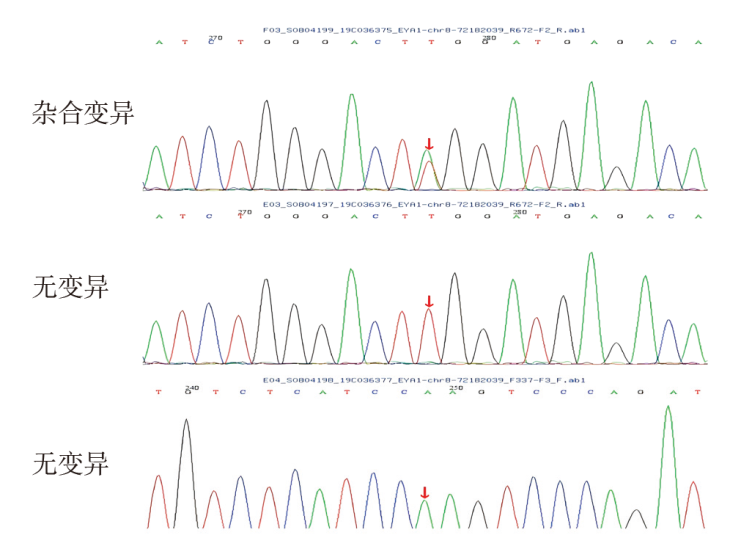
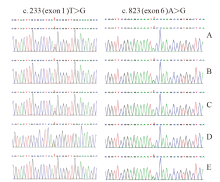
Figure 3
Sequencing peak map of compound heterozygous COQ2 mutation"
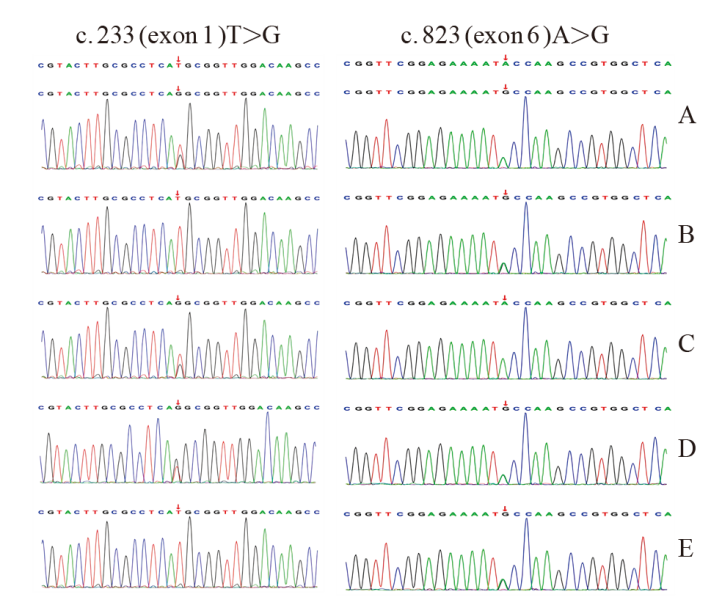
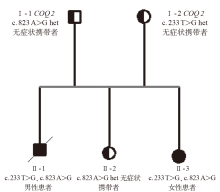
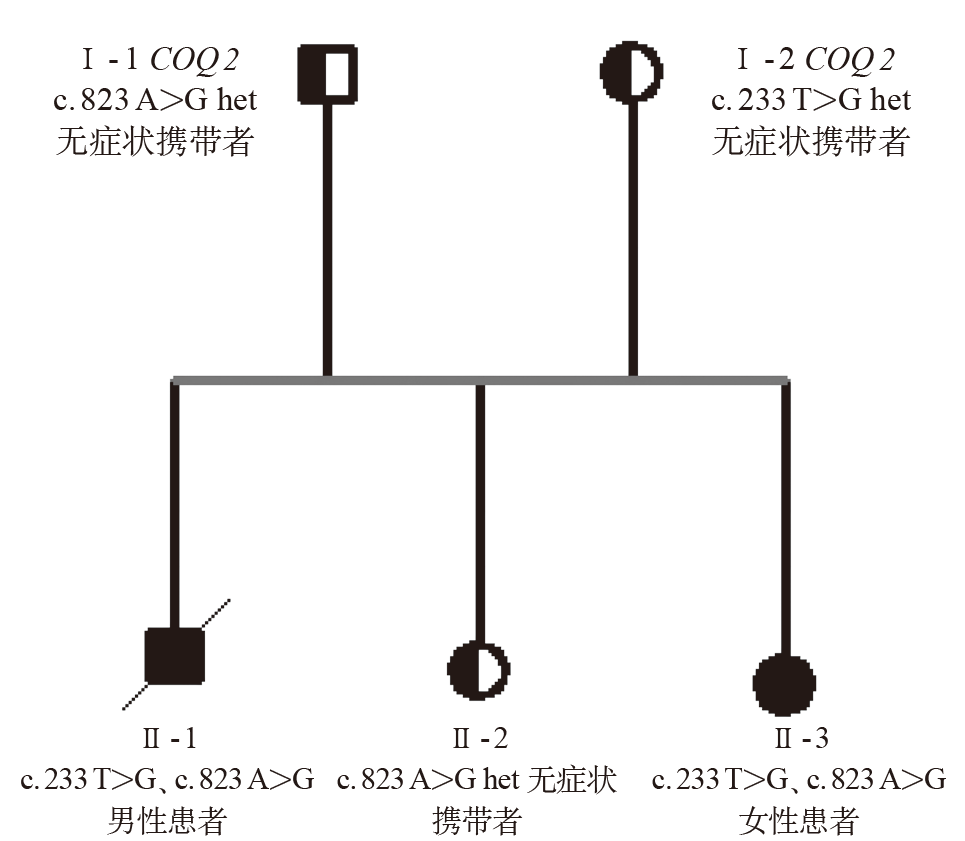
Figure 4
Pedigree of the two pediatric patients"
| [1] | Kidney Disease: Improving Global Outcomes (KDIGO) Nephrotic Syndrome In Children Work Group, Floege J, Gibson KL, Vivarelli M, et al. KDIGO 2025 Clinical practice guideline for the management of nephrotic syndrome in children[J/OL]. Kidney Int, 2025, 107(5S): S241-S289. https://doi.org/10.1016/j.kint.2024.11.007. |
| [2] | Hughes BG, Harrison PM, Hekimi S. Estimating the occurrence of primary ubiquinone deficiency by analysis of large-scale sequencing data[J/OL]. Sci Rep, 2017, 7(1): 17744. https://doi.org/10.1038/s41598-017-17564-y. |
| [3] | Mantle D, Millichap L, Castro-Marrero J, et al. Primary coenzyme Q10 deficiency:an update[J/OL]. Antioxidants (Basel), 2023, 12(8): 1652. https://doi.org/10.3390/antiox12081652. |
| [4] | Freyer C, Stranneheim H, Naess K, et al. Rescue of primary ubiquinone deficiency due to a novel coq7 defect using 2,4-dihydroxybensoic acid[J/OL]. J Med Genet, 2015, 52(11): 779-783. https://doi.org/10.1136/jmedgenet-2015-102986. |
| [5] | Lee EH, Kim-McManus O, Yang JH, et al. Hpdl variant type correlates with clinical disease onset and severity[J/OL]. Ann Clin Transl Neurol, 2025, 12(7): 1360-1367. https://doi.org/10.1002/acn3.70047. |
| [6] | Forsgren M, Attersand A, Lake S, et al. Isolation and functional expression of human coq2, a gene encoding a polyprenyl transferase involved in the synthesis of coq[J/OL]. Biochem J, 2004, 382(Pt 2):519-526. https://doi.org/10.1042/BJ20040261. |
| [7] | Wang Y, Lilienfeldt N, Hekimi S. Understanding coenzyme Q[J/OL]. Physiol Rev, 2024, 104(4): 1533-1610. https://doi.org/10.1152/physrev.00040.2023. |
| [8] | Montero R, Sánchez-Alcázar JA, Briones P, et al. Analysis of coenzyme Q10 in muscle and fibroblasts for the diagnosis of coq10 deficiency syndromes[J/OL]. Clin Biochem, 2008, 41(9): 697-700. https://doi.org/10.1016/j.clinbiochem.2008.03.007. |
| [9] | Li M, Yue Z, Lin H, et al. CoQ2 mutation associated isolated nephropathy in two siblings from a chinese pedigree[J/OL]. Ren Fail, 2021, 43(1): 97-101. https://doi.org/10.1080/0886022X.2020.1864402. |
| [10] | Abdelhakim AH, Dharmadhikari AV, Ragi SD, et al. Compound heterozygous inheritance of two novel coQ2 variants results in familial coenzyme q deficiency[J/OL]. Orphanet J Rare Dis, 2020, 15(1): 320. https://doi.org/10.1186/s13023-020-01600-8. |
| [11] | Eroglu FK, Ozaltin F, Gönç N, et al. Response to early coenzyme q10 supplementation is not sustained in coq10 deficiency caused by coQ2 mutation[J/OL]. Pediatr Neurol, 2018, 88: 71-74. https://doi.org/10.1016/j.pediatrneurol.2018.07.008. |
| [12] | Diomedi-Camassei F, Di Giandomenico S, Santorelli FM, et al. CoQ2 nephropathy:a newly described inherited mitochondriopathy with primary renal involvement[J/OL]. J Am Soc Nephrol, 2007, 18(10): 2773-2780. https://doi.org/10.1681/ASN.2006080833. |
| [13] | Wu X, Wang W, Liu Y, et al. A steroid-resistant nephrotic syndrome in an infant resulting from a consanguineous marriage with coQ2 and arsb gene mutations:a case report[J/OL]. BMC Med Genet, 2019, 20(1): 165. https://doi.org/10.1186/s12881-019-0898-4. |
| [14] | Mollet J, Giurgea I, Schlemmer D, et al. Prenyldiphosphate synthase, subunit 1 (PDSS1) and oh-benzoate polyprenyltransferase (CoQ2) mutations in ubiquinone deficiency and oxidative phosphorylation disorders[J/OL]. J Clin Invest, 2007, 117(3): 765-772. https://doi.org/10.1172/JCI29089. |
| [15] | Alwazzan S, Alnwaihi O, John N, et al. Novel coenzyme q2 (CoQ2) mutation in a pediatric patient with primary steroid-resistant nephrotic syndrome due to coenzyme q10 (CoQ10) deficiency[J/OL]. Cureus, 2024, 16(12): e75669. https://doi.org/10.7759/cureus.75669. |
| [16] | Bezdíčka M, Dluholucký M, Cinek O, et al. Successful maintenance of partial remission in a child with CoQ2 nephropathy by coenzyme Q10 treatment[J/OL]. Nephrology (Carlton), 2020, 25(2): 187-188. https://doi.org/10.1111/nep.13600. |
| [17] | González-García P, Jiménez-Sánchez L, Corral-Sarasa J, et al. The treatment of primary CoQ deficiency requires the targeting of multiple pathogenic mechanisms[J/OL]. Commun Med (Lond), 2025, 5(1): 286. https://doi.org/10.1038/s43856-025-01000-8. |
| [18] | Shi G, Miller C, Kuno S, et al. Coenzyme q headgroup intermediates can ameliorate a mitochondrial encepha-lopathy[J/OL]. Nature, 2025, 645(8080): 466-474. https://doi.org/10.1038/s41586-025-09246-x. |
| [19] | Distelmaier F, Corral-Sarasa J, Jiménez-Sánchez L, et al. Preclinical and first-in-human evidence of 4-hydroxybenzoic acid for mitochondrial COQ2 deficiency[J/OL]. Brain, 2026, 149(5): 1784-1797. https://doi.org/10.1093/brain/awaf334. |
| [20] | 中华医学会儿科学分会肾脏学组, 国家儿童健康与疾病临床医学研究中心, 中华儿科杂志编辑委员会. 儿童激素耐药型肾病综合征基因检测及其管理临床实践指南(2025)[J/OL]. 中华儿科杂志, 2025, 63(9): 939-948. https://doi.org/10.3760/cma.j.cn112140-20250402-00294. |
| Renal Study Group of the Pediatric Society of Chinese Medical Association, National Clinical Research Center for Child Health and Diseases, Editorial Board of Chinese Journal of Pediatrics. Clinical practice guideline for genetic testing and management of steroid-resistant nephrotic syndrome in children (2025) [J/OL]. Zhonghua Erke Zazhi, 2025, 63( 9): 939-948. https://doi.org/10.3760/cma.j.cn112140-20250402-00294. | |
| [21] | James KN, Clark MM, Camp B, et al. Partially automated whole-genome sequencing reanalysis of previously undiagnosed pediatric patients can efficiently yield new diagnoses[J/OL]. npj Genom Med, 2020, 5: 33. https://doi.org/10.1038/s41525-020-00140-1. |
| [22] | Wojcik MH, Lemire G, Berger E, et al. Genome sequencing for diagnosing rare diseases[J/OL]. N Engl J Med, 2024, 390(21): 1985-1997. https://doi.org/10.1056/NEJMoa2314761. |
| [23] | Imasawa T, Hirano D, Nozu K, et al. Clinicopathologic features of mitochondrial nephropathy[J/OL]. Kidney Int Rep, 2022, 7(3): 580-590. https://doi.org/10.1016/j.ekir.2021.12.028. |
| [24] | 中华预防医学会出生缺陷预防与控制专业委员会产前筛查和诊断学组. 孕前及孕早期常见隐性单基因遗传病携带者筛查临床应用专家共识[J/OL]. 中华围产医学杂志, 2024, 27(1): 3-12. https://doi.org10.3760/cma.j.cn113903-20230922-00228. |
| Prenatal Screening and Diagnosis Group, Professional Committee for Birth Defect Prevention and Control of Chinese Preventive Medicine Association. Expert consensus on clinical application of carrier screening for common recessive monogenic inherited diseases before pregnancy and in early pregnancy [J/OL]. Zhonghua Weichan Yixue Zazhi, 2024, 27( 1): 3-12. https://doi.org/10.3760/cma.j.cn113903-20230922-00228. | |
| [25] | 中国医师协会生殖医学专业委员会, 中国医师协会医学遗传医师分会. 单基因病胚胎着床前遗传学检测专家共识[J/OL]. 中华生殖与避孕杂志, 2021, 41(6): 477-485. https://doi.org/10.3760/cma.j.cn101441-20210118-00030. |
| Reproductive Medicine Professional Committee of Chinese Medical Doctor Association, Medical Genetics Physician Branch of Chinese Medical Doctor Association. Expert consensus on preimplantation genetic testing for monogenic diseases[J/OL]. Zhonghua Shengzhi Yu Biyun Zazhi, 2021, 41(6): 477-485. https://doi.org/10.3760/cma.j.cn101441-20210118-00030. |
| [1] | LIN Jinfeng, CHEN Yi, DENG Yan, FENG Ai, HUANG Juan, CHEN Lizhu, XIE Jingqi, NIE Xiaojing. A comparative study on the detection of anti-Nephrin antibodies in children's nephrotic syndrome by chemiluminescence method and cell-based assay [J]. Journal of Clinical Pediatrics, 2026, 44(8): 682-689. |
| [2] | ZHENG Fangyuan, WANG Miao, DING Mingming, LU Aidong, JIA Yueping, ZENG Huimin, ZHANG Leping. Next-generation sequencing identified gene variants and their prognostic impact in pediatric Philadelphia chromosome positive acute lymphoblastic leukemia [J]. Journal of Clinical Pediatrics, 2026, 44(8): 690-697. |
| [3] | ZHANG Xiao, FANG Hongjun, KUANG Xiaojun, WANG Lijuan, WU Zhao, JIANG Sha, LI Pei, WU Liwen. Analysis of the clinical and electrophysiological characteristics of atonic seizures in children [J]. Journal of Clinical Pediatrics, 2026, 44(8): 698-704. |
| [4] | WANG Mengqian, YANG Hui. Case series analysis of 13 intestinal Behcet’s syndrome in children [J]. Journal of Clinical Pediatrics, 2026, 44(8): 705-711. |
| [5] | WU Xirong, GAO Qi, GUO Siyuan, YIN Qingqin, QIN Qiang, YIN Ju, JIAO Anxia, CHEN Chenghao, WU Di, WANG Bei, DUAN Xiaomin, PENG Yun, XU Baoping, GAO Liwei. Clinical characteristics and prognosis of pulmonary mucormycosis in children with diabetes mellitus [J]. Journal of Clinical Pediatrics, 2026, 44(8): 712-720. |
| [6] | HAN Yanan, GE Lanlan, CUI Jieyuan. A case report of branchio-oto-renal syndrome caused by EYA1 gene variant with a 6-year follow-up [J]. Journal of Clinical Pediatrics, 2026, 44(8): 721-726. |
| [7] | Rachel Rosen, Osvaldo Borrelli, Christophe Faure, Katja Karrento, Usha Krishnan, Samuel Nurko, Nathalie Rommel, Alan Silverman, Michiel van Wijk, Marc Benninga (Author), Chinese Medical Association Parenteral and Enteral Nutrition Branch Pediatrics Group, The Subspecialty Group of Gastroenterology, The Society of Pediatric, Chinese Medical Association, Gastroenterology Group, Pediatrician Branch, Chinese Medical Doctor Association (Translator). Core interpretation and explanation of Rome Ⅴ diagnostic criteria: upper gastrointestinal disorders of gut-brain interaction in children and adolescents [J]. Journal of Clinical Pediatrics, 2026, 44(7): 595-608. |
| [8] | Carlo Di Lorenzo, Miguel Saps, Bruno P. Chumpitazi, Shaman Rajindrajith, Annamaria Staiano, Nikhil Thapar, Miranda van Tilburg, Carlos Velasco-Benítez, Arine Vlieger (Author), Chinese Medical Association Parenteral and Enteral Nutrition Branch Pediatrics Group, The Subspecialty Group of Gastroenterology, The Society of Pediatric, Chinese Medical Association, Gastroenterology Group, Pediatrician Branch, Chinese Medical Doctor Association (Translator). Core interpretation and explanation of Rome Ⅴ diagnostic criteria: lower and biliary disorders of gut-brain interaction in children and adolescents [J]. Journal of Clinical Pediatrics, 2026, 44(7): 609-621. |
| [9] | LI Xufeng, TANG Haoxun, LI Xingjun, ZHANG Lize, GAO Chenqing, ZHAO Shunying, LIU Jianhua. Clinical characteristics, chest CT imaging phenotypes, and their correlation with prognosis in 76 children with Chlamydia pneumoniae pneumonia [J]. Journal of Clinical Pediatrics, 2026, 44(7): 622-627. |
| [10] | WANG Zhen, SHAO Jingbo, ZHANG Na, XIA Min, ZHU Jiashi, DU Chengkan, LI Hong. Factors influencing long-term recurrence in pediatric acute lymphoblastic leukemia patients with low-risk disease at initial diagnosis: a five-year follow-up analysis of 254 cases from a single center [J]. Journal of Clinical Pediatrics, 2026, 44(7): 628-635. |
| [11] | GUO Xuemei, XUE Yao, WANG Yongren, RONG Liucheng, FANG Yongjun, LIN Rufeng. Clinical features and prognosis of childhood acute myeloid leukemia with CBFA2T3::GLIS2 fusion [J]. Journal of Clinical Pediatrics, 2026, 44(7): 636-643. |
| [12] | YANG Lijun, FU Dongxia, CUI Yan, YANG Junmei, ZHANG Liming. Clinical manifestation and genetic analysis of CHARGE syndrome caused by CHD7 gene variation [J]. Journal of Clinical Pediatrics, 2026, 44(7): 644-650. |
| [13] | HU Yan, YANG Fan, LIANG Aimin, MAO Meng. Identification and management of faltering growth in children: insights from the 13th International Conference on Nutrition and Growth [J]. Journal of Clinical Pediatrics, 2026, 44(6): 485-488. |
| [14] | LIU Ziyao, WANG Congying, WANG Hongmao, ZHANG Mingming, XU Yingjie, LAI Jianming, NIU Wenquan, LI Xiaohui. Early differentiation of Kawasaki disease with joint symptoms and systemic juvenile idiopathic arthritis with Kawasaki disease-like symptoms: a single-center retrospective study [J]. Journal of Clinical Pediatrics, 2026, 44(6): 489-498. |
| [15] | LI Jian, LI Tao, HE Lulu, WU Lei, HU Tianjiao, HUANG Yixuan, LIN Xinrong, SHEN Qiyang, PAN Sirui, XIE Nan, ZHOU Jianfeng, ZHOU Chunlei, ZHOU Li. A retrospective analysis of 50 cases of malignant rhabdoid tumor in children: clinical features, treatment response and prognostic factors [J]. Journal of Clinical Pediatrics, 2026, 44(6): 499-507. |
|
||
